When selecting a diesel generator for backup power, construction sites, remote mining operations, telecom stations, or industrial continuous power supply, the cooling method is one of the most fundamental technical choices. The cooling system directly impacts power stability, service life, maintenance workload, environmental adaptability and long-term running cost. Two mainstream designs dominate the global generator market: air-cooled diesel generators and water-cooled (liquid-cooled) diesel generators. They follow totally different heat dissipation logic and fit distinct working scenarios.
Air-cooled diesel generators rely on forced airflow to carry away engine heat. A large engine-driven or electric fan blows high-volume ambient air directly over the finned cylinder block and cylinder head. Heat transfers from hot metal surfaces to moving air and dissipates into the surrounding environment, with no circulating coolant, water jackets, radiators or water pumps in the core cooling loop.
Most air-cooled diesel engines are single-cylinder or twin-cylinder configurations, commonly built for small power ratings. They are widely paired with portable and light-duty generator sets. Air-cooled units usually require installation in open or well-ventilated enclosures, as sufficient fresh airflow is mandatory for stable heat removal.
First of all, the mechanical structure is extremely simple. Fewer cooling-related components mean fewer potential failure points, bringing lower overall failure rates and straightforward maintenance work. Operators do not need to check coolant levels, test antifreeze ratio or flush cooling circuits regularly. Startup performance is reliable, especially for intermittent use. The fan consumes little shaft power, which helps keep fuel consumption at a competitive level.
The biggest global advantage is outstanding environmental adaptability for remote and harsh locations. Air-cooled gensets work perfectly in high-altitude zones, arid water-short regions and frigid cold areas. Operators do not need to worry about coolant boiling at low atmospheric pressure, frozen coolant cracking the block, or internal corrosion and scaling inside water passages. These units are highly popular for mobile rental fleets, remote monitoring stations, temporary event power and off-grid small loads.
Cooling capacity is naturally restricted. Heat transfer by air is far less efficient than liquid medium. Under sustained full load, the engine temperature fluctuates more obviously, and local hot spots may form inside the cylinder. Therefore air-cooled diesel generators are generally limited to lower power ranges. They are not suitable for long-duration continuous heavy-duty operation.
Noise level is another obvious drawback. Large cooling fans create steady airflow noise, so air-cooled models are harder to meet strict low-noise regulations in residential zones, hospitals and urban commercial sites. Their output performance will also drop when running in consistently high ambient temperature environments.
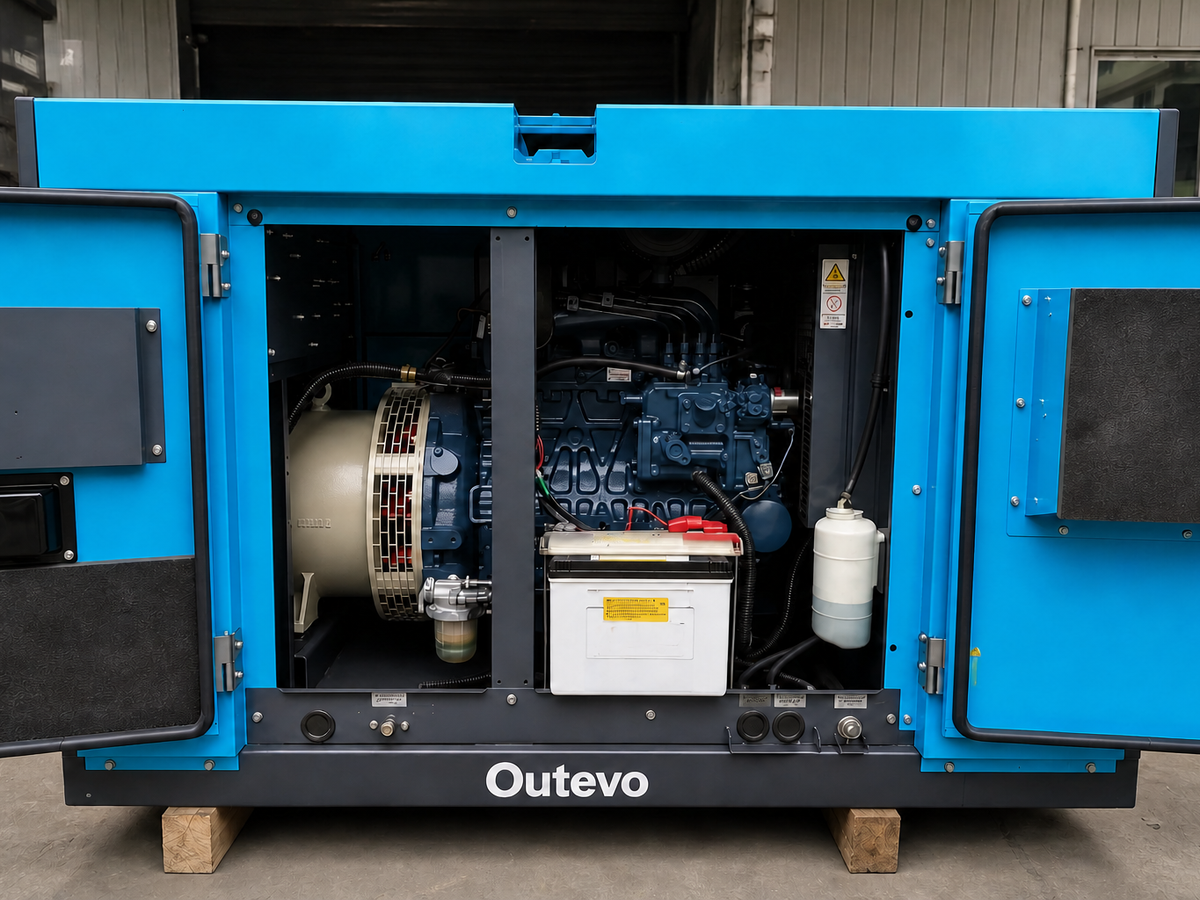
Water-cooled diesel generators adopt a closed liquid circulation cooling system. A mixture of water and antifreeze (coolant) is pumped through internal water jackets cast inside the engine block and cylinder head. The coolant absorbs combustion heat evenly from all key engine components. After heating up, the fluid flows to the radiator, where a fan dissipates heat to ambient air. The cooled coolant circulates back to the engine repeatedly to maintain a stable working temperature. This system normally includes radiator, centrifugal water pump, thermostat, expansion tank, connecting hoses and sealing gaskets.
Water-cooled diesel engines are mostly multi-cylinder designs including 4-cylinder, 6-cylinder and 12-cylinder models, serving medium and large generator sets for industrial, data center, hospital and base station backup power. This is the standard solution for continuous prime power and critical emergency standby power worldwide.
Liquid coolant delivers much higher heat transfer efficiency and uniform temperature control. The thermostat stabilizes engine operating temperature within a narrow designed window, eliminating sharp temperature swings and localized overheating. This stable thermal environment reduces thermal stress on pistons, liners, cylinder heads and crank assemblies, extending the overall engine service life significantly.
For the same power output class, water-cooled engines achieve higher power density. The compact heat management allows manufacturers to fit larger power into a relatively smaller footprint compared with air-cooled alternatives. These units run smoothly under 24/7 continuous heavy loads and can sustain stable output for prime power applications. The water jacket also helps suppress mechanical and airflow noise, making water-cooled gensets easier to configure into silent or super-silent containerized packages for noise-sensitive projects.
The whole cooling assembly is complex with many wearable parts. Operators need to carry out scheduled maintenance: inspecting coolant leakage, replacing coolant periodically, cleaning radiator fins, checking pump seals and removing internal scaling. Initial procurement and installation cost is higher.
Water-cooled units face extra challenges in special environments. At high altitudes, lower atmospheric pressure reduces the boiling point of coolant. Without properly pressurized closed cooling loops and correct antifreeze additives, overheating risk rises. In freezing climates, wrong coolant mixing ratio can lead to frozen fluid, cracked cylinder blocks and permanent engine damage. In coastal salt-spray environments, radiators and water circuits need extra anti-corrosion protection. Water-cooled gensets are heavier and less mobile, better suited for fixed permanent installation rather than frequent relocation.
Choose air-cooled diesel generators if your project has these conditions: intermittent standby use, small power demand, limited maintenance support, no stable water supply, frequent relocation, high-altitude plateau or freezing remote sites. Typical applications include portable construction power, field equipment power supply, remote surveillance systems and temporary event power.
Choose water-cooled diesel generators for critical continuous loads and high-power requirements: data center UPS backup, hospital life support power, factory prime power, hotel emergency power, mining fixed power stations and containerized silent power plants. They deliver stable, long-running performance and are easier to integrate into standardized low-noise power rooms.
Neither cooling design is universally better. Air-cooled generators win with simplicity, reliability and flexible environmental tolerance for light-duty and mobile scenarios. Water-cooled generators provide precise thermal control, high continuous capacity and quiet running for heavy-duty critical power systems. Understanding the difference between these two cooling principles helps power engineers, distributors and end users pick the correct generator to match local climate, load profile, running hours and maintenance capacity.
Shanghai Outevo Machinery Co.,Ltd.
Web: www.outevo.com

Shanghai Outevo Machinery Co., Ltd. provides custom power supply solutions for industrial applications. Our diesel generator sets deliver reliable, stable electricity with 24/7 production and nationwide support. Request a quote today.
Copyright © Shanghai Outevo Machinery Co., Ltd Privacy Policy