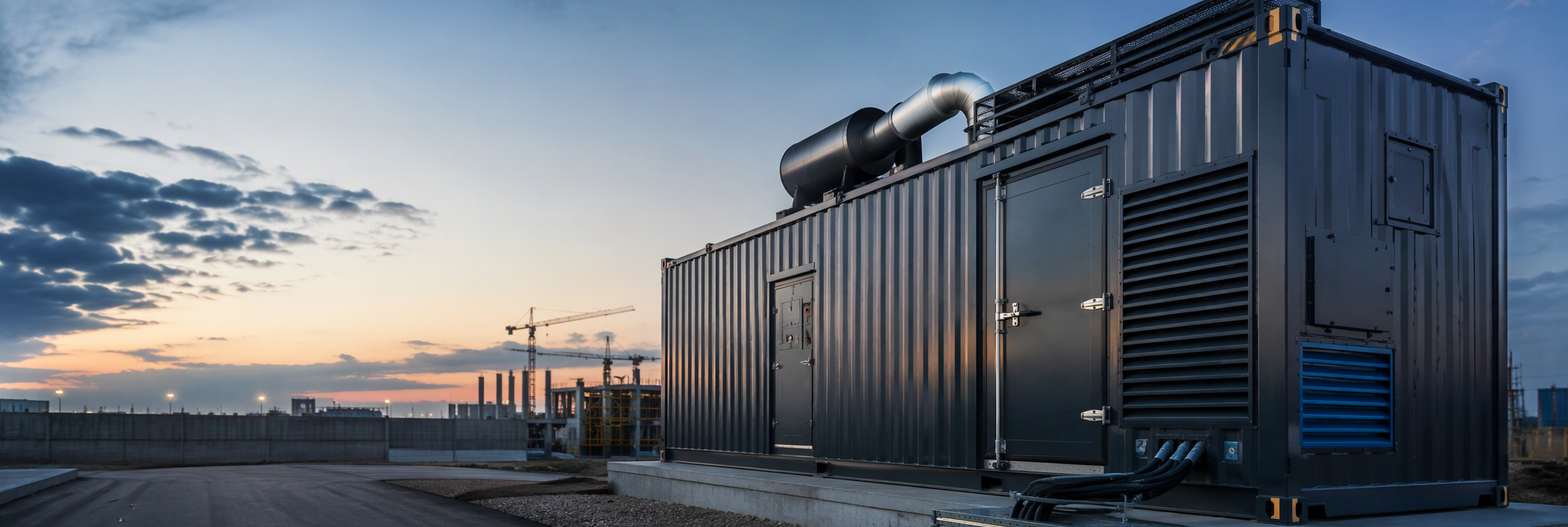
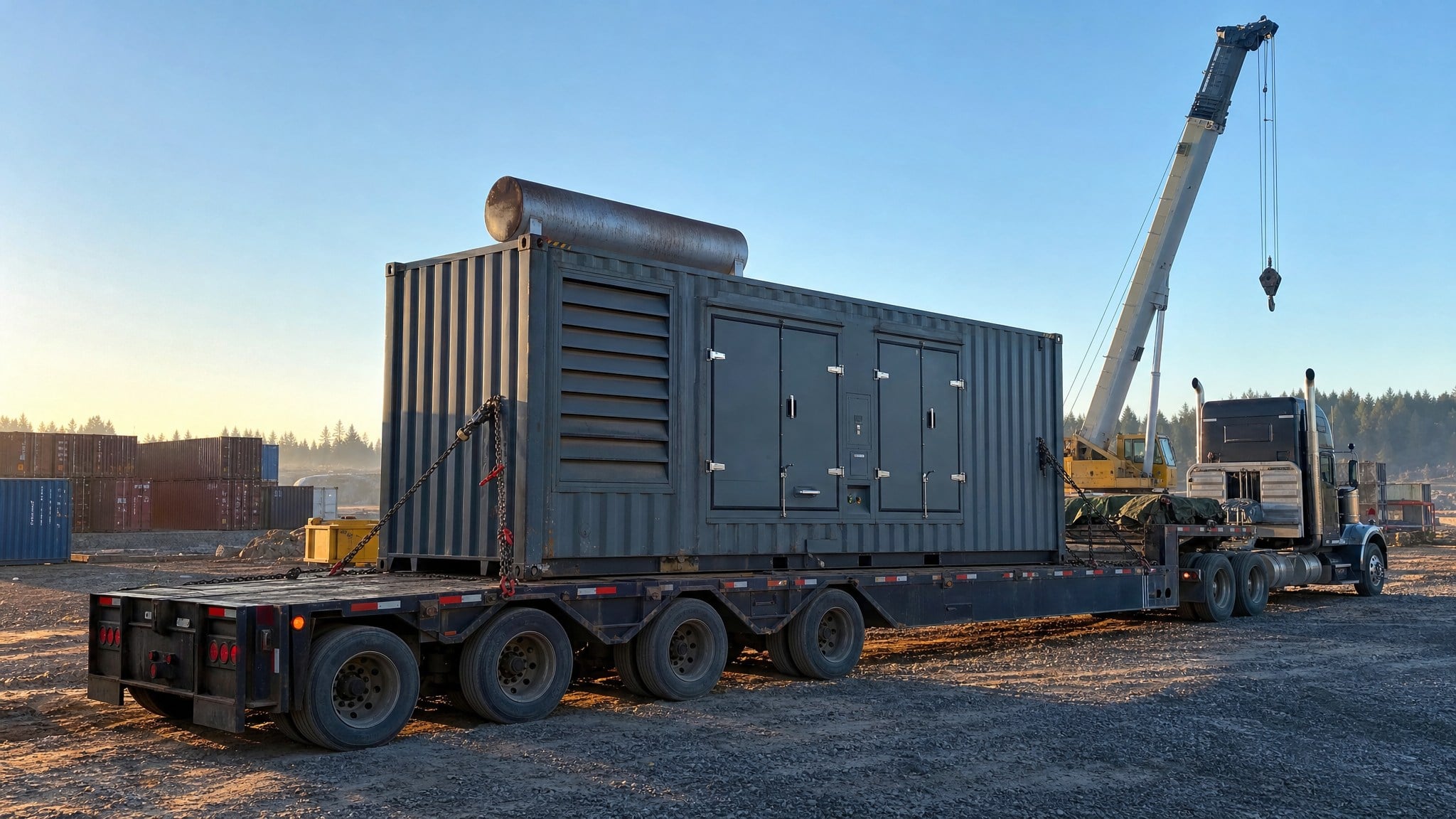
A transportable container power unit is bought for a reason that has nothing to do with its electrical design: it will move. It may serve a construction site for eighteen months and then a second site, or follow a mining operation as the pit advances, or sit on standby for a utility and be deployed twice a year. In each case the commercial case rests on the unit arriving at the next location complete, quickly recommissioned, and without a rebuild.
That makes transportability an engineering discipline in its own right. This article deals with the transport, lifting, connection and relocation questions. It does not cover mine or construction power strategy as such — that is set out in our mining and construction power solutions section — because a unit that is well matched to a mine's load profile can still be a poor asset if it cannot be moved between pits without a crane larger than the site possesses.
Deciding what kind of mobility you actually need
Four mobility models are common, and they are not interchangeable. Getting this decision wrong is the most expensive mistake in the category, because it is usually discovered after the first move.
- Container-mounted, crane-lifted. The unit travels as a freight container and is lifted on and off by crane or reach stacker at each end. Excellent for sea freight and for sites with lifting capacity; unsuitable where the final position has no crane access.
- Skid-mounted. A structural skid that can be dragged or winched short distances and lifted by crane otherwise. Common where the unit sits on a concrete pad for years and moves only at the end of a project.
- Trailer-mounted. The unit is road-towable and self-contained for movement, but the trailer is then part of the asset and needs registration, maintenance and a suitable towing vehicle.
- Modular blocks. Several smaller units that can be moved individually with standard lifting equipment and reassembled into a plant at the new site. The most flexible option and the most complex to control electrically.
The decision should be driven by the number of moves expected over the asset's life, the lifting and transport equipment available at each end, the road class between them, and whether the unit must be operational within days of arrival. A single move favours a simple skid or container; five moves favour a container with quick connections; a site with no crane at all may need a trailer or a set of small blocks.
Container frames are not automatically transport-rated
A steel box with a generating set inside is not the same as a transport-rated container power unit. The differences that matter are the structural ones: a frame designed to carry the machine's mass and dynamic loads through the corner castings and the base structure; lifting points positioned so that the unit lifts level and without racking; a base stiff enough to keep the machine aligned after repeated handling; and defined lashing points that suit the actual securing method used on trucks and ships.
For sea transport, the accelerations are not trivial, and the securing arrangement has to be designed for them rather than improvised at the port. For road transport, the unit's mass and centre of gravity determine the axle loads and therefore the permits. Neither of these can be verified from a drawing that shows only external dimensions, so a buyer specifying a transportable unit should ask for the mass, the centre of gravity, the lifting arrangement, the lashing arrangement and the transport configuration — with any removable items identified.
The route survey is part of the specification
Every relocation starts with a route survey, and the survey findings should feed back into the unit specification rather than being treated as a separate logistics exercise. The survey covers:
- Mass and dimensions. Overall transport height including any skid, stack or lifting beam, width including any protrusions, and length. Height is the constraint that most often forces a redesign, because overhead lines, bridges and tunnel clearances are fixed.
- Axle and point loads. Determined by the tractor-trailer combination and the unit's centre of gravity; these drive permit requirements and, on poor roads, the feasibility of the move at all.
- Road class and surface. A mine haul road and a public highway impose different limits. Gradients, cambers and surface condition affect both the lashing design and the arrival condition of the equipment.
- Port, quay and lifting capacity. The crane or reach stacker at each end must be rated for the load at the radius it will actually work, not at its nominal maximum.
- Permits and windows. Abnormal-load permits, escort requirements, curfews and seasonal road restrictions can determine when a move is possible at all.
On multi-site operations, this survey is repeated for each route, and the differences are what determine whether one unit can serve all the sites or whether two configurations are needed.
Connection philosophy: what makes the second move fast
The difference between a unit that takes a day to recommission and one that takes a week is usually in the connections, not the machine. A transportable unit should present a small, repeatable set of interfaces that can be broken and remade with standard tools:
- Fuel: quick-release couplings with dry-break behaviour, a defined connection height and orientation, and a fill arrangement that works with the tanker available at each site.
- Power: a plug-in or bolted termination at a fixed position, with the cable entry protected in transit and the termination format recorded so that the same cable set can be reused.
- Control: a single network connection for remote monitoring and plant-level signals, with the addressing and settings documented per site.
- Earthing: a defined earthing point and a stated requirement for the site's earthing arrangement, because earthing practice differs between sites and is a safety item rather than an installation detail.
Each of these should be shown on a single connection drawing that travels with the unit. Without it, every move reinvents the interface, and the reinvention is done by whoever is on site at the time.
Site preparation at each new location
A transportable unit is only as portable as its site allows. The receiving site needs a hardstanding able to take the point loads during lifting and the bearing pressure in service, drainage that keeps water away from the base, a cable route to the point of connection, a fuel access route that a tanker can use, and clearance for the cooling air intake and discharge. On construction sites these items are frequently improvised, and the result is a unit that runs hot, sits in water, or cannot be reached for service.
A short site readiness checklist issued with the unit — hardstanding dimensions and tolerance, clearances, cable route, fuel access, lifting plan, earthing requirement — prevents most first-week problems and makes the second site faster than the first.
Recommissioning: the repeatable checklist
Recommissioning after a move is not the same as first commissioning. The unit has been transported, possibly by sea, and has been disconnected and reconnected by a different team. The check should cover insulation resistance before energisation, protection settings against the new site's fault level, fuel system integrity and filter condition, cooling airflow and intake cleanliness, exhaust and silencing integrity, control network addressing, and a load test that confirms the unit performs as it did before the move. Recording the results each time builds a comparison history, and a change between moves is an early warning of transport damage or deterioration.
Fleet management across sites
Once units move, they stop being individual machines and become a fleet. That requires a register that records, for each unit, its current location, configuration revision, protection settings, running hours, service history, transport history and any site-specific modifications. It also requires a spares strategy: common consumables and a small pool of rotable assemblies that travel with the fleet rather than sitting in one warehouse.
The configuration revision matters more than it sounds. A unit that has been adapted for one site — a different fuel connection, a modified exhaust route, a changed protection setting — and then moves to another site carries that adaptation with it. Without a record, the next site inherits a machine that does not match its drawings.
What repeated movement does to equipment
Transport is a mechanical event. Repeated moves accumulate effects that a stationary installation never sees: fastener relaxation, seal movement, chafing of cables and hoses against edges, small alignment changes in the base frame, and moisture ingress during sea transit. None of these is dramatic individually, and all of them are cheap to catch at recommissioning and expensive to catch later.
The maintenance plan for a transportable unit should therefore include a post-move inspection routine that is specific to transport damage — not just the standard service checklist — and a pre-move routine that prepares the unit for travel: fuel level decisions, battery isolation, protection of openings, securing of loose items, and documentation of any temporary modifications.
Scenarios where transportability is the deciding factor
Construction power that follows the works. As a project moves from earthworks to structures to fit-out, the load centre moves with it. A container unit that can be lifted to a new position keeps cable runs short and avoids a second purchase.
Advancing mining operations. Where the working face moves, fixed power infrastructure becomes a liability. A transportable unit follows the operation and is recovered at the end of the campaign rather than abandoned.
Seasonal industrial demand. Plants with a seasonal peak can move standby capacity between sites instead of holding capacity at every site all year.
Utility and rental fleets. Where the asset is deployed to different customers, the value of the unit is directly proportional to how quickly it can be recommissioned at each new location.
Shanghai Outevo Machinery Co., Ltd. configures containerized generating sets for transportable duty across a broad range — from 10 kVA to 3,750 kVA when applicable — with the rating, the frame arrangement and the connection philosophy set by the project-specific configuration and the routes the unit will actually travel.
Frequently asked questions
Can any container generator set be transported repeatedly?
It can be transported, but repeated moves are kindest to a unit that was designed for them: a transport-rated frame, defined lifting and lashing points, protected connections and a documented interface drawing. A unit designed as a fixed installation will survive a move, but each move costs more time and carries more risk.
What information is needed to plan a move?
The unit's transport mass, dimensions and centre of gravity; the lifting arrangement; the route survey including axle loads, height restrictions and permits; and the lifting capacity available at both ends at the working radius. Most move problems are decided by height and lifting capacity rather than by distance.
How long does recommissioning take after a move?
It depends on how many interfaces have to be remade and whether the receiving site is prepared. A unit with documented quick connections arriving at a prepared site is a short job; the same unit arriving at an unprepared site with improvised cabling can take considerably longer. The reliable way to shorten it is site preparation and a written checklist, not a faster crew.
Does a transportable unit need different protection settings at each site?
Often yes, because the fault level and the earthing arrangement at the point of connection differ. Settings should be checked and recorded at every recommissioning, and the record should travel with the unit.
Container, skid or trailer — which is best for a multi-site project?
Container-mounted units are usually best where cranes are available at both ends and sea freight is involved. Trailer units suit road-based deployment with no lifting equipment. Skids suit a small number of moves with long dwell times. A mix is common: containers for the main plant, a trailer unit for fast response.
How should a fleet of transportable units be documented?
With a register per unit covering location, configuration revision, protection settings, running hours, service and transport history, plus a connection drawing and a site readiness checklist that travels with the asset.
Plan the move before you plan the plant
If a unit will move, the route and the lifting arrangements belong in the technical specification from the start, alongside the load profile. Send Shanghai Outevo Machinery Co., Ltd. your expected number of moves, the routes and the lifting equipment available at each end, and we will propose a transportable container configuration whose frame, connections and transport data are documented for the way the asset will actually be used.
Related reading: container generator sets, trailer generator sets, mining and construction power.