This article breaks down what single-phase and three-phase actually mean in plain language, then walks through how those differences should shape your choice of containerized generator for Russian applications.
Think of electricity flowing through a wire like water flowing through a pipe. In a single-phase system, the electrical current oscillates in a single sine wave — it rises, falls, and reverses direction in one smooth, repeating pattern. At any given moment, the power delivery pulses. It is not constant.
That is not a flaw. It works perfectly fine for most everyday applications. Your home outlets, workshop tools, small office equipment — these all run on single-phase power. In Russia, the standard single-phase voltage is 220 volts at 50 hertz, which is the same frequency used across most of Europe and Asia.
The practical upshot? Single-phase generators are simpler to build, cheaper to buy, and easier to maintain. They are the workhorses for residential backup power, small construction sites, retail shops, and anything that does not involve heavy industrial machinery. A typical single-phase container generator you would find in the Russian market might range from 5kW to around 50kW — enough to power a village hall, a small clinic, or a construction camp’s basic needs.
But there is a limit. Push a single-phase generator too hard, and you start running into problems. The wires need to be thicker to handle the same power at lower voltage. The alternator wears faster because it is delivering power in pulses rather than a steady stream. And when you need to run multiple heavy loads at once — say, a welder, a compressor, and a heating system all running simultaneously — a single-phase unit starts to sag.
Three-phase power takes a different approach. Instead of one sine wave, you get three, each offset by 120 degrees. Imagine three people on a merry-go-round, each pushing at a different point in the cycle. The result is power that arrives at the load continuously, without the dips you get in a single-phase system.
In practice, this means three-phase generators can deliver more power with less stress on the alternator. They are more efficient, more durable under heavy load, and they handle motor starting currents much better — which is a big deal when you are running industrial equipment like large pumps, cranes, or HVAC systems.
In Russia, the standard three-phase voltage is 380 volts line-to-line (with 220 volts available line-to-neutral), also at 50 hertz. This is the backbone of Russian industry. Factories, mining operations, oil and gas facilities, data centers — they all run on three-phase power. The Russian electrical grid, built largely during the Soviet era and upgraded gradually since, is designed around this standard.
A three-phase container generator for the Russian market typically starts around 50kW and goes up to several megawatts. The big names you will see quoted in specifications — Cummins engines paired with Marathon or Leroy-Somer alternators — are almost always three-phase units. A 500kVA containerized set, for instance, can power an entire mid-sized factory or a remote mining camp.
Russia is not just another export market. It is a market with some very specific demands that should drive your generator selection from day one.
Russia spans eleven time zones and parts of it get genuinely brutal in winter. We are talking minus 40 degrees Celsius in Moscow during a cold snap, and minus 50 degrees or lower in Siberia and the Far East. A generator that starts fine in a temperate climate can refuse to turn over in those conditions — thickened oil, brittle seals, condensation in the fuel system.
Any container generator destined for Russia needs what the industry calls a “northern version” package. That means cold-start batteries rated for low temperatures, block heaters for the engine coolant, pre-heated fuel lines, synthetic lubricants that will not gel, and a container that is properly insulated and weather-sealed. The certification side matters too — you will need EAC certification (the Eurasian Conformity mark) plus a GOST cold-weather test report. If you are selling to Siberia or the Far East, the cold-weather rating needs to be at least minus 50 degrees Celsius. Do not cut corners here; minus 40 certification will not cover you in Yakutsk.
Russia uses 380V/220V at 50Hz, which happens to align with Chinese and many European standards. But the tolerance bands differ. Russian GOST standards allow plus or minus 5% voltage variation, and in practice, some remote areas of Siberia see actual voltage drops of 8% to 12% due to long transmission lines. That means your generator’s voltage regulation needs to be robust, and you should plan for automatic voltage regulators (AVRs) with a wide adjustment range. Some buyers also specify voltage stabilizers as a separate piece of equipment, particularly for sensitive electronics.
This is where the single-phase versus three-phase question becomes a purchasing decision. Here is a practical way to think about it:
If your project involves residential-style loads — housing blocks, small shops, schools, clinics — and the total demand stays under 50kW, a single-phase container generator makes sense. It is cheaper, simpler, and those loads do not need three-phase power anyway.
If you are powering a construction site with heavy machinery, a mining operation, a factory, or a data center, you need three-phase. The moment you start running motors above 5 to 7kW, three-phase becomes not just preferable but practically necessary. Russian industrial motors are almost exclusively three-phase, and trying to run them off a single-phase generator either will not work or will require expensive and inefficient phase converters.
The container itself needs thought beyond just housing the generator. For Russia, you want:
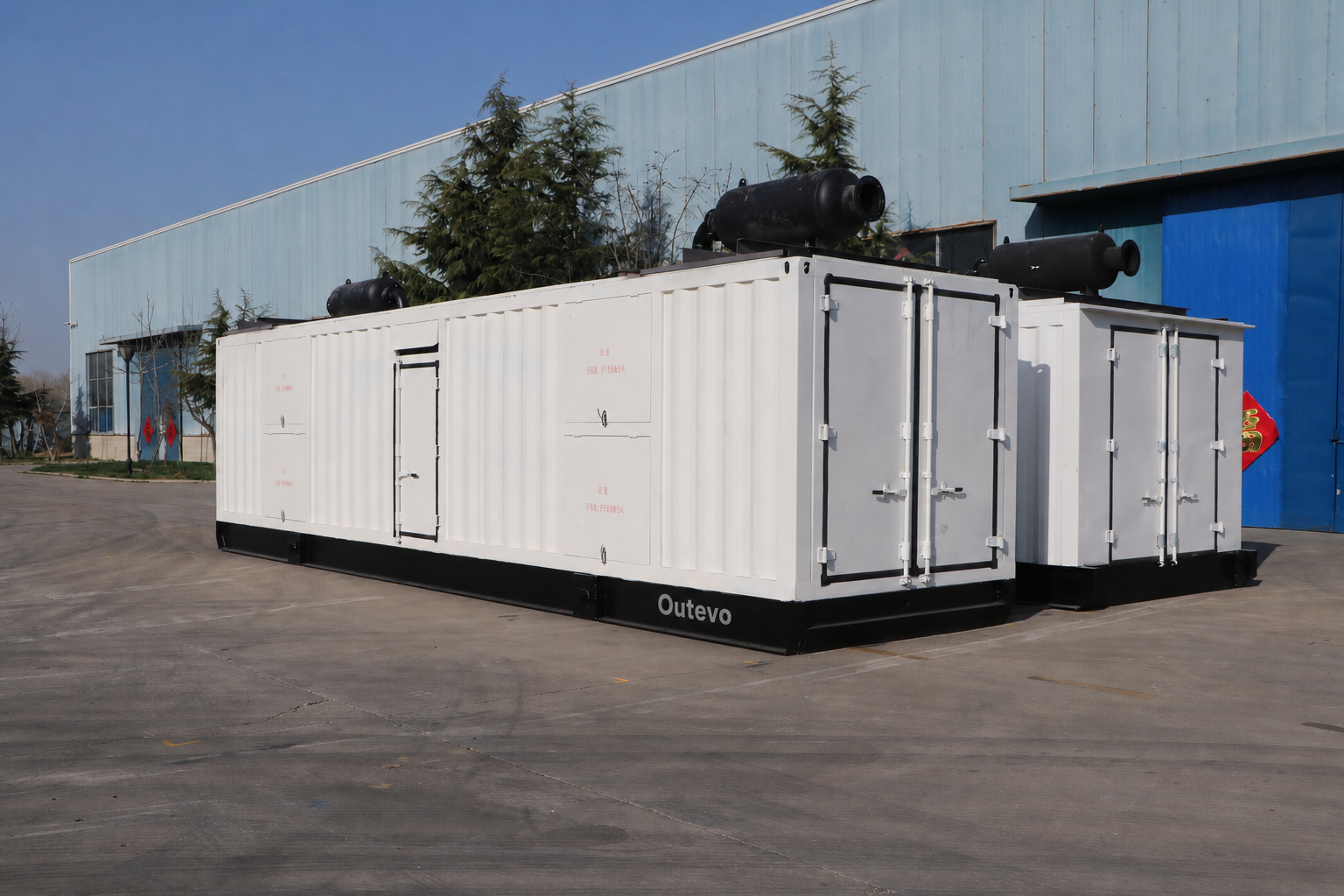
For power ratings, 20-foot containers typically house units up to about 1000kVA, while 40-foot containers are used for larger sets. The Russian market sees a lot of 200 to 500kW units in 20-foot containers for mid-range applications, and 40-foot containers for the 800kW and above range.
Beyond EAC and GOST cold-weather testing, make sure your documentation is in order. Russian customs and end users will expect technical passports in Russian, operation manuals translated into Russian, and test certificates from recognized laboratories. Having CE or ISO certifications on file helps streamline the process but does not replace the need for local certification.
Picking between single-phase and three-phase is not about which is “better” — it is about which matches what you actually need to power. For the Russian market specifically, the climate and infrastructure realities should be your starting point, not an afterthought. A well-specified three-phase container generator, properly configured for extreme cold and backed by the right certifications, will outlast and outperform a mismatched single-phase unit every time — but only if you have sized it correctly for the actual load profile.
Before you sign the purchase order, do the load calculation properly. List every piece of equipment, note whether it is single-phase or three-phase, account for motor starting currents (which can be 6 to 8 times the running current), and add a 20% safety margin. That simple exercise will save you from the most common mistake we see: buying a generator that looks good on paper but struggles the moment you flip the switch.

Shanghai Outevo Machinery Co., Ltd. provides custom power supply solutions for industrial applications. Our diesel generator sets deliver reliable, stable electricity with 24/7 production and nationwide support. Request a quote today.
Copyright © Shanghai Outevo Machinery Co., Ltd Privacy Policy