What’s the Difference Between Single-Phase and Three-Phase Power in Generators? Read This to Avoid Making the Wrong Choice
When purchasing a generator set, many people struggle to distinguish between single-phase and three-phase power. If they accidentally buy the wrong one, the equipment may not be able to power their load and could even be damaged. Today, we’ll clearly explain the differences between the two once and for all.
What Are Single-Phase and Three-Phase Power?
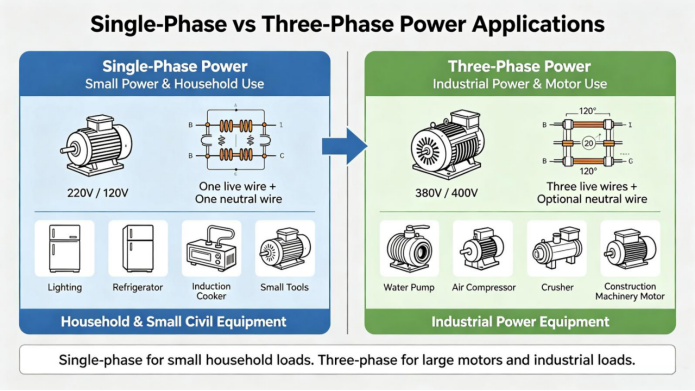
✅ A single-phase generator outputs 1 live wire + 1 neutral wire, with a standard voltage of 220V. It has only one set of generating windings and a single current waveform—this is the type of mains power we use in our homes every day.
✅ A three-phase generator has three sets of windings internally, with the three live wires phase-shifted by 120° relative to each other. The line voltage is 380V, and connecting any live wire to the neutral wire yields 220V. This is commonly referred to as a three-phase, four-wire system, and a single generator set can simultaneously supply power for both motor-driven equipment and lighting/appliances.
Comparison of Key Differences
- Voltage and Wiring: Single-phase: 220V, one live wire and one neutral wire; Three-phase: 3 live wires (380V); connecting to the neutral wire yields 220V.
🔹Suitable Power: Single-phase: Mostly low-power models, generally under 10 kW; high-power single-phase generators are bulky and have relatively high fuel consumption. Three-phase: Available in both high and low power ratings; for power ratings above 10 kW, three-phase is the preferred choice, as it offers a smaller footprint, higher generation efficiency, and better fuel economy for the same power output.
- Operational Stability Single-phase: Power output is intermittent, with significant torque fluctuations; it is difficult to start electric motors, and vibration is relatively noticeable. Three-phase: Three sets of windings continuously alternate in operation, providing stable torque output with minimal vibration; no additional starting devices are required to drive industrial motors.
- Suitable Loads Single-phase: Household and small civilian equipment such as lighting, refrigerators, induction cooktops, and small tools. Three-phase: Industrial power equipment such as water pumps, air compressors, crushers, and construction machinery motors; can also supply 220V for general electrical use, but loads must be evenly distributed to prevent phase imbalance from burning out the generator.
How to Choose? A Simple Guide
- If you’re only powering home appliances and lighting, and the total power consumption is low → Choose a single-phase generator
- If you need to power industrial motors, high-power equipment, or require both power and household electricity simultaneously → Choose a three-phase generator
Common Pitfalls to Avoid
Although three-phase generators can output 220V, try to balance the three-phase loads as much as possible; severe phase imbalance can damage the unit.
Single-phase generators struggle to power high-power motors; the high starting load can easily cause the engine to stall.
At the same power rating, high-power three-phase generators offer better fuel efficiency.
In a nutshell: Choose a single-phase generator for small household loads; prioritize a three-phase generator for industrial power and high-power applications.