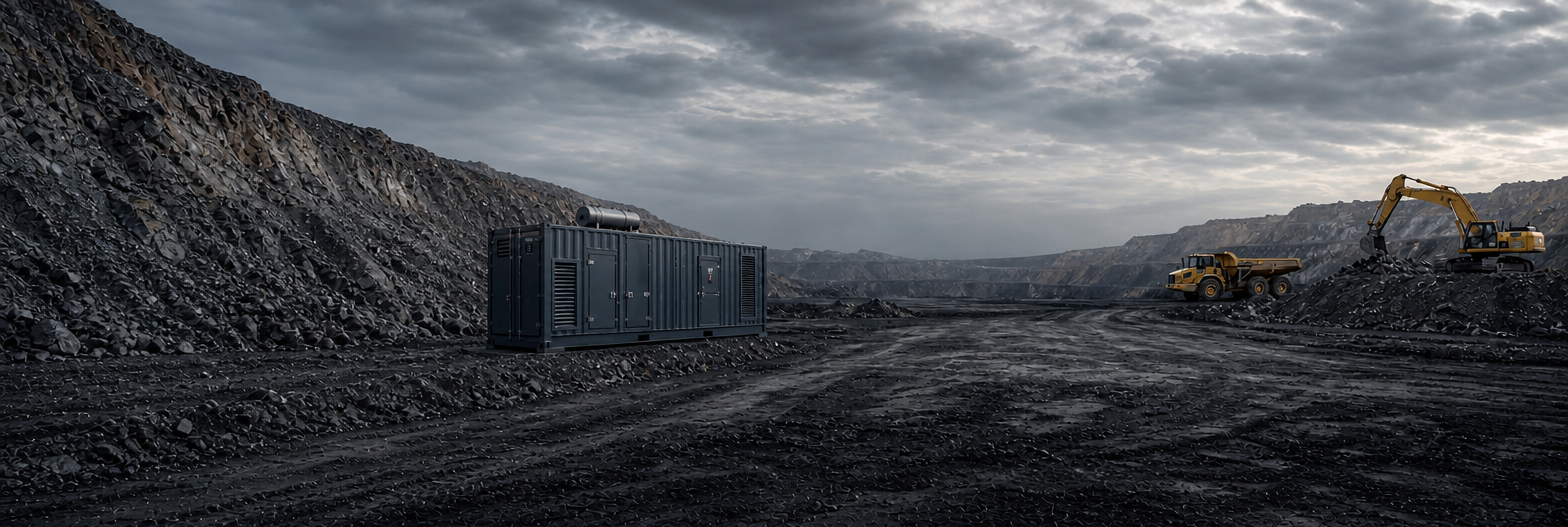
Prime power for remote mining camps and plants: duty definitions, load estimation, modular build-out, N+1 redundancy, fuel logistics and remote monitoring.
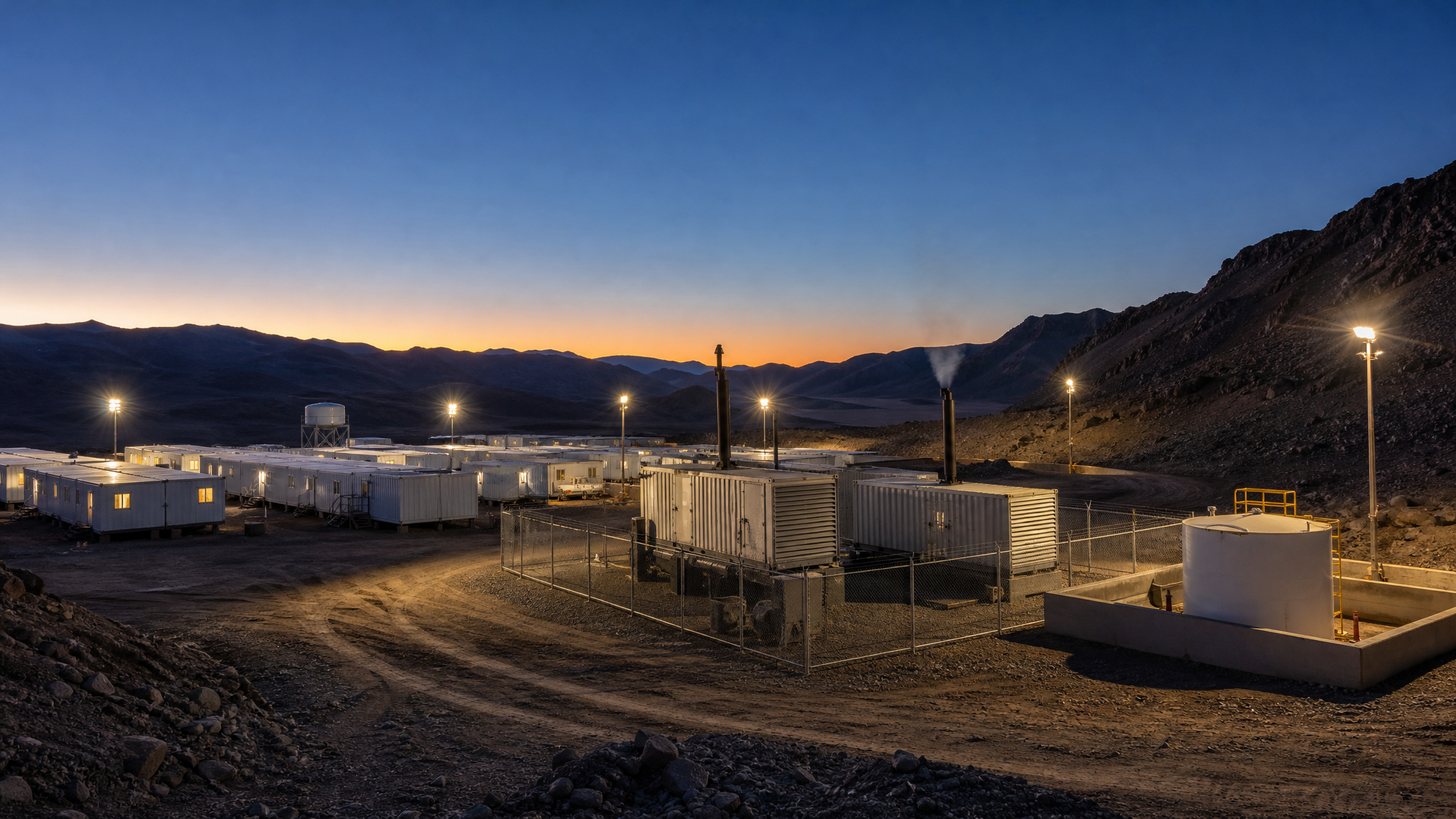
A mine camp, a conveyor corridor, a water treatment plant, a communications site or a construction village in a remote region has one characteristic that dominates every other design consideration: it cannot borrow power from anywhere. There is no utility to fall back on, no neighbouring plant to interconnect with and, in most cases, no realistic prospect of a fast repair visit. When generation is the primary source rather than a backup, the planning language changes from "capacity" to "availability over the whole operating year".
Shanghai Outevo Machinery Co., Ltd. configures diesel and gas generator-set packages for remote mining and construction infrastructure within the 10–3,750 kVA range when applicable to the project scope. Prime power planning is the discipline that turns that range into a system a site can actually run: knowing what the load is, how much of the year it runs, what happens when a unit is down, and how fuel and people reach the site.
Three duty definitions are commonly confused, and the confusion is expensive.
Remote infrastructure is usually prime power, occasionally continuous, and almost never standby. Specifying a standby-rated unit for prime duty produces an asset that is thermally and mechanically overloaded for the way it is used, with service intervals and warranty assumptions that do not match reality. The duty definition belongs in the first paragraph of the specification, before any rating is discussed.
Greenfield remote projects have no metered history, so load estimates come from design documents. Three techniques improve their reliability.
List every significant load with its rated input, utilisation factor, hours per day and seasonality. Accommodation blocks, kitchens, water pumping, sewage treatment, workshops, conveyors, lighting and communications each behave differently. A camp of 300 people does not consume the same as a plant of the same connected load, because the camp's profile is dominated by mornings and evenings while the plant's is dominated by shift patterns.
A generator running at a low load factor for months is not efficient, and it is also not healthy: light-load operation can lead to incomplete combustion, wet stacking and reduced reliability on diesel units. Remote sites frequently over-size because the design case was a peak that occurs a few days per year. The better approach is to design for the common load band and provide capacity for the peak through a second unit or a defined load-shedding scheme.
Every remote project grows. The growth allowance should be an explicit number linked to a known expansion plan, not an unexplained percentage. A stated basis lets the next engineer understand why the system has the shape it has.
Remote infrastructure is usually commissioned in stages: early works camp, then construction power, then process plant, then permanent operations. Building the final generation capacity on day one ties up capital and leaves the site running large engines at low load for months.
A modular approach — a first unit sized for early works, additional units added as load grows, all designed to operate in parallel — keeps the load factor in a healthier band at every stage and matches capital to demand. It requires the electrical design to be thinking about the end state from the beginning: common voltage and frequency, compatible protection, a paralleling philosophy, and space reserved for the units that will arrive later.
| Stage | Typical generation shape | Design decisions to make early |
|---|---|---|
| Early works | Single unit for camp and construction loads | Footprint reserved for future units; fuel storage sized for the final site. |
| Construction peak | Additional unit or units, parallel or via transfer | Busbar arrangement and protection coordination for parallel operation. |
| Operations | N+1 arrangement with load-dependent dispatch | Control system capable of automatic start/stop and load sharing. |
| Expansion | Additional capacity or a hybrid renewable element | Metering, data and control interfaces that can accept future sources. |
Redundancy is often specified as a slogan ("N+1") without defining what counts as a failure. In a remote camp, the failure that matters is usually not the generator but the fuel system, the control system, the cooling system or the maintenance organisation. A second generator that cannot be started because nobody trained the operator, or that has no fuel because the tank was not sized for two units, is not redundancy.
A defensible redundancy design states, for each load group: the maximum acceptable outage duration, the automatic or manual response, the fuel and spares required to support the response, and the person responsible. For remote sites the acceptable outage duration for accommodation and communications is often very different from that for process water pumping, and treating all loads the same produces either excess cost or a false sense of protection.
In remote locations, fuel is the operating cost, the logistics risk and the environmental hazard all at once. Planning questions that belong in the design:
Remote monitoring is valuable, but it must be designed for the site's actual communications. A system that assumes continuous connectivity will spend much of its life in an alarm state that nobody can act on.
A workable architecture has three layers: local control and protection that operates autonomously without any network; local logging that retains trend and alarm history for a defined period; and remote telemetry that reports a prioritised subset — running state, load, fuel level, critical alarms — over whatever link exists. The specification should state which alarms are safety-critical and must act locally, and which are informational and can wait for a connection.
The maintenance model for remote prime power has to assume that a technician may not arrive quickly. That changes the design in concrete ways:
Many remote projects now consider solar or wind to reduce fuel consumption. The engineering reality is that variable renewables on an isolated grid change how the generator fleet must behave: minimum loading, ramp rates, spinning reserve and protection all need re-examination. The practical approach is to design the generator system so that it can accept future renewable capacity — metering, controls, and a load-sharing scheme that can operate with a reduced generator baseline — rather than retrofitting renewables onto a system designed for constant output.
Where a project plans a hybrid system from the start, the generator package should be specified with the hybrid operating mode in view: expected start/stop frequency, minimum stable load and the control interface to the energy management system.
For remote prime power, the purchasing decision is rarely about the lowest equipment price. It is about the cost of the delivered kilowatt-hour over the project life, which includes fuel, maintenance, spares, technician mobilisation, downtime and the cost of carrying spare capacity. Projects that compare offers on equipment price alone tend to discover the difference in the second year of operation.
A better comparison asks each supplier to state: the site-rated output, the expected load factor, the fuel consumption at defined load points, the recommended service interval and parts holding, the expected major overhaul horizon and the documentation and training provided. That set of answers makes offers genuinely comparable.
Prime power describes a generator that is the main source for a variable load over long running hours. A camp or plant without a utility connection is prime power duty, and the equipment, service intervals and warranty basis must match that duty.
Enough to cover the loads whose outage the site cannot tolerate, for the duration of a realistic repair. That usually means N+1 generation for critical groups plus fuel and spares sized for two units, with a written response procedure.
Storage should cover the worst credible delivery interval rather than the average, with margin for consumption growth. The figure comes from measured or estimated daily consumption and the site's logistics plan.
Yes, and it should be designed for that from the start: common electrical characteristics, compatible protection, space for additional units and a control philosophy that supports parallel operation.
Prolonged light-load operation is inefficient and can be mechanically harmful on diesel units. Modular capacity and load-dependent dispatch keep units in a healthier load band.
Configurations typically fall within 10–3,750 kVA when applicable, with the final rating driven by the load study, duty definition, site conditions and redundancy requirement.
Send Shanghai Outevo Machinery Co., Ltd. your load estimate, site conditions, delivery constraints and redundancy requirement. We will return a prime-power configuration proposal covering duty basis, modular expansion path, fuel and storage strategy, control and monitoring scope and the service model — a package designed to be operated by the team that will actually be on site.

Shanghai Outevo Machinery Co., Ltd. provides custom power supply solutions for industrial applications. Our diesel generator sets deliver reliable, stable electricity with 24/7 production and nationwide support. Request a quote today.
Copyright © Shanghai Outevo Machinery Co., Ltd Privacy Policy


