
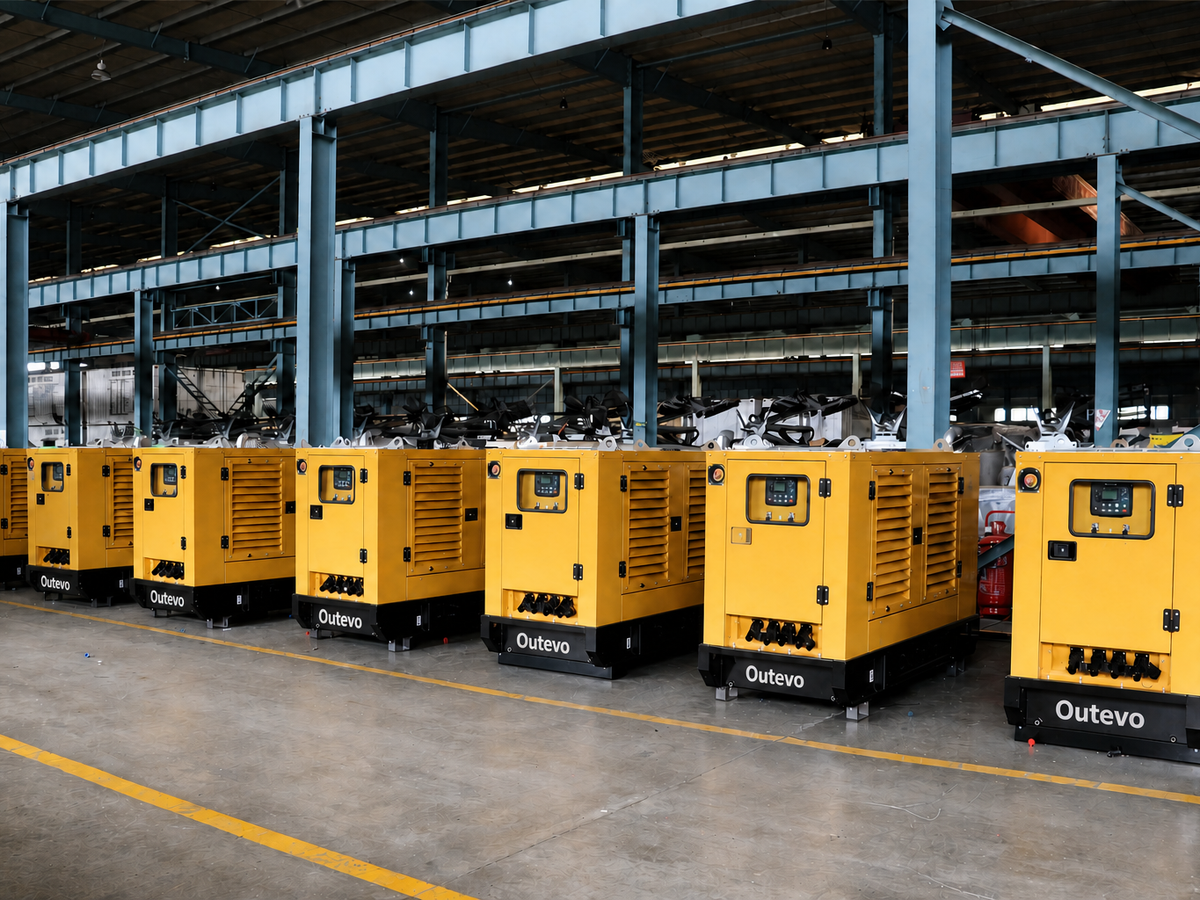
Paralleling generator sets means operating two or more generating units as a single coordinated power source: the units synchronize onto a common busbar, share load in proportion to their ratings, and can be added to or removed from the bus without interrupting supply to the site. For project buyers it is a capacity and reliability decision rather than an equipment preference, because it determines how a power plant grows with demand, how much reserve capacity is carried, and how maintenance is scheduled without a full shutdown.
This guide explains how synchronization and load sharing work in practice, how N+1 redundancy is sized without oversizing the plant, and which engineering points decide whether a multi-generator installation performs reliably in remote or harsh project environments.
Why Project Power Plants Parallel Instead of Buying One Large Unit
A single large generator set is the simplest architecture, but it concentrates risk: one footprint, one delivery date, one failure mode, and a machine that may run at low load for most of its life. Paralleling distributes those constraints across modules.
- Capacity follows demand. A plant can start with two units and add modules as the mine, camp or facility expands, instead of oversizing on day one.
- Redundancy inside one plant. With N+1 architecture, a unit can be taken out for service while the remaining sets still carry the critical load.
- Better part-load behaviour. Running fewer units near their efficient load band is generally preferable to running one very large unit at a light, unstable load.
- Scheduled maintenance without shutdown. Units can be rotated, so no single machine accumulates all the running hours.
- Practical logistics. Two or three container-sized modules are usually easier to transport, lift and position on a remote site than one oversized engine-driven unit.
How Synchronization Actually Works
A generator can only be closed onto a live bus when four parameters match: voltage magnitude, frequency, phase angle and phase sequence. Any mismatch produces a current surge at the moment of closing, and a phase-sequence error can cause severe mechanical and electrical damage.
The four matching conditions
Voltage is trimmed with the automatic voltage regulator (AVR), frequency and phase angle are trimmed with the engine governor, and phase sequence is fixed by the wiring and must be verified during commissioning. In automatic systems a synchronizing relay or check-sync relay supervises the window and issues the close command; manual synchronization with a synchroscope is normally retained only as a backup.
Governor and AVR behaviour during synchronizing
Before the breaker closes, the incoming set runs in a frequency-matching mode. After closing, control transfers to the load-sharing scheme, and the AVR moves from voltage matching to reactive power sharing. Understanding this handover is the difference between a plant that loads smoothly and one that hunts between units.
Load Sharing: Droop, Isochronous and Load-Sharing Lines
Load sharing is where most parallel installations succeed or fail. Two control philosophies dominate, and they are often combined.
Droop control lets each unit reduce speed slightly as load increases. Because every unit droops by a similar percentage, they naturally settle into proportional sharing without a communication link. It is robust, simple and well suited to isolated plants where a small frequency offset is acceptable.
Isochronous control with a load-sharing controller holds frequency constant and distributes load through a communication bus and analogue load-sharing lines. It supports precise kW and kVAR sharing, base-loading of selected units and automatic start/stop of modules as demand changes.
Which control mode to specify
For a mining camp or construction site where the load is variable and unattended operation is expected, isochronous control with automatic start/stop is usually the practical choice. For simpler two-unit installations, droop sharing with a load-sharing line can be sufficient. The important point for procurement is that the specification states the required mode, the sharing tolerance and the sequence of automatic operations, rather than leaving the controller behaviour to be decided on site.
Designing N+1 Redundancy Without Oversizing the Plant
N+1 means the plant can lose its largest single unit and still carry the critical load. The calculation is not simply the total load divided by the number of units: the design must also cover the largest motor starting step, the transient dip accepted by sensitive equipment, and the reserve needed for future expansion.
| Architecture | Behaviour if one unit trips | Typical application |
|---|---|---|
| Single unit | Total loss of supply | Non-critical, short-duration duty |
| 2 x 50% parallel | Load transferred to one unit; overload risk if demand exceeds its rating | Small plants with moderate redundancy needs |
| N+1 modular | Remaining units absorb the load within their rating | Data centres, hospitals, process plants, mining camps |
| N+2 modular | Tolerates loss of one unit during maintenance of another | Critical loads with strict availability targets |
Two practical checks keep an N+1 design honest. First, confirm that the remaining units can carry the load plus the largest starting step, not just the steady-state figure. Second, confirm that the automatic start sequence can bring a standby unit online within the time the critical load allows.
Protection and Switchgear in Multi-Genset Systems
A parallel plant needs protection that a single-set installation does not. The specification should normally include generator circuit breakers rated for the bus fault level, reverse-power protection to detect a unit being driven as a motor, overcurrent and earth-fault protection, over/under-voltage and over/under-frequency protection, and a synchronizing check that blocks any close command outside the permitted window. Neutral earthing arrangement, busbar segregation and cable routing deserve the same attention as the generators themselves, because most parallel-plant failures originate in the switchgear and control wiring rather than in the engines.
Fuel, Cooling and Service Access
Parallel installations concentrate fuel demand, heat rejection and maintenance activity in one area. Fuel storage and polishing should be sized for the combined consumption of all running units plus a realistic refuelling interval for the site; cooling air paths must not let one unit discharge hot air into another unit intake; and service access must remain possible with all units installed, not only when the hall is half empty. On containerized plants, radiator access, exhaust routing and lifting points should be reviewed at layout stage, because these details are expensive to change after the foundation is poured.
Site Conditions Across the Middle East, Africa, Southeast Asia, Central Asia and Russia
Parallel plants are usually built where the grid is weak or absent, and the environment becomes an engineering input rather than a footnote.
In the Middle East and North Africa, high ambient temperature reduces achievable output and raises cooling demand; specifying the plant for the site ambient, not the standard reference condition, is essential. In sub-Saharan Africa, fuel quality, dust and long spare-parts lead times usually matter more than the nameplate rating, so filtration, fuel polishing and a defined critical spares list belong in the contract. In Southeast Asia, humidity, salt-laden air and monsoon drainage drive enclosure specification and corrosion protection. In Central Asia and Russia, low-temperature starting, fuel waxing and snow load on outdoor containers determine the auxiliary heating and enclosure design. A supplier that has delivered into these regions will normally raise these points before the buyer does.
Commissioning and Handover Checklist
- Verify phase sequence and insulation resistance on every unit before first close.
- Test synchronization in both manual and automatic modes, including a deliberate out-of-window close attempt to confirm the blocking logic.
- Step-load the plant and record kW and kVAR sharing between units across the operating range.
- Trip the largest unit under load and confirm that the remaining units accept the load within the specified transient limits.
- Test automatic start/stop sequencing, load-dependent start and cool-down behaviour.
- Confirm protection settings against the approved single-line diagram and record them in the handover file.
- Provide as-built drawings, test certificates and an operator training session in the site language where required.
FAQ: Paralleling Generator Sets
Is paralleling more complex than using one large generator set?
Yes. It adds switchgear, synchronization control, load-sharing settings and commissioning time. The trade-off is capacity that can grow, redundancy inside the plant and maintenance without shutdown, which is usually worth the additional engineering for project power that must run for years.
Can generator sets with different power ratings be paralleled?
They can, provided the control system supports proportional load sharing and the switchgear is rated for the combined fault level. In practice, keeping ratings within a similar band simplifies settings and avoids one unit being pushed to its limit while another runs lightly.
How many generator sets can be paralleled?
The limit is set by the controller, switchgear and busbar design rather than by the generator itself. Small plants commonly use two to four units; larger installations use more units arranged across bus sections. The number should be stated in the design basis, not left to the controller supplier.
What happens if one unit trips while the plant is running?
The remaining units pick up the load up to their capacity, and the control system starts a standby unit if the load requires it. Whether the site rides through the event depends on how the plant was sized against the largest-unit contingency and on the transient limits of the connected equipment.
Is paralleling suitable for temporary or rental project power?
Yes, and it is often the reason rental fleets are built from modules. Modular units can be added for a peak construction phase and removed afterwards, while the same control philosophy remains in place for the next site.
What documentation should be requested with a parallel generator plant?
Ask for the single-line diagram, load schedule and sizing calculation, synchronization and load-sharing scheme, protection settings, factory test certificates, commissioning records and the operation and maintenance manual. These documents are what allow a plant to be maintained and expanded later.
Working with Shanghai Outevo Machinery Co., Ltd.
Shanghai Outevo Machinery Co., Ltd. has manufactured generator sets since 2006 and supplies project-oriented diesel and gas generator set solutions from 10 kVA to 3,750 kVA, including containerized, silent, open-frame and trailer-mounted configurations. As an authorized system integrator for Cummins, Perkins, Weichai, Yuchai and SDEC, the company supports multi-set layouts for data centre and commercial backup, mining and construction, and emergency and mobile power, with every unit full-load tested before shipment. Warranty is up to two years or 2,000 hours, depending on series.
If you are preparing a technical submittal for a parallel plant, share the load schedule, site ambient conditions and redundancy target, and the engineering team can advise on configuration and control philosophy.
Table of Contents
- Why Project Power Plants Parallel Instead of Buying One Large Unit
- How Synchronization Actually Works
- Load Sharing: Droop, Isochronous and Load-Sharing Lines
- Designing N+1 Redundancy Without Oversizing the Plant
- Protection and Switchgear in Multi-Genset Systems
- Fuel, Cooling and Service Access
- Site Conditions Across the Middle East, Africa, Southeast Asia, Central Asia and Russia
- Commissioning and Handover Checklist
-
FAQ: Paralleling Generator Sets
- Is paralleling more complex than using one large generator set?
- Can generator sets with different power ratings be paralleled?
- How many generator sets can be paralleled?
- What happens if one unit trips while the plant is running?
- Is paralleling suitable for temporary or rental project power?
- What documentation should be requested with a parallel generator plant?
- Working with Shanghai Outevo Machinery Co., Ltd.
