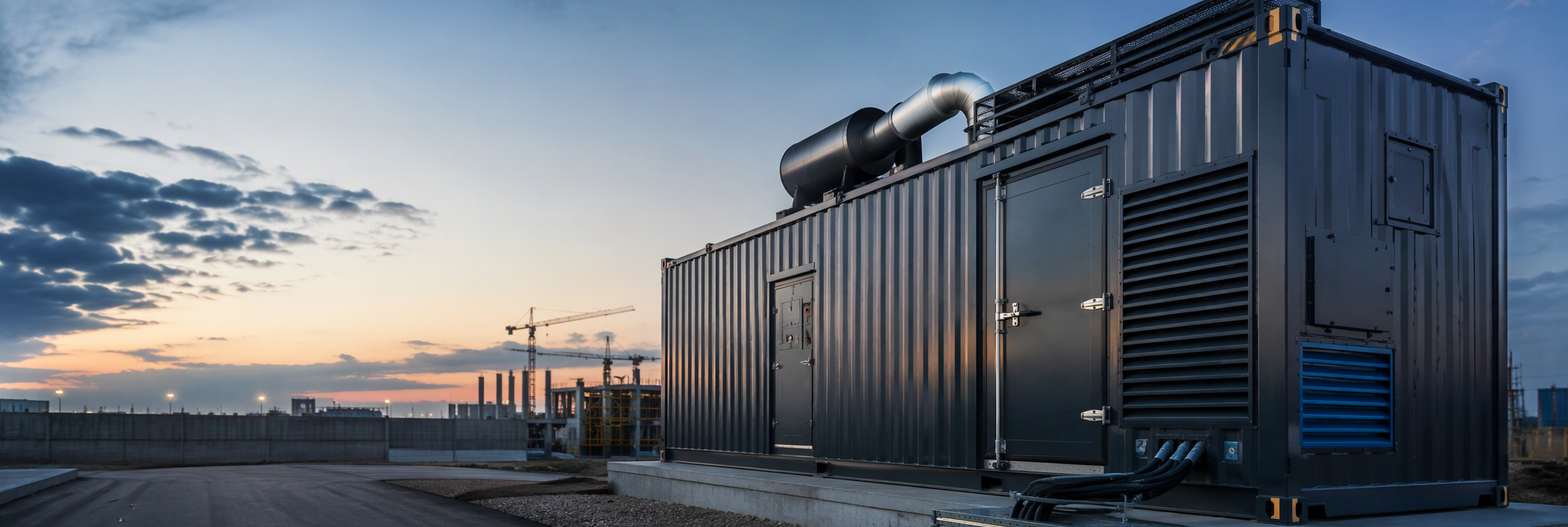
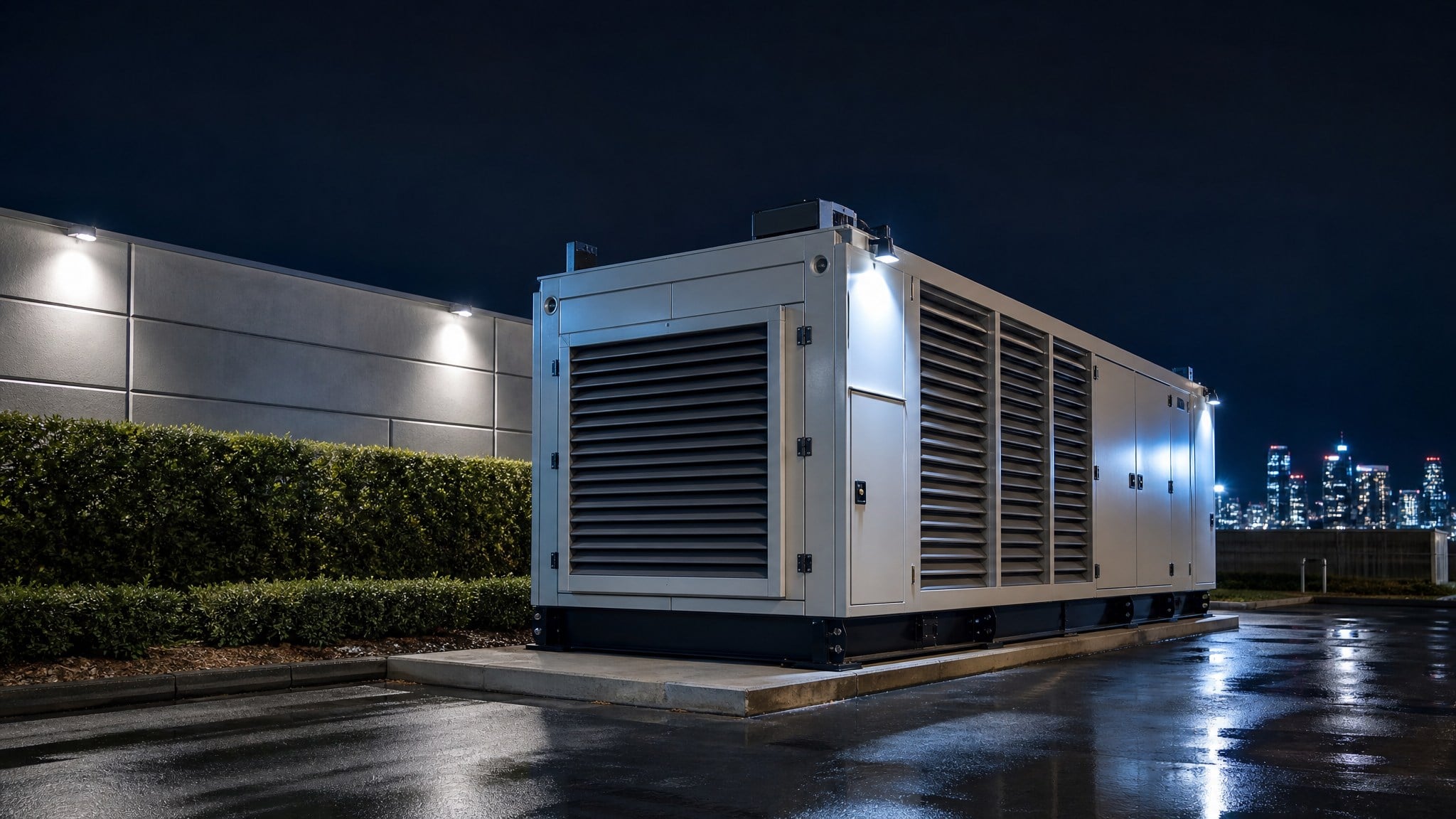
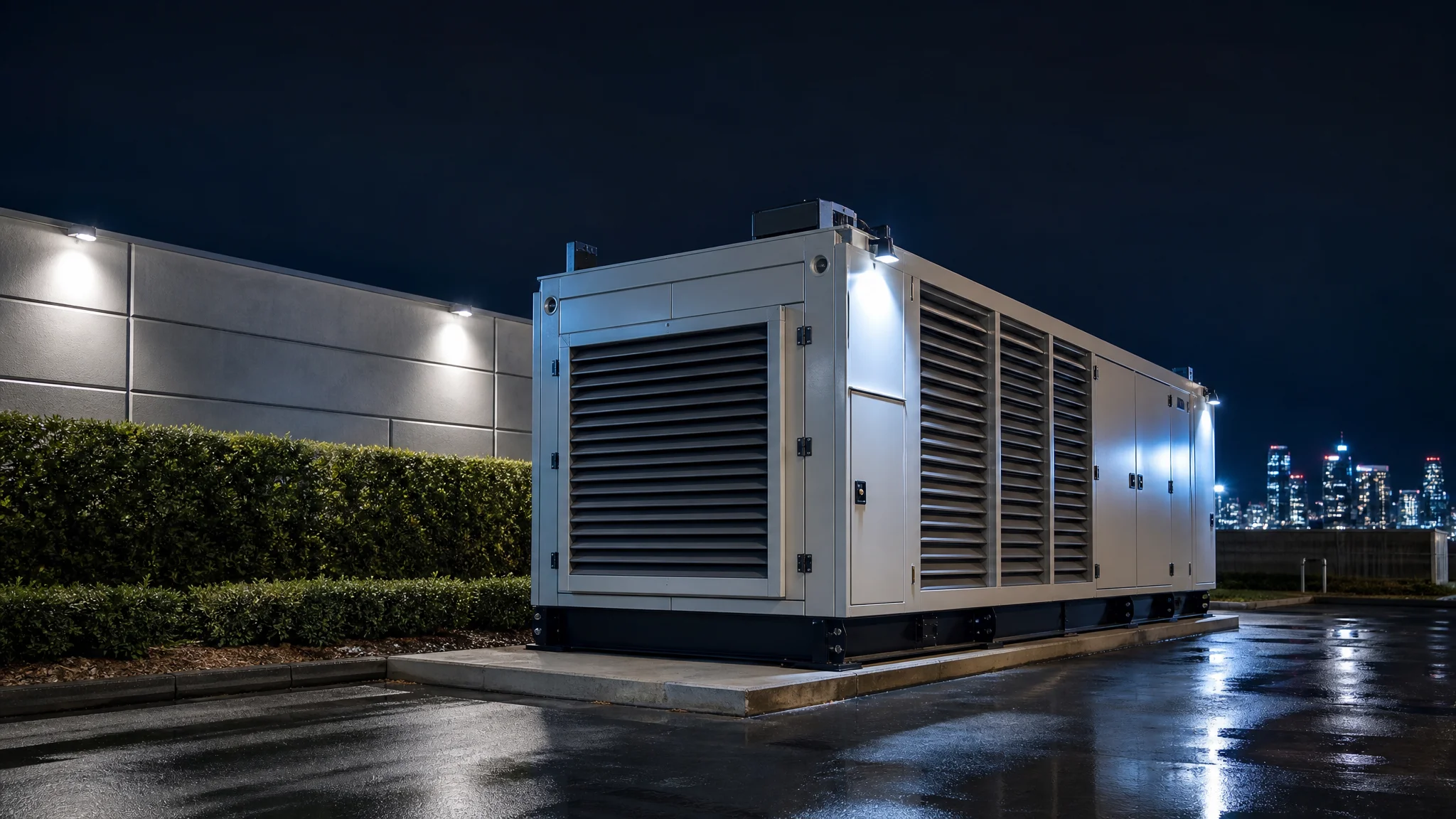
Noise is the constraint that most often decides whether a container generator set can be installed at a particular site at all. A generator that is perfectly adequate electrically can still be refused a permit because it exceeds a boundary limit at night, and a package that meets a sound level on the test certificate can still fail a site measurement because the certificate was measured somewhere else, under different conditions, at a different distance.
This article is about acoustic and environmental design as an engineering discipline rather than a product attribute. It covers how noise from a containerized generating set actually travels, how an enclosure and its louvers are designed around that path, how to set a specification that can be measured, and how the related environmental requirements — emissions, fuel containment, drainage, waste — are handled in the same package.
Start from the receiving position, not the machine
Acoustic design begins with a limit at a position: a boundary, a neighbouring dwelling, a workplace, a property line at night. That limit is normally expressed as a sound pressure level with a reference time period and often a tonal or impulsive penalty. Everything else follows from it: the distance to the source, the number of units, the presence of reflecting surfaces, the background noise level, and the attenuation the enclosure must provide.
Two mistakes are common at this stage. The first is specifying a sound level at one metre from the enclosure when the permit is written at the boundary; the conversion between the two depends on distance, ground effect, barriers and directivity, and it is not a fixed offset. The second is ignoring the background. If the site already has a high background at the boundary, the generator's contribution has to be assessed against it, and a limit that looks generous in absolute terms may still be difficult to meet because the permitted increment over background is small.
The noise path, broken into parts
Sound from a containerized generating set reaches a listener through several paths, and treating them as one number is why some projects miss their target after the enclosure has been upgraded.
- Airborne through the enclosure walls. Controlled by panel construction, mass, damping and the elimination of gaps. A single unsealed cable gland or a poorly closing door can dominate the performance of an otherwise well-built wall.
- Airborne through cooling openings. Cooling air must enter and leave, and those openings are the largest acoustic weak point. Acoustic louvers, splitter silencers or plenum arrangements are used to attenuate the openings, at the cost of airflow resistance.
- Exhaust noise. Usually the dominant source at low frequencies. Controlled by the silencer selected for the engine and the exhaust route, including the discharge orientation relative to the listener.
- Structure-borne and vibration. Engine and alternator vibration travels through mounts into the base frame and then into the foundation, the container structure and any connected pipework. Resilient mounts and flexible connections address this path.
- Radiated noise from auxiliary equipment. Fans, pumps and the radiator itself can become significant once the main sources are treated.
An acoustic design that addresses only the first two paths will hit a floor determined by the exhaust or by structure-borne transmission. The specification should therefore identify which paths are controlled and by what means, so that a shortfall in one area can be diagnosed rather than guessed at.
The airflow-versus-attenuation trade-off
Every acoustic measure applied to a cooling opening costs airflow. Louvers and splitters add pressure drop; that reduces the volume of cooling air for a given fan, which raises internal temperatures and pushes the machine toward derating. Designers resolve this in one of three ways: specify a larger fan and radiator to recover the airflow, accept a derated rating, or restructure the cooling arrangement so that intake and discharge are separated and ducted, reducing the amount of attenuation needed on each path.
The important consequence for a buyer is that acoustic performance, ambient temperature and rating are one coupled problem. A requirement for a low sound level at a high ambient temperature will reduce the achievable output of a given container unless the cooling system is enlarged, and a proposal that offers both the low sound level and the full rating without saying how should be questioned.
Writing a sound specification that can be verified
A verifiable noise specification states the quantity (sound pressure level, or sound power level), the frequency weighting and any penalty adjustments, the measurement position and height, the operating condition of the machine during measurement — load percentage, fan state, number of units running — the background noise condition and the correction method, and the standard or method to be used. It also states the number of units and their layout, because two identical containers side by side produce a higher level than one.
With those elements in place, acceptance testing becomes a measurement rather than an argument. Without them, a supplier can legitimately claim compliance at a position the buyer never intended, and the resulting dispute usually costs more than the acoustic treatment would have.
Emission treatment and the rest of the environmental package
Acoustic design is usually the loudest requirement but not the only environmental one. Depending on the jurisdiction and the site, the package may need to address exhaust emission limits and the documentation that demonstrates compliance, fuel storage containment and bunding capacity, spill response provisions, rainwater management from bunded areas, waste oil and filter handling, and in some cases visible plume or odour.
These items interact with the acoustic design. An exhaust after-treatment device changes back pressure, which affects both the engine setting and the noise signature, and its position on the container affects access for maintenance and the route of hot surfaces. A bunded fuel area adds mass and footprint. Deciding these at concept stage keeps them inside the container envelope; discovering them at permit stage usually means an external structure.
Where the site is in a sensitive location, it is also worth checking the operating hours permitted, because a night curfew changes the requirement from "meet the limit" to "do not run at night", which is a different design problem — one that storage or a different operating strategy may solve more cheaply than additional attenuation. Hybrid arrangements are discussed in our article on hybrid container power for remote projects.
Site layout: the cheapest attenuation available
Before adding mass to an enclosure, use the layout. Distance reduces sound pressure predictably. Barriers — a wall, an earth bund, a service building — interrupt the direct path. Orientation matters: pointing an exhaust or a discharge louver away from the sensitive receiver can be worth more than an upgrade to the silencer. Grouping noisy equipment away from the boundary and placing quieter auxiliary equipment between them and the receiver is standard practice that is often skipped when the layout is driven purely by cable lengths.
Layout also determines whether the acoustic design survives operation. A container installed with its intake facing a reflective wall, or with two units discharging into each other, will be louder at the boundary than the same units in an open yard. The layout drawing should show the noise-sensitive positions and the discharge directions together.
Verification, handover and the first year
Acceptance measurement should be planned rather than improvised: instrument class, calibration, weather conditions, wind speed, background measurement before and after, and the operating condition of the plant. Results should be recorded at the agreed positions with the plant running at the agreed load. Where the measured result is close to the limit, it is worth recording the spectrum as well as the overall level, because the spectrum tells you which path is dominant if a future complaint arrives.
The handover pack should include the acoustic design basis, the treatment applied on each transmission path, the measurement results, the maintenance items that affect acoustic performance — door seals, louver condition, silencer inspection — and the operating conditions assumed in the design. Acoustic performance degrades quietly: a perished seal or a missing louver blanking plate can undo a design margin without anyone noticing until a complaint is made.
What Outevo can confirm, and what depends on your site
Shanghai Outevo Machinery Co., Ltd. configures containerized generating sets with acoustic treatment matched to the project's stated limit and measurement position. Because the achievable level depends on the machine, the enclosure, the cooling arrangement, the exhaust route, the number of units and the site layout, the acoustic figure is a project-specific configuration value rather than a universal product claim. We will state the basis of any figure we give — position, load condition and configuration — and we will say when a target requires a layout measure rather than an enclosure measure.
Frequently asked questions
What sound level can a containerized generator achieve?
It depends on the machine, the enclosure, the cooling arrangement and the measurement position, so a single figure across all configurations would be misleading. What matters is that the target is expressed at your receiving position with a defined measurement method, and that the offered configuration is stated against that basis.
Why does the site measurement differ from the factory certificate?
Because the conditions differ: distance, height, reflective surfaces, background noise, number of units running, load condition and wind. A certificate is useful for comparing packages on a common basis; it is not a prediction of the level at your boundary.
Can a container be retrofitted with better acoustic treatment?
Often yes — seals, louver upgrades, an improved silencer or additional internal lining — but the available improvement is limited by airflow and by the remaining untreated paths. A retrofit that adds attenuation without addressing the resulting pressure drop can cost rating rather than gain quiet.
Does a quieter package always mean a larger footprint?
Usually it means more volume dedicated to attenuation and airflow, which can translate into a larger enclosure or an additional container. That is why acoustic targets are best set early, while the layout can still absorb them.
How should fuel containment be specified alongside the acoustic requirement?
As part of the same environmental package: bunded volume, drainage and separation arrangements, fill and vent positions, and access for inspection. These are permit-relevant items in most jurisdictions and should be described in the same drawing set as the acoustic treatment.
What maintenance affects acoustic performance?
Door and panel seals, louver condition and cleanliness, silencer and exhaust integrity, resilient mounts, and the sealing of cable and pipe penetrations. Each of these is a small item that can quietly remove a design margin.
Set the limit, then design to it
If you have a boundary limit, a measurement position and a site layout, you have enough to start. Send those to Shanghai Outevo Machinery Co., Ltd. together with the required rating, duty and ambient conditions, and we will propose a containerized configuration with its acoustic treatment and its airflow consequences stated together, so the choice between quiet, cool and compact is made deliberately rather than discovered at commissioning.
Related reading: silent generator sets, container generator sets, solution overview.


