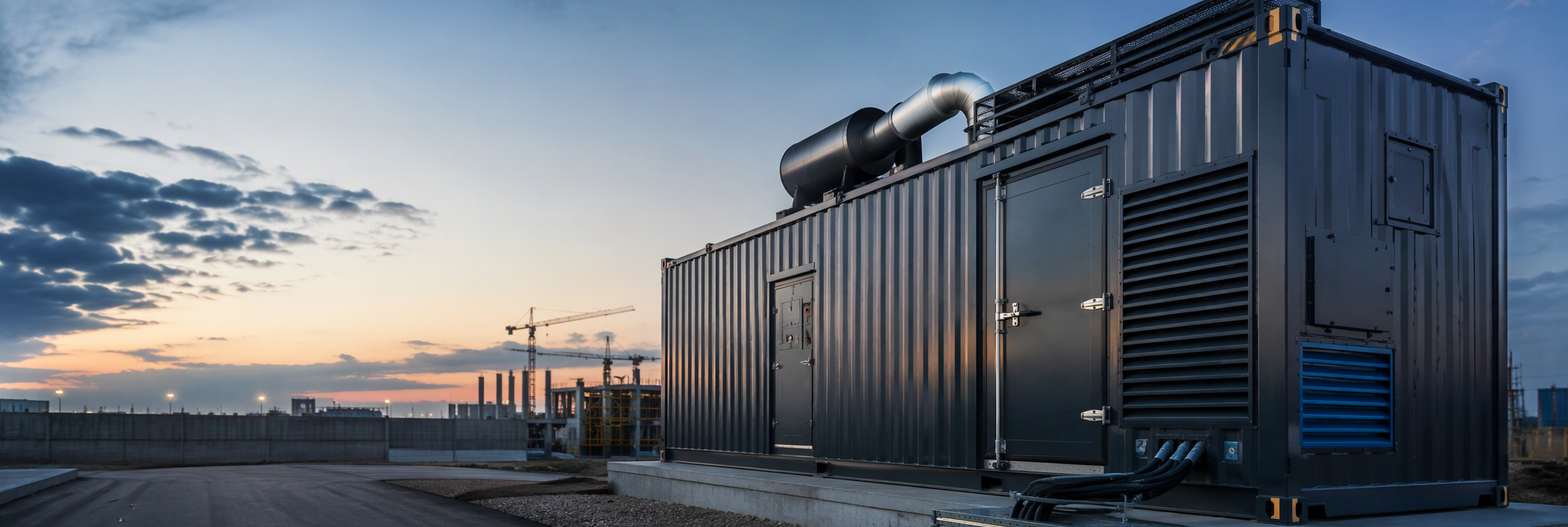
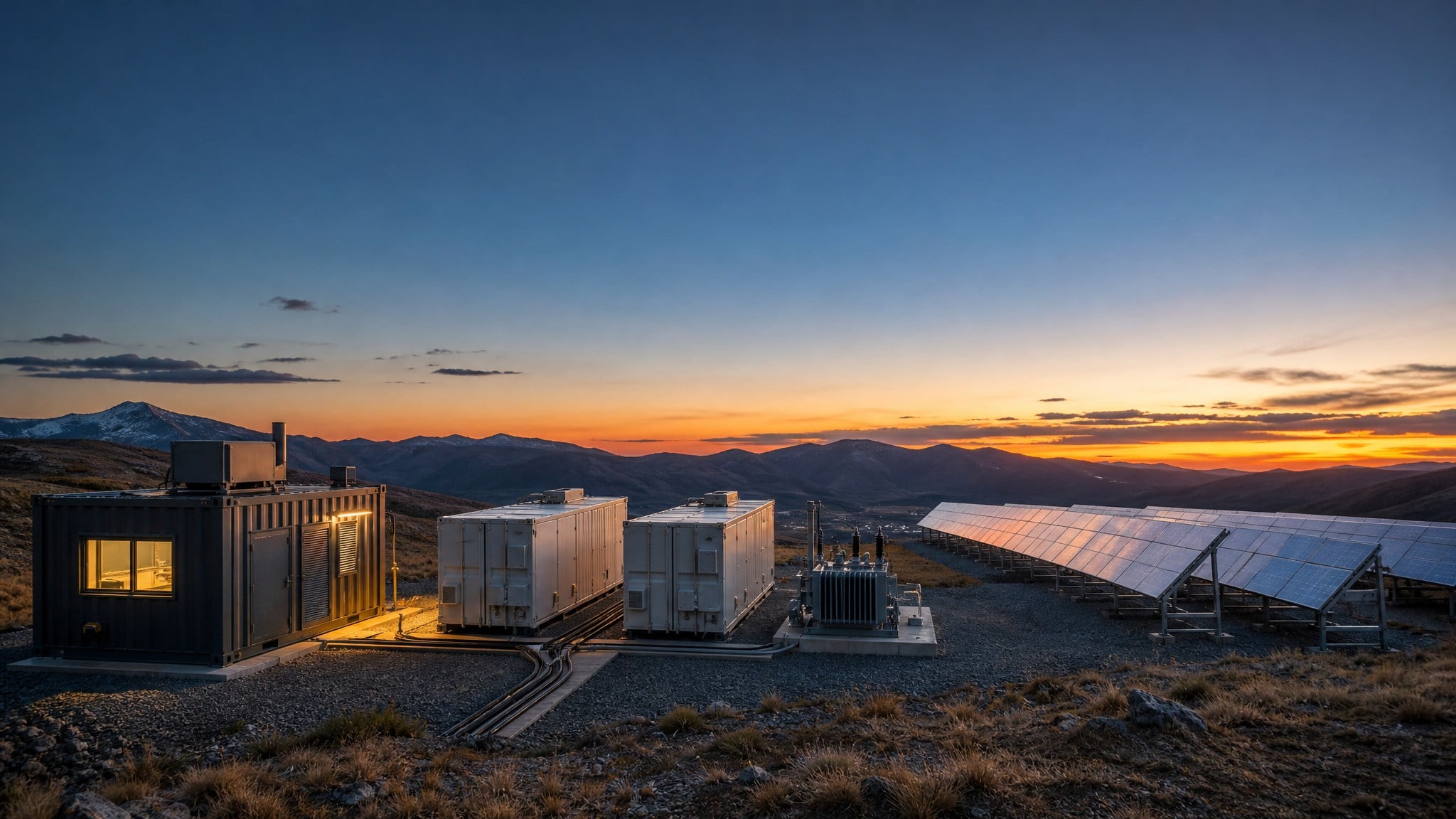
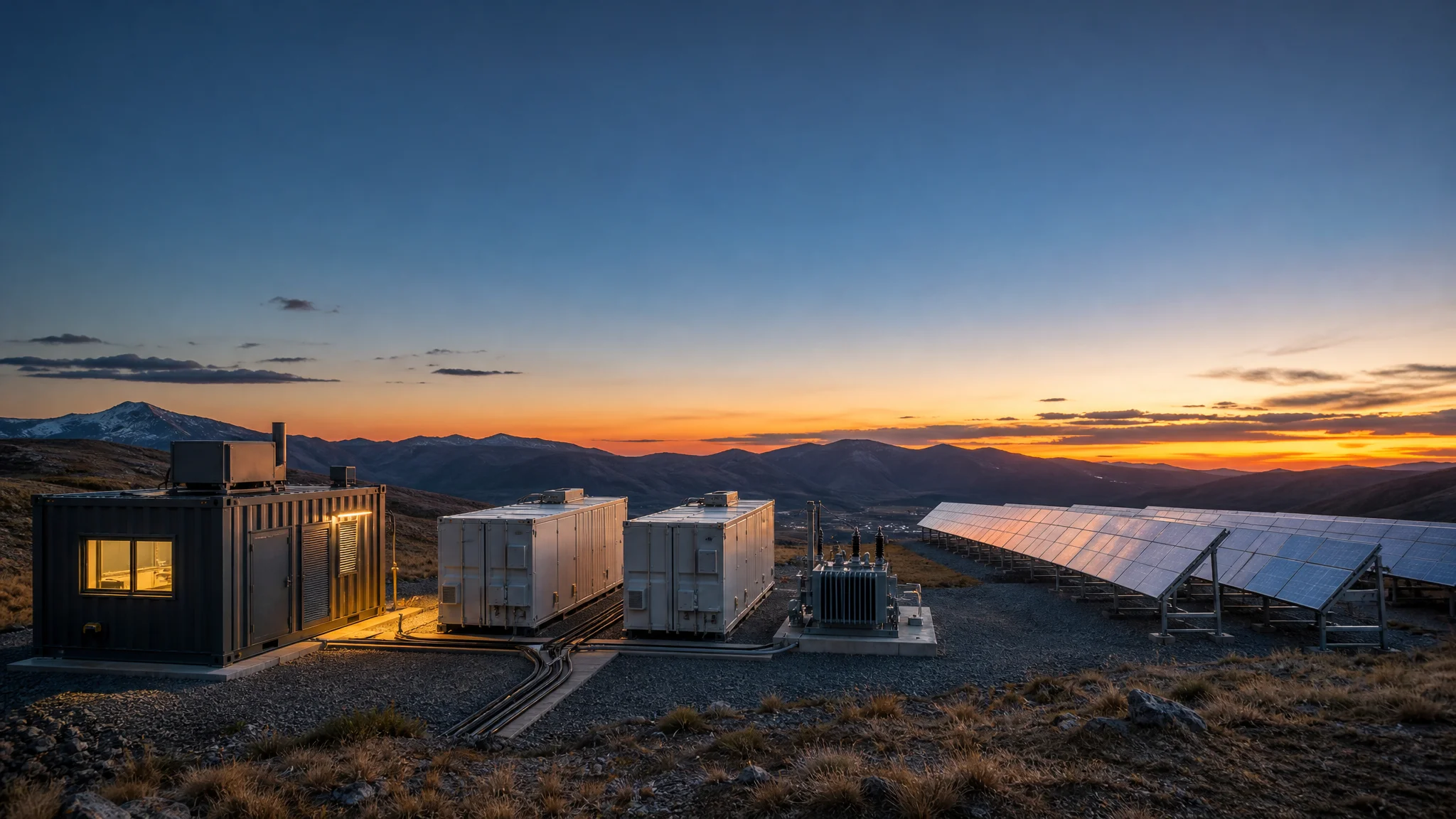
A hybrid container power solution combines a containerized generator set with energy storage, and often with photovoltaic generation, under a single control philosophy. The generator no longer carries every kilowatt of load directly; instead it supplies average energy and recharges the battery, while the battery covers peaks, transients and the periods when the generator would otherwise run lightly loaded or not at all.
Hybrid architectures are proposed for a very wide range of projects, and they are not always the right answer. On a site with cheap fuel, a stable load and easy maintenance access, a straightforward containerized generator may deliver better value with far less integration risk. This article explains when hybrid is worth the added complexity, how to size it defensibly, what has to be integrated, and which questions separate a credible proposal from an optimistic one.
The problem hybrid architectures actually solve
Four site conditions recur in projects where hybrid pays back. The first is expensive or difficult fuel logistics: where diesel has to be trucked hundreds of kilometres over poor roads, every litre avoided has a value well beyond the delivered fuel cost, because it also removes a delivery, a driver, a security escort and a stock-out risk. The second is a load profile with a low average and high peaks: a mine camp, a construction site or a crusher with intermittent heavy starts can spend most of its life well below the installed generator capacity, which is inefficient in fuel terms and hard on the machine. The third is a resource that is available but intermittent, typically solar, which can supply daytime energy without fuel but needs something else to carry the night and the clouds. The fourth is an operating constraint: emission limits, noise curfews, or a contractual requirement to reduce generator running hours.
If none of those four applies, be sceptical. Hybrid equipment adds converters, a battery management system, a supervisory controller and a new set of failure modes. It earns that complexity when it displaces something more expensive 鈥?usually fuel logistics or oversizing.
Sizing: energy first, power second, generator third
The most common sizing error is to start from the generator. A hybrid system should be sized in this order:
- Load energy over a representative period. Build an hourly or half-hourly profile for a typical day in each season, and for the worst day. If measured data does not exist, build the profile from the equipment list by duty cycle, and mark it as an estimate that must be validated during commissioning.
- Renewable contribution. Estimate the solar or wind yield for the site's actual irradiance or wind resource and its seasonal pattern, with a realistic derating for soiling, temperature and availability. Treat the yield estimate as an energy input to the model, not as a firm capacity.
- Storage energy and power. Storage must cover the night-time energy, the peak power, and the reserve needed when the renewable resource drops faster than forecast. Two separate numbers matter: kilowatt-hours of usable energy, and kilowatts of discharge capability. A battery sized only on energy will trip on a peak; one sized only on power will run flat before morning.
- Generator rating and minimum loading. The generator must be able to carry the site load plus battery charging, and it must be able to do so without sitting below the load level at which it runs efficiently and cleanly. This is the constraint that determines how hybrid systems are actually operated, and it is frequently ignored in proposals that simply add storage to an existing generator.
Only after those four steps should the container count and the physical layout be fixed. Outevo configures containerized generation for these projects across a broad range 鈥?10 kVA to 3,750 kVA when applicable 鈥?with each unit's rating set by the project-specific configuration, including the duty the hybrid controller will impose on it.
Control philosophy: who decides, and what happens when the sun goes
Hybrid systems fail on control logic more often than on hardware. The specification should answer a short list of behavioural questions:
- What is the sequence when the battery reaches its low limit and the renewable resource is falling 鈥?does the generator start on a schedule, on a state of charge threshold, or on a load forecast?
- How is generator loading managed so that it stays above its efficient minimum while still following the load?
- How does the system ride through a transient 鈥?a large motor start, a transformer energisation 鈥?without dropping the site?
- What is the behaviour during a generator service, when the site must run on storage and renewables alone for a defined period, or be curtailed?
- What happens if the supervisory controller fails? A single controller that owns every decision is a single point of failure for the whole site.
- How are setpoints changed, by whom, and are changes logged?
These are not academic questions. A hybrid site is a small microgrid, and its operating rules need to be written down, tested and handed over, not left implicit in a supplier's firmware defaults.
Integration points that decide whether the project runs smoothly
The physical integration is usually simpler than the electrical one. Mechanically, the containers arrive as freight units and need the same foundation, lifting and access planning as any other container plant. Electrically, the interfaces multiply: generator output, battery converter, photovoltaic inverters, the site distribution board, and the earthing and protection scheme that has to work in every operating mode. Control interfaces multiply as well, because the generator controller, the battery management system and the plant controller all have to agree on who is in charge at any moment.
Two integration details deserve early attention. The first is protection coordination in islanded mode: fault current in an inverter-dominated system is limited differently from a generator-dominated one, and settings that work in one mode may not in the other. The second is earthing and neutral arrangement when the system transitions between modes, which is a design decision with safety consequences and should be settled at concept stage.
Scenarios where a hybrid container solution fits
Remote camps and construction sites. Daytime load served by solar with battery support, generator running in efficient blocks during evening peaks and overnight, fuel deliveries reduced. The value is in logistics as much as in energy.
Mine and quarry operations with spiky demand. Storage absorbs crusher starts and hoist peaks that would otherwise dictate a larger generator, allowing a smaller, better-loaded machine.
Islanded industrial sites with an emission or noise constraint. Storage can carry the site through a curfew period or a low-emission window, with the generator held in reserve.
Telecom and utility nodes on weak networks. A hybrid container can provide firm supply where a grid connection exists but is unreliable, with the generator as backup rather than as the primary source.
Where the application is fundamentally about rapid deployment rather than energy optimisation, a straightforward mobile arrangement may serve better; our emergency and mobile power section covers that case.
What a credible hybrid proposal contains
Ask for the model, not only the conclusion. A defensible proposal shows the load profile it was sized against, the seasonal renewable yield assumption, the storage energy and power figures with the depth-of-discharge and round-trip assumptions stated, the generator operating hours per month that the control strategy implies, and the fuel volume that follows from those hours. It should also show what happens in the worst week of the year, not only in an average month, because hybrid systems are sized by their weakest period.
Equally, the proposal should state its own limits. If the design depends on the generator running at a load level the machine cannot sustain for long periods, or on a battery cycling regime that shortens its life, that should be visible in the numbers rather than discovered in year two.
Operation and maintenance in a hybrid plant
Hybrid plants change the maintenance profile rather than removing it. Generator running hours fall, which extends service intervals in calendar terms but can also mean the machine sits idle for long periods 鈥?and idle generators need their own regime: periodic exercise runs, battery charging, fuel polishing and checks for condensation. Storage adds a new discipline: state-of-health trending, thermal management checks, and a clear procedure for isolating a string for service. Renewable generation adds soiling and cleaning. The site's maintenance plan should list all three regimes explicitly, with intervals, and should identify which tasks can be done by site staff and which need specialist support.
Remote support capability matters more in a hybrid plant than in a single generator, because the interactions between subsystems are harder to diagnose locally. Remote monitoring that records generator state, storage state of charge and renewable output on a common time base is worth specifying at the outset; without it, every fault investigation starts from anecdote.
Commercial framing without invented numbers
Hybrid business cases are usually built on avoided fuel, avoided generator hours, deferred capacity and reduced logistics risk. Each of those is site-specific. The fuel saving depends on the load profile and the renewable resource; the maintenance saving depends on how the hours fall; the logistics saving depends on distance and road condition. A proposal that quotes a percentage saving without showing the model behind it is not a business case, and the assumptions should be auditable line by line.
Shanghai Outevo Machinery Co., Ltd. approaches these projects as configuration and integration work: defining the generator scope so that it suits the duty the hybrid controller will impose, agreeing the interfaces with the storage and renewable suppliers, and documenting the operating logic at handover. We do not publish performance guarantees for a site we have not modelled, and we would rather state an assumption than a promise.
Frequently asked questions
Is a hybrid container solution always cheaper to run than a diesel generator alone?
No. It is cheaper to run where fuel logistics are expensive, where the load profile is spiky or has a low average, or where a renewable resource is strong and predictable. Where fuel is cheap and the load is steady and well matched to the generator, the added capital and complexity usually outweigh the savings.
How much storage does a remote site need?
Enough usable energy to carry the site through the longest expected period without renewable input, plus enough power to cover the largest transient, plus a reserve for forecast error. Sizing on a single average day is the most common cause of undersized storage.
Can storage be added to an existing container generator later?
Often yes, if the existing generator's controller can accept external dispatch signals and the switchboard has space for the additional connection. The constraints are usually control compatibility and protection coordination rather than physical space, and both should be checked before the storage is ordered.
What happens to the generator when the battery is carrying the load?
It shuts down or runs at a defined efficient load to recharge, depending on the control strategy. The important design question is how often it starts and stops, because frequent cycling is harder on a generator than steady running. A well-designed strategy groups generator running into blocks rather than following every fluctuation.
Does a hybrid system need a different generator specification?
It needs a specification written for the duty it will actually see: step loading from the storage converter, sustained low-load periods, and a higher number of starts. Those requirements should be stated explicitly rather than assumed from a standby rating.
Who should own the control integration?
One party must own it contractually. Splitting generator, storage and renewable control between three suppliers without a named integrator is the most reliable way to produce a system that works in factory tests and misbehaves on site.
Start with the load profile
If you are evaluating a hybrid solution for a remote project, the single most valuable input is a load profile 鈥?measured if the site exists, estimated with stated assumptions if it does not 鈥?together with the fuel logistics distance, the renewable resource data and the operating constraints. Share those with Shanghai Outevo Machinery Co., Ltd. and we will help you test whether hybrid is justified, and if it is, define the generator scope and the interfaces that make the system work as one plant.
Related reading: container generator sets, gas generator sets, service and support.


