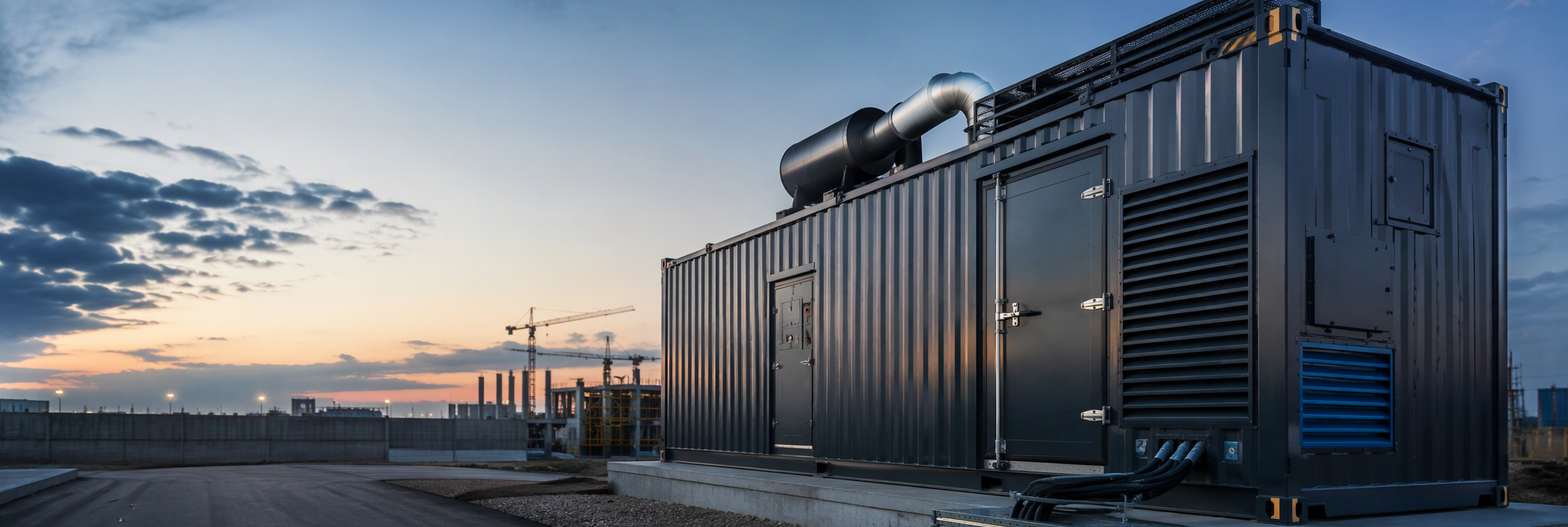
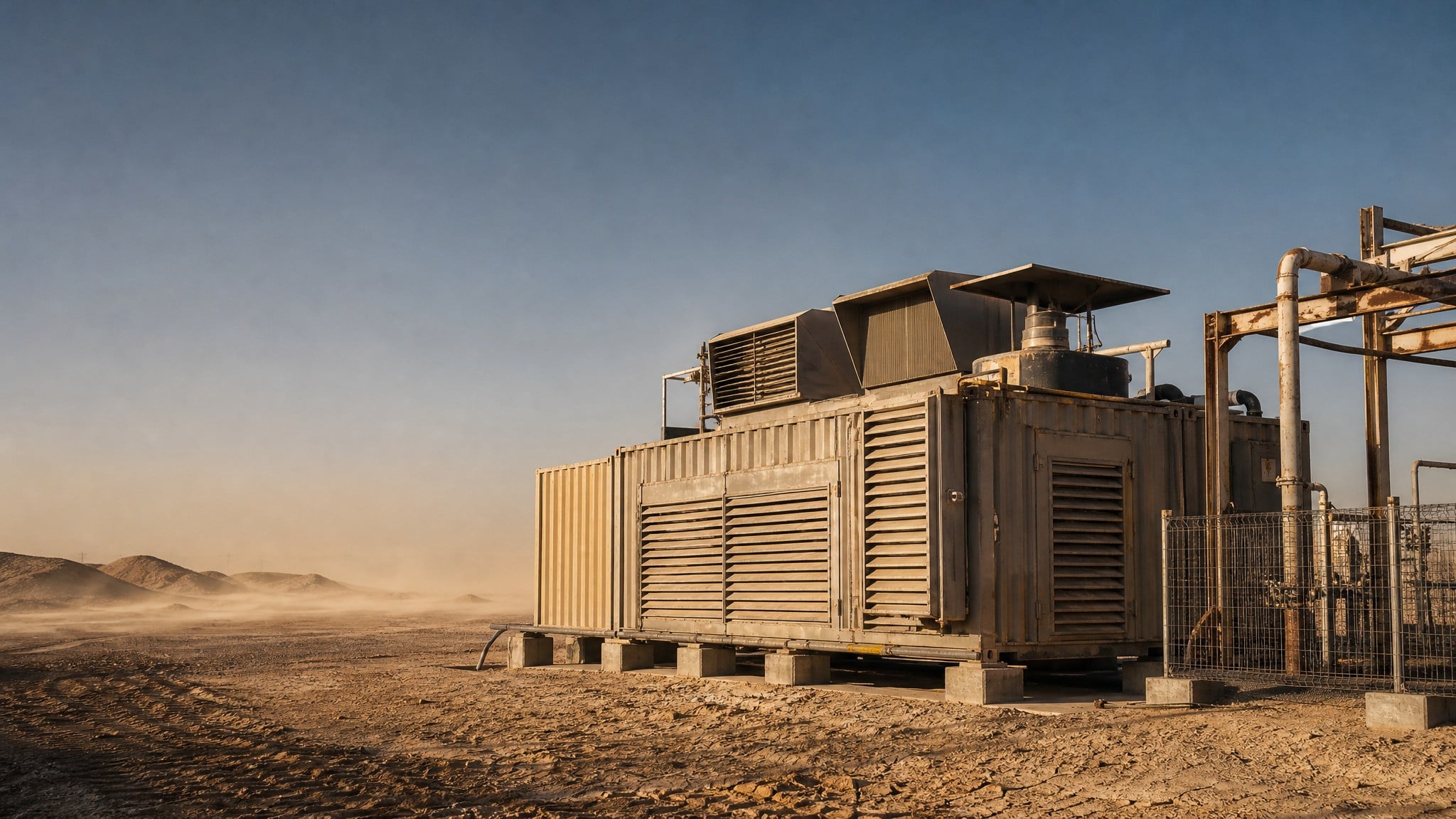
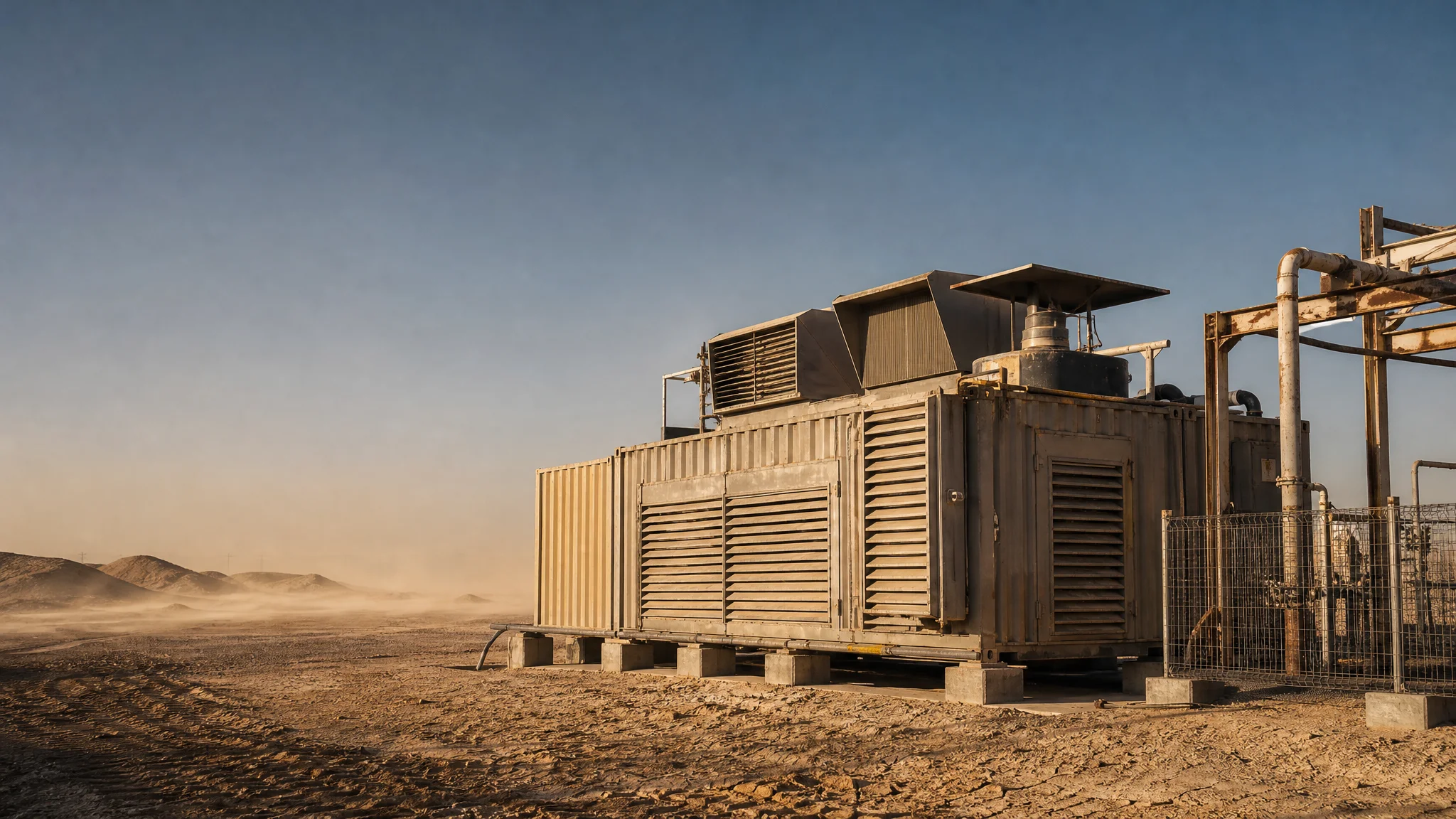
Most generator specifications are written for a temperate, clean, level site with reliable road access. Most generator sites are not that. A container power station bound for a desert concession, a coastal terminal, a high-altitude mine or a tropical processing plant will spend its life in conditions that attack the enclosure, the cooling system, the electrical insulation and the maintenance schedule at the same time. The container protects the machine, but only if the container itself has been designed for the environment it is going into.
This article sets out how a custom container power station is adapted to harsh environments, in the order a project engineer should think about it: first define the environmental load case, then decide which adaptations that load case actually requires, then check the consequences each adaptation has on the others. It is written for owners and EPC teams specifying equipment for sites where a standard package would either derate heavily or fail early.
Step one: write the environmental load case, not a weather description
"Hot climate" is not a specification. A useful environmental load case states the design maximum and minimum ambient temperature and, separately, the temperature of the air actually entering the enclosure; the design humidity range and whether condensation cycles occur; dust concentration, particle type and whether the dust is abrasive or conductive; salt content and distance from the coast; altitude; wind and seismic requirements from the site's structural study; rainfall intensity and flood level; and the presence of corrosive gases, such as hydrogen sulphide near certain industrial or geothermal operations.
Two entries on that list are routinely underspecified and routinely expensive. The first is the difference between ambient temperature and intake temperature: an enclosure placed next to a hot process line, or in a yard where hot air recirculates between units, can see intake air well above the meteorological maximum. The second is dust character. Fine abrasive dust and conductive metallic dust require different filtration and different maintenance intervals, and a filter chosen for the wrong one will either pass the dust or choke the airflow.
Heat: the dominant constraint in most harsh sites
Every enclosure is an airflow problem. The engine and alternator reject heat that has to leave the container through the radiator and through the enclosure surfaces, and the enclosure's acoustic treatment, filtration and weather protection all reduce the area available for that airflow. In a hot climate the design margin shrinks quickly, and the practical consequence is derating: the machine cannot deliver its nominal output at the design ambient without exceeding acceptable temperatures.
The engineer's job is to decide where the margin comes from. Options include a larger radiator and fan arrangement, a split cooling configuration with the radiator outside the enclosure, ducted intake and discharge that separates hot discharge air from intake air, and a larger machine frame operated below its nominal rating. Each has consequences. Ducting adds pressure drop, which must be included in the fan selection. A split cooling arrangement improves heat rejection but adds external pipework and a second installation interface. A larger frame costs more capacity per container but keeps the container count down.
The important discipline is to state the design ambient and the resulting rating in the specification, so that offers can be compared on the same basis. A package quoted at nominal rating without an ambient condition is not a comparable offer.
Cold, altitude and the combination that catches people out
Cold climates bring their own list: coolant and lubricant selection, battery capacity and heating, fuel waxing and fuel-line heat tracing, control-cabinet heaters and anti-condensation heaters, materials that stay ductile at low temperature, and snow load on the roof. Cold starting also changes the commissioning plan, because the first start at minus twenty is not the moment to discover that the pre-heat circuit was never enabled.
Altitude is often treated as a minor correction and is not. Lower air density reduces combustion air mass and cooling capability at the same time, so a unit sized for sea level will derate at altitude on two counts. Where altitude and high ambient coincide — a common combination on Andean and Central Asian sites — the derating is multiplicative and has to be calculated rather than guessed, and the enclosure's airflow design has to be revisited because the fan moves a lower mass of air for the same volume.
Dust, sand and the filtration trade-off
In desert and mine environments, filtration competes directly with cooling. A finer filter protects the engine and the alternator windings, but it also increases pressure drop and therefore reduces airflow, which pushes the unit toward derating. There is no free choice; the design has to pick an operating point and then support it with a maintenance regime.
Practical measures that recur in container projects include multi-stage intake filtration with a coarse pre-cleaner ahead of the fine element, sand louver or vane separators on the intake and discharge, positive pressurisation of the control compartment so that dust enters through filters rather than door seals, sealed cable entries, and sun hoods or double roofs to reduce solar gain. Discharge arrangements matter as much as intake ones: a discharge that blows dust back into its own intake, or into the intake of a neighbouring container, will undo the filtration design within a season.
Humidity, salt and corrosion
Coastal and tropical sites attack the enclosure from outside and the electrics from inside. Outside, the issues are coating system selection, galvanising of the structural frame, stainless or properly coated fasteners, and detailing that avoids water traps and dissimilar-metal contacts. These are specification items, not finish preferences, and they should reference the corrosivity category of the site rather than a generic "anti-corrosion" phrase.
Inside, the enemy is condensation, which forms when a warm humid day follows a cool night and the enclosure's thermal mass stays cold. Anti-condensation heaters in the control cabinet, correct breather and desiccant practice, and a ventilation strategy that does not pull humid air through the machine when it is not running all help. Insulation resistance trending during commissioning and the first year gives the earliest warning that the moisture strategy is not working.
Wind, seismic and structural honesty
A container is a strong box, but it is a box with large openings cut into it for cooling. Wind loading on the enclosure, uplift on the roof, and the seismic restraint of the machine on its frame all have to be checked for the actual site, not inherited from a template. Where the site is exposed — a coastal terminal, a ridge-top mine, an open desert plain — the anchorage design and the door and louver hardware are the parts that fail first, and they are cheap to upgrade at build stage and awkward to upgrade later.
Access and maintenance in the conditions that cause the failures
Harsh-environment design fails most often not in the machine but in the maintenance access. If the filters cannot be changed without scaffolding, they will not be changed on schedule. If the doors open into the prevailing wind, every service becomes a dust event. If the control panel is reachable only by standing on a pipe, it will be inspected less often than it should be.
Layout decisions taken on the drawing board therefore have real operating consequences: door orientation relative to prevailing wind, platform and stair access to filters and to the exhaust and cooling components, lighting inside the container, space for filter elements to be carried in and out, and a defined laydown area for removed parts. On remote sites, the same logic applies to spares: a filter set, a belt and hose kit, and a small number of critical sensors held on site will avoid long shutdowns waiting for a shipment.
Commissioning and handover for remote, extreme sites
Commissioning is where the environmental assumptions get tested. The plan should include verification of the actual derated capability at site conditions, thermal performance under sustained load rather than a short run, the behaviour of the cooling and filtration system at design ambient, the cold-start sequence if applicable, protection settings that reflect the site's fault level, and a documented baseline for insulation resistance and vibration that later readings can be compared against.
Handover should include the environmental design basis itself: the ambient and altitude assumptions, the derating applied, the filtration class and change criteria, the coating system, and the maintenance intervals that follow from the site conditions. Without that document, the operating team inherits a machine with no explanation of why it is configured the way it is, and the first symptom of a wrong assumption is usually an unplanned trip at the worst possible ambient temperature.
Configuration logic in one page
| Environmental stress | Typical design response | Consequence to manage |
|---|---|---|
| High ambient temperature | Oversized or split cooling, ducted hot-air discharge, larger frame | Derating, extra pipework, container count |
| Abrasive dust | Multi-stage filtration, sand louvers, pressurised control compartment | Pressure drop, filter change frequency |
| Salt-laden air | Corrosivity-classed coating system, galvanised frame, stainless fixings | Inspection intervals, touch-up regime |
| Low temperature | Heaters, low-temperature materials, fuel conditioning | Auxiliary power demand, cold-start procedure |
| Altitude | Re-rated output, revised airflow and fuel settings | Compounded derating with high ambient |
| Exposed wind and seismic | Site-specific anchorage, upgraded hardware | Foundation design, door and louver selection |
Shanghai Outevo Machinery Co., Ltd. configures container power stations against a stated environmental design basis rather than a generic climate label. Ratings within the 10–3,750 kVA range, when applicable, are fixed by the project-specific configuration: ambient, altitude, filtration, acoustic requirement and duty all move the final figure, and the figure that appears in the offer is the one calculated for your site.
Frequently asked questions
Can a standard container generator be used in a desert or coastal site without modification?
It can be installed, but it will normally operate below its nominal rating and will need a shorter inspection cycle. Whether that is acceptable is a commercial decision. The technical risk is that filtration, cooling airflow and coating are all working against you at once, which shortens component life and makes unplanned trips more likely.
How is the rating determined for a high-temperature or high-altitude site?
From the site's design ambient and altitude together, applied to the selected machine, with the cooling and airflow arrangement that the enclosure can actually support. It is a calculated figure for that configuration, not a catalogue value, which is why two offers for the "same" rating can differ substantially.
Does a higher protection rating solve dust problems?
Only partly. A high ingress-protection rating limits what enters through seals and joints, but cooling air still has to pass through the enclosure, and that path needs filtration and, in severe dust, sand separation. The ingress rating of the enclosure and the filtration of the cooling air are two separate design decisions.
How is acoustic treatment affected by a harsh environment?
Acoustic linings and louvers consume space that cooling airflow also needs, and filters add pressure drop. On a hot, dusty, noise-sensitive site the three requirements have to be solved together. Treating them as separate line items in a specification is the most common reason a package ends up derated after award.
What documentation should be handed over for a harsh-environment installation?
The environmental design basis, the derating calculation, the filtration class with change criteria, the coating system and its reference standard, protection settings, commissioning records for thermal performance and insulation resistance, and the maintenance intervals derived from the site conditions.
Can a container power station be relocated between sites with different climates?
Yes, provided the original configuration left margin and the control and protection settings can be re-applied for the new site. A unit configured with generous cooling and filtration margin travels well; one trimmed to a single operating point does not. Relocation should include a re-assessment of the environmental design basis, not just a new foundation.
Send us the site conditions, not just the power requirement
The fastest way to get a realistic configuration is to share the environmental design basis with your enquiry: design ambient and minimum temperature, altitude, dust and salt exposure, wind and seismic criteria, acoustic limit and measurement position, duty profile and the transport route. Shanghai Outevo Machinery Co., Ltd. will return a configuration proposal that states its assumptions explicitly, so that the rating in the offer can be defended in your technical review.
Related reading: container generator sets, silent generator sets, mining and construction power.


