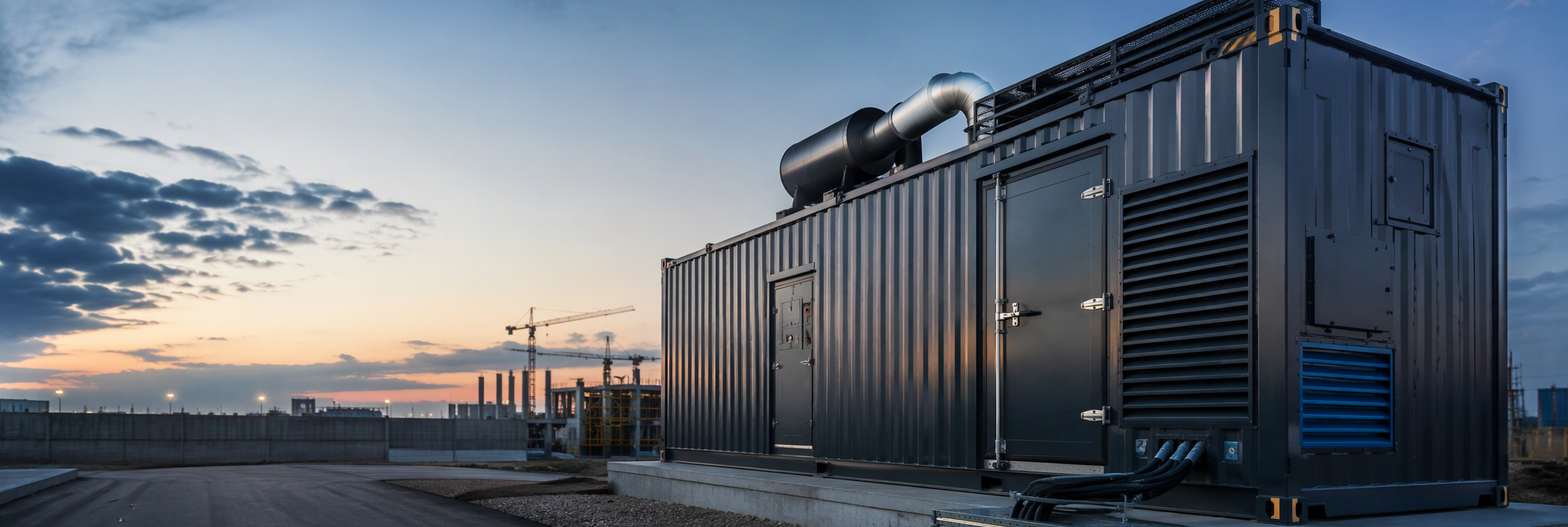
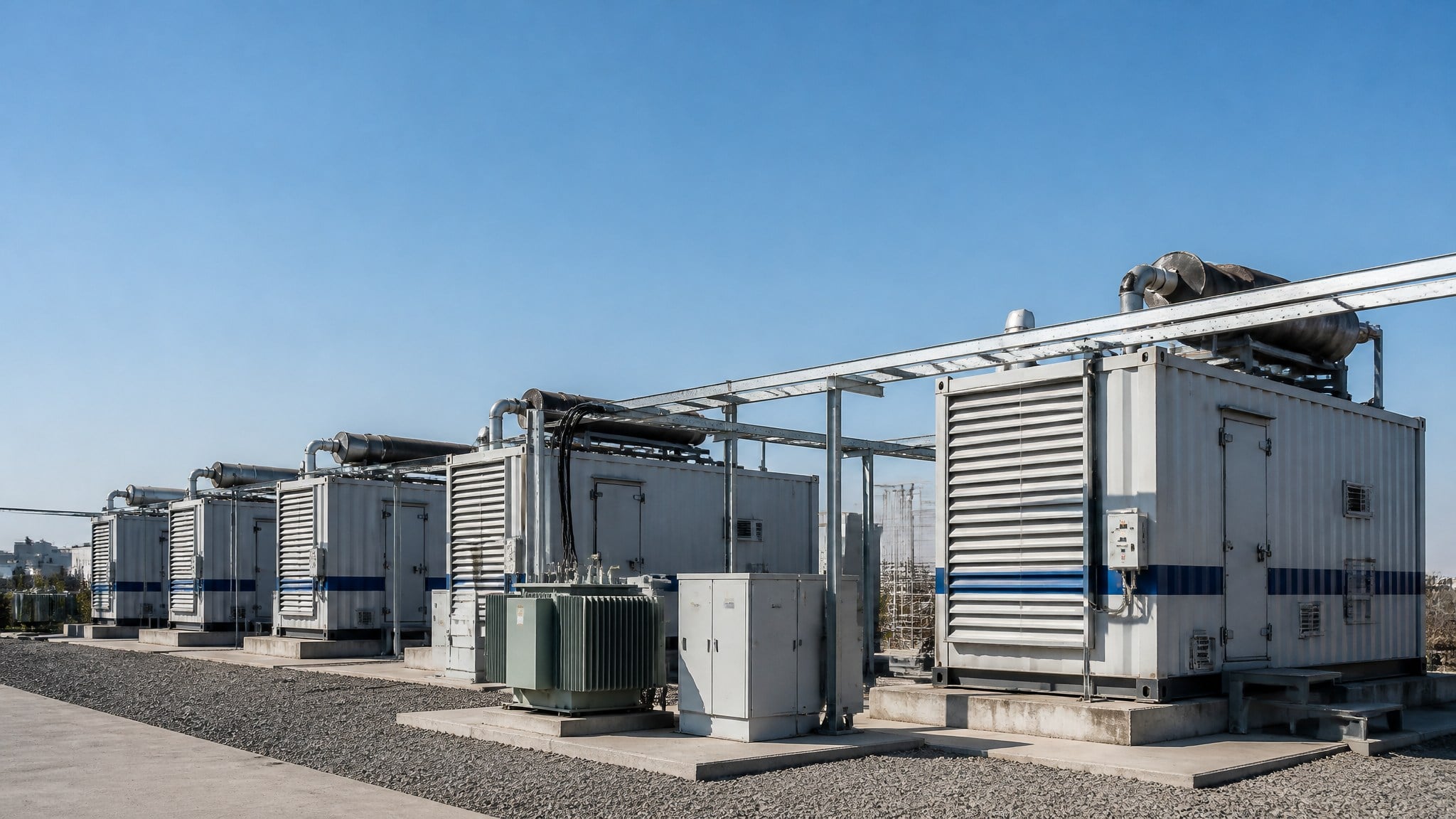
Modular power infrastructure treats generation capacity as a set of repeatable blocks rather than a single engineered machine. Instead of ordering one large power plant and hoping the load forecast holds, the owner buys standard blocks, brings them online in stages, and adds capacity when demand actually appears. The container is what makes this model practical: it gives every block the same footprint, the same lifting points, the same electrical interface and the same logistics profile, so the second, third and tenth block behave exactly like the first.
This article is written for the people who have to make that decision defensibly: the consulting engineer preparing a specification, the EPC contractor pricing a temporary or permanent plant, and the owner's technical team who will live with the asset for a decade. It covers how modular containerized generation is structured, how to size and stage it, what has to be agreed at the interface level, and where modular thinking usually breaks down in procurement.
Why modular architecture is being specified more often
Three pressures push projects toward modular containerized generation. The first is uncertainty. Industrial demand growth, data-centre commissioning schedules and construction site power profiles rarely arrive on the curve that was forecast at financial close. A block-based plant can be sized to the near-term load and extended later without a new building, a new foundation design or a new grid connection study. The second is schedule. A containerized block is assembled and tested under workshop conditions, then transported as a freight unit, which moves a large share of the integration risk off the site critical path. The third is repeatability. Standard blocks share spares, documentation, training and maintenance routines, which lowers the operating burden across a fleet that may eventually sit in several locations.
These advantages are real but conditional. Modularity pays back only when the interfaces between blocks are defined before the first unit is built. A plant made of ten blocks that were each customised independently is not modular; it is ten small bespoke projects sharing a fence.
What "modular" has to mean at the container level
A containerized generating block is more than an engine inside a steel box. For the block to be interchangeable, five interface families must be standardised and documented:
- Mechanical interface. Footprint, mass, centre of gravity, lifting points, anchoring pattern and the acceptable foundation or hardstanding tolerance. If two blocks cannot sit on the same pad design, the site layout becomes bespoke every time.
- Electrical interface. Voltage, frequency, neutral arrangement, fault level contribution, cable-entry position and the termination format. The block should present a predictable connection point to the plant busbar, not an open question for the site electrician.
- Control interface. The protocol and signal list used for start/stop, load sharing, alarm transfer and remote monitoring, plus the behaviour expected when one block is isolated for service.
- Fuel and fluid interface. Connection sizes, delivery pressure, return arrangements, fill points and bunding strategy. Fuel is where modular plants most often become non-modular, because every site invents its own tank arrangement.
- Thermal and exhaust interface. Discharge direction, minimum clearance to walls and to adjacent blocks, and whether exhaust treatment or stack extension is inside or outside the container scope.
Documenting these five families is the difference between a catalogue of products and a power infrastructure system. It is also the basis for the interface schedule that a consulting engineer can attach to a tender, which in turn is what makes competing offers comparable.
Sizing a module before sizing the plant
The module size decision usually comes before the total capacity decision, and it deserves its own method. Start from a real load list rather than a nameplate total: continuous load, intermittent load, large motor starting or transformer inrush, harmonic-producing loads, and the standby or essential subset that must survive the loss of a block. Apply diversity honestly. Then test candidate module sizes against four constraints:
- Redundancy granularity. With N+1, the spare block should cover the loss of the largest single block. Small blocks give fine granularity and better part-load behaviour; large blocks give fewer connections and lower installation labour.
- Turndown and part-load operation. A plant that runs most of its life at a fraction of installed capacity will accumulate running hours inefficiently. More, smaller blocks allow a subset to run near a sensible load point while others stay on standby.
- Transport limit. The largest block that can reach the site on the available road, quay or shaft sets a hard ceiling. This is a logistics decision as much as an engineering one, and it should be confirmed before the electrical design is frozen.
- Future expansion. Reserve space, busbar capacity and control headroom for at least one more block than the current phase requires. The cost of designing headroom is small compared with retrofitting a switchboard.
Outevo's containerized generator scope is offered across a broad range — from 10 kVA to 3,750 kVA when applicable — with the actual rating fixed by the project-specific configuration rather than by a family name. Within that envelope, the module size is a project decision, and it is normally made jointly by the electrical engineer and the logistics planner.
Paralleling, control and the behaviour of a block plant
A multi-block plant lives or dies on its control philosophy. At minimum, the specification should state how blocks synchronise, how real and reactive load is shared, how a block is added or removed as load changes, what happens when a block trips, and how the plant behaves during a black start if that is a requirement. It should also state what the plant does when the master controller fails, because single-point dependency on one controller is the most common hidden weakness in otherwise sound modular designs.
Two philosophies are common. A central plant controller gives a single, coherent view of the plant and simplifies operator training, but it concentrates risk. Distributed load sharing among identical blocks removes that concentration, at the cost of more complex commissioning and a stricter requirement that every block's controller firmware and settings match. Either can be correct; what is not correct is leaving the choice to the supplier's default without the owner understanding the difference.
Where modular plants earn their keep
Phased industrial development. A park or plant that will be built in three stages can commission generation in three matching steps, avoiding years of paying for capacity that is not yet loaded, and avoiding a temporary plant that later has to be scrapped.
Temporary support during grid works. When a utility reinforcement or substation upgrade runs behind the construction schedule, containerized blocks provide interim capacity that can later be relocated rather than written off.
Islanded or weak-grid sites. Remote industrial sites often need a generation backbone that can grow with the operation. Blocks can be added as the processing line is expanded, and a failed block can be exchanged rather than rebuilt on site.
Data-centre and mission-critical build-out. Containerized blocks suit staged IT hall commissioning, where capacity follows the white-space build and standby behaviour has to be provable one hall at a time. That application is covered in our data centre backup power section.
Transport and site logistics of a block plant
Modularity is a logistics claim before it is an engineering claim. Confirm the route envelope early: bridge weights, turning radii, overhead lines, ferry or quay lifting capacity, and any permit windows. Confirm that the container's lifting points and the site crane plan match, and that the hardstanding can take the point loads during installation, not only the finished bearing pressure. Where blocks will be installed in a tight plant room arrangement, agree the installation sequence and the maintenance clearance before the foundation drawing is issued, because a block that cannot be reached for a major service is a design defect that surfaces years later.
For plants that will be relocated, the transport story should include the connections as well as the boxes: quick-release fuel couplings, plug-in busbar or cable terminations, and a control network that can be re-addressed at each new site. Transportable power is treated in more depth in our article on transportable container power for mining, construction and industry.
Commissioning a plant made of blocks
Commissioning should be organised block by block and then plant by plant. Each block is proven individually — protection settings, governor and voltage response, alarm and shutdown testing, fuel system integrity, thermal performance under load. Then the plant is proven as a system: synchronising, load sharing across the full range, staged load acceptance, loss-of-one-block response, and the transitions between grid-parallel and islanded modes where both apply. Records from the block tests should be filed per block, so that when a block is later exchanged or relocated its baseline travels with it.
Maintenance across a fleet rather than a machine
Fleet maintenance is a different discipline from single-machine maintenance. It needs a register that ties each block to its location, running hours, service history and configuration revision; a spares strategy built around common consumables and a small number of rotable assemblies; and a rule for how a block is isolated and returned to service without disturbing plant capacity. Owners who plan for one rotable spare block, rather than a shelf of individual parts, usually find that major services stop being capacity events.
Outevo supports containerized projects with documentation, configuration records and service planning agreed at order stage. Warranty terms follow the series and configuration, with coverage of up to two years or 2,000 hours depending on series, and the applicable terms are stated in the order documents rather than assumed from a brochure.
Six procurement mistakes that undermine modularity
- Buying blocks from several suppliers without a common interface schedule, then discovering that the switchboard, fuel system and control protocol do not meet in the middle.
- Fixing the module size from a preferred shipping container dimension before checking the electrical redundancy requirement.
- Leaving the control philosophy to a default, so nobody can explain what happens when the master controller fails.
- Specifying acoustic performance as a single sound level without stating the measurement position and the background noise condition.
- Treating site works as the contractor's problem, when foundation tolerance, cable entry and fuel routing are what actually determine whether the blocks fit.
- Omitting a spare-block strategy, then discovering that a major service removes a quarter of the plant's capacity for weeks.
Frequently asked questions
How many containerized generator blocks should a modular plant have?
There is no universal number. The practical range is set by three things: the redundancy you need, the largest block your transport route allows, and how well the plant must behave at part load. A plant that must survive the loss of any single unit usually needs at least three blocks; a plant that will run for years at low load usually benefits from more, smaller blocks. The right answer comes from a load list and a logistics survey, not from a rule of thumb.
Can containerized blocks be added to an existing plant later?
Yes, if the original design reserved busbar capacity, switchboard space, control headroom and physical space for the additional block. Retrofitting capacity into a plant that was designed as a closed system is possible but expensive. The cheapest future block is the one that was planned for at the start.
Is a containerized block suitable for both standby and continuous duty?
It can be, but the configuration differs. Continuous duty places sustained demands on cooling, lubrication and service intervals that a standby-rated package does not face. The duty class must be stated in the specification, because it drives the radiator sizing, the derating assumptions and the maintenance plan.
What has to be agreed before the foundation design is issued?
Footprint, mass, centre of gravity, anchoring pattern, cable-entry position, fuel connection position, exhaust direction and maintenance clearance. If any of these are still open when the foundation drawing is released, the site will absorb the difference in change orders.
How is capacity range handled across a project with several blocks?
Outevo covers containerized generation across a range that extends from 10 kVA to 3,750 kVA when applicable, and each block's rating is fixed by its project-specific configuration. For a multi-block plant, the ratings, the paralleling arrangement and the protection settings are agreed as one configuration package so that the blocks behave as a single system.
Does a modular plant need a single supplier for all blocks?
Not necessarily, but it needs a single interface authority. If blocks come from different suppliers, someone must own the interface schedule, the control philosophy and the commissioning criteria — in the contract, not by assumption.
Next step
If you are planning a phased or expandable power installation, the most useful first conversation is about the load list and the transport envelope, not a specific model. Send your load profile, site conditions, redundancy requirement and the largest unit your route can accept, and Shanghai Outevo Machinery Co., Ltd. will help translate them into a block configuration, an interface schedule and a staged deployment plan you can take to tender.
Related reading: container generator sets, solution overview, service and support.


