How to Choose and Maintain Diesel Generators for Construction Projects in Middle East Coastal Areas
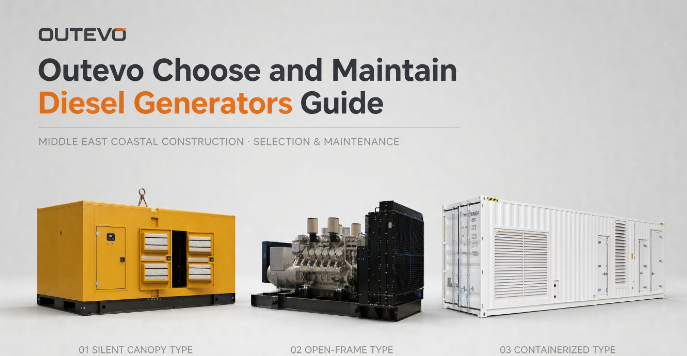
The construction industry in Middle East coastal regions (such as UAE, Saudi Arabia, Qatar, Oman) faces extreme operating conditions: summer temperatures regularly exceed 50°C, coastal salt mist corrosion, frequent sandstorms, and high humidity 1, 3 . Selecting the right diesel generator and following proper maintenance procedures is critical to keeping projects on schedule. Below is a practical guide for construction companies and equipment buyers.
Part 1: How to Choose the Right Generator Type
1. Prioritize Environmental Adaptation
- High-temperature cooling system: Choose units with enlarged radiator capacity (30% larger than standard models) and high-temperature rated copper water tanks designed for 55°C ambient operation. Standard units will derate significantly above 40°C 1, 5 .
- Corrosion protection: For coastal sites, select units with IP54+ enclosure rating, heavy-duty anti-corrosion coatings (ISO 12944 C5 standard), and stainless steel fasteners to resist salt mist damage 3, 7 .
- Dust & sand protection: Install multi-stage air filtration systems (primary + secondary filters) to prevent sand ingress into cylinders, which is a leading cause of premature engine failure in the region 1, 3 .
2. Select the Right Enclosure Type
- Silent/soundproof canopy type: Recommended for urban construction sites near residential areas, as Dubai Municipality and other Emirates enforce strict noise regulations (≤70–75 dB at 1 meter). Also provides additional protection against sand and salt 6, 12 .
- Open-frame type: Suitable for remote desert sites where noise is not a concern. Lower cost and easier to maintain, but requires a protective shelter on-site.
- Containerized type: Ideal for large, long-term infrastructure projects. Offers full weather protection, integrated fuel tanks, and easy transportation via standard shipping containers 13 .
3. Size the Generator Correctly
- Calculate total running load of all equipment (cranes, pumps, welding machines, lighting, site offices).
- Add 20–30% safety margin for future expansion and motor starting surge.
- For motor loads, account for starting current: direct start requires 5–7× rated current, while soft start only needs 2–4× 6, 7 .
- Example: A medium construction site with ~280 kW running load should select a 450–500 kVA prime-rated genset 6 .
4. Choose Reliable Engine Brands with Local Support
- International brands (Cummins, Volvo, MTU) dominate the Middle East market with established service networks and parts availability 2, 3 .
- Chinese brands (Yuchai, Weichai) offer competitive pricing with improving reliability, and many now provide global after-sales support 2, 5 .
- Ensure the supplier offers local technical support and spare parts supply in the target country.
Part 2: Maintenance Best Practices for Coastal Construction Sites
1. Shorten Maintenance Intervals
Due to extreme heat and dust, standard maintenance cycles must be reduced 3, 4 :
- Engine oil & oil filter: Every 200–250 hours (instead of standard 500 hours). Use high-temperature grade oil (SAE 15W-40 or 20W-50).
- Air filter: Inspect weekly; clean or replace every 100–150 hours in dusty conditions.
- Fuel filter: Replace every 250 hours. Drain water from the fuel separator daily.
- Coolant: Check level daily; replace every 500 hours. Use distilled water or anti-corrosion coolant to prevent scaling.
2. Daily Operating Practices
- Warm-up: Idle for 3–5 minutes after startup before applying load. Allow oil pressure and water temperature to stabilize 8, 17 .
- Cool-down: Run at no-load for 3–5 minutes before shutdown to protect the turbocharger 8, 17 .
- Load management: Avoid prolonged operation below 30% load (causes carbon buildup) and never exceed rated capacity 4, 18 .
- Battery care: Check voltage weekly. High temperatures accelerate battery degradation — consider relocating batteries to a shaded, ventilated area 4, 8 .
3. Corrosion Prevention for Coastal Sites
- Wipe down electrical connections and control panels weekly to remove salt deposits.
- Apply anti-corrosion spray to exposed metal parts monthly.
- Store spare parts (filters, belts, sensors) in sealed, dry containers to prevent moisture damage 1, 3 .
4. Record Keeping & Monitoring
- Maintain a logbook recording running hours, fuel consumption, maintenance actions, and any fault codes.
- Consider installing remote monitoring systems (IoT sensors for oil pressure, water temperature, voltage) to enable predictive maintenance and reduce unplanned downtime 4, 13 .
Quick Reference: Key Selection Checklist for Middle East Coastal Construction
|
Factor |
Recommendation |
|
Ambient temperature rating |
50–55°C with enlarged radiator |
|
Enclosure type |
Silent canopy or containerized for coastal/urban sites |
|
Protection level |
IP54 minimum; IP55+ for harsh coastal exposure |
|
Air filtration |
Multi-stage (primary + secondary) |
|
Corrosion protection |
Heavy-duty coating + stainless fasteners |
|
Maintenance interval |
Reduce standard cycles by 40–50% |
|
Local support |
Confirm spare parts and service availability |
Choosing the right generator and following disciplined maintenance will significantly reduce downtime, extend equipment life, and keep your construction project running smoothly — even in the toughest Middle East coastal conditions. If you need help sizing a generator for your specific site or want a customized quotation, feel free to reach out with your load requirements and project location.
