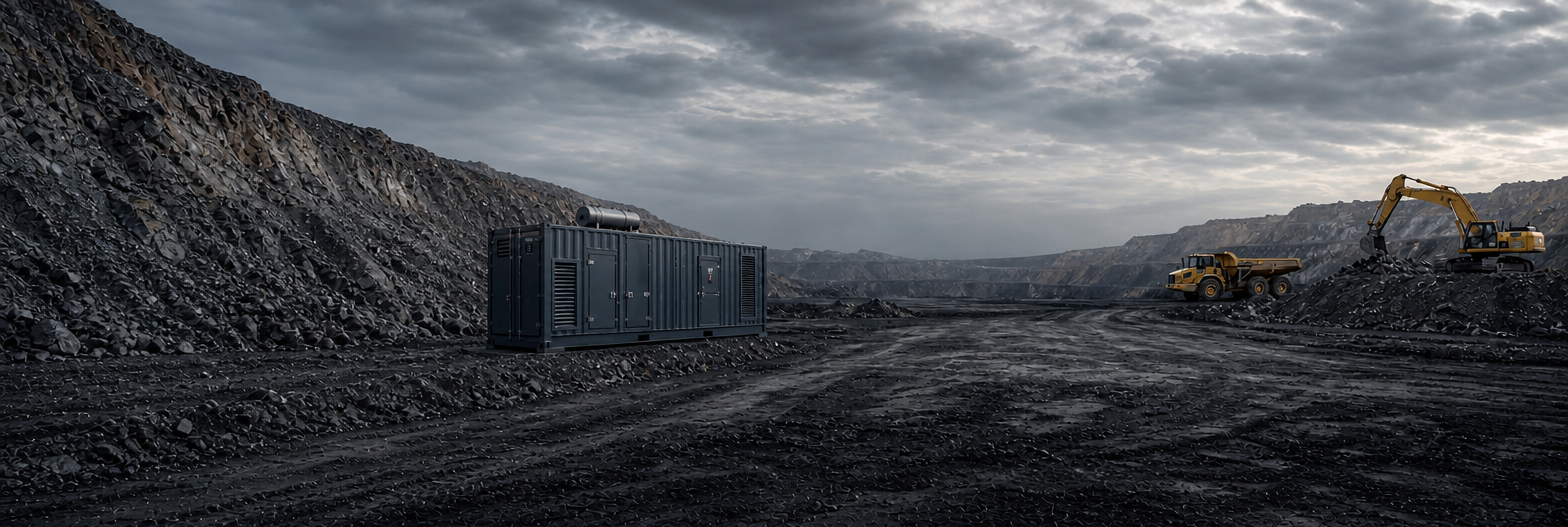
Construction power reliability: fuel storage and quality, service access and intervals, four redundancy levels from rental contingency to parallel operation.
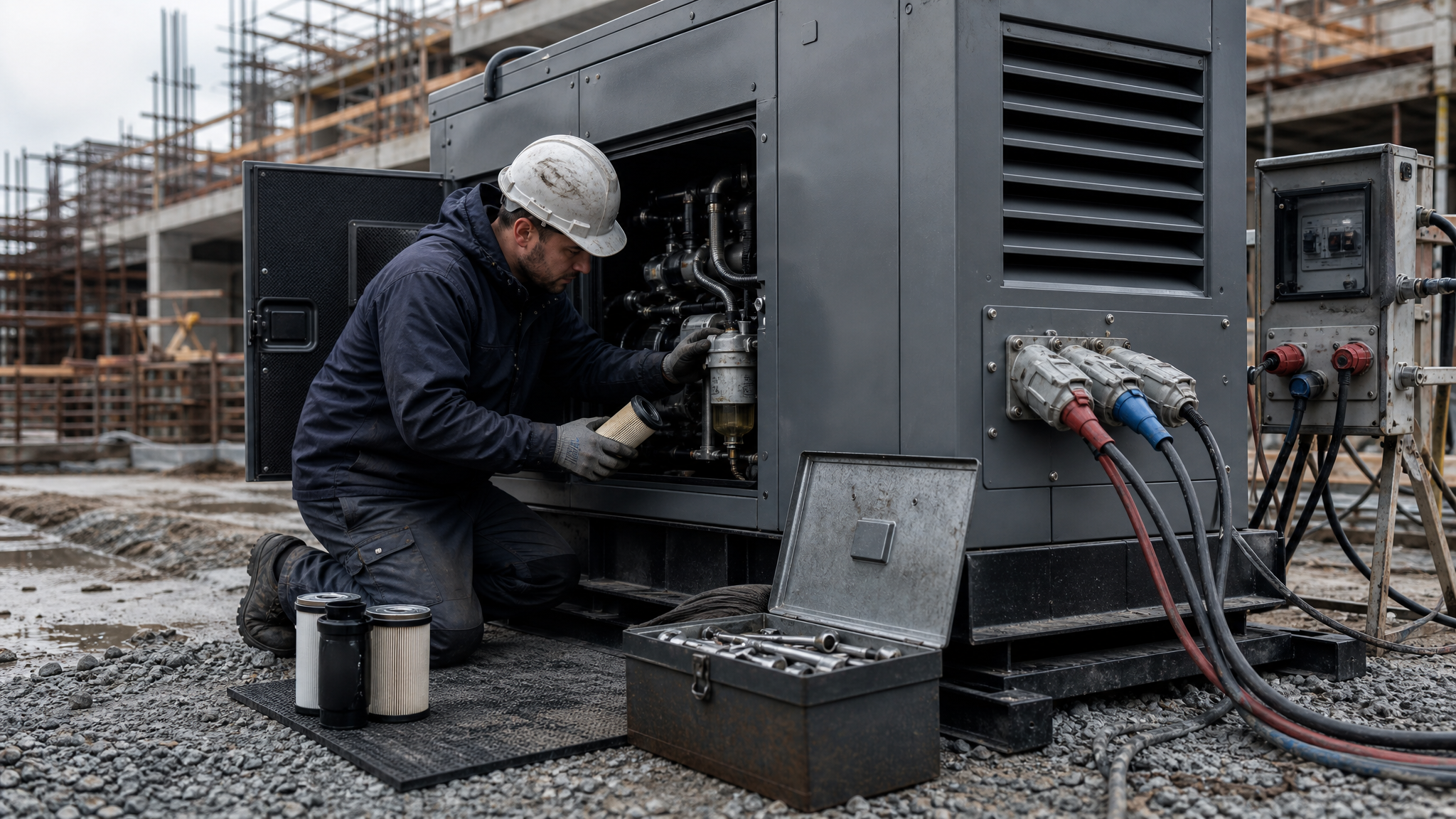
Most construction power failures are not generator failures. They are fuel failures, service failures or coordination failures — a tank that ran dry during a pour, a filter that was never changed, or a changeover that did not happen because nobody had tested it. The generator itself is usually the most reliable component in the arrangement.
This is the practical companion to the earlier guide on sizing site power for cranes, pumps and temporary facilities. Here the subject is everything around the generator: how fuel reaches it, how it is maintained through a programme that may last two years, and how redundancy is arranged so that a single fault does not stop the site. Shanghai Outevo Machinery Co., Ltd. builds these considerations into construction generator-set configurations within the 10–3,750 kVA range when applicable, because a package that ignores them is only half-specified.
Fuel is the largest consumable on a construction site and the easiest to mismanage. A generator running out of fuel does not simply stop: it draws air into the fuel system, requires bleeding, and may take hours to restart. On a site with a concrete pour in progress, that is a programme event.
The starting point is not tank size but the site's refuelling logistics: which vehicle can reach the generator position, how often, at what hours, and whether access will change as the build progresses. Storage should be sized so that the site can miss at least one scheduled delivery without interrupting production. On constrained inner-city sites with limited laydown area, that often means a day tank fed from a small bunded store rather than a large integral tank.
Any fuel storage on a construction site needs secondary containment sized for the volume stored, a filling procedure that prevents overfill, and a documented spill response. This is a legal and environmental requirement in most jurisdictions, and it also protects the project's relationship with the client and the neighbours.
Diesel stored for months in a site tank accumulates water and microbial growth. The symptoms appear as blocked filters, rough running and injector damage. Practical mitigation: draw fuel from the bottom of tanks periodically, fit water separators at the generator, keep tanks clean, and polish fuel where storage duration is long. Fuel quality is more often the cause of a "generator fault" on a two-year site than any mechanical defect.
| Fuel decision | Practical guidance |
|---|---|
| Tank location | Accessible to the refuelling vehicle, away from excavations and crane slewing zones, protected from impact. |
| Autonomy | At least one delivery interval plus a margin; longer for sites with restricted access hours. |
| Level monitoring | Visible local gauge plus a low-level alarm that reaches someone able to order fuel. |
| Filtration | Water separator and primary filter at the set; spare elements held on site. |
| Housekeeping | Bunded storage, drip trays, absorbent kit and a written refuelling procedure. |
Construction sites are hostile to maintenance because every hour of downtime competes with a trade that needs power now. The answer is not to ask the site to be more disciplined; it is to specify equipment whose routine service is quick, accessible and hard to postpone.
Filters, dipstick, oil drain, battery terminals, belts and coolant level should all be reachable from ground level through a door that opens fully in the position where the generator actually stands. A set installed with its service side against a hoarding is a set that will be maintained late.
Service intervals are defined in running hours with a calendar backstop, because a site generator may run intensively for three months and then sit idle. Consumables that should be held on site: engine oil, coolant, primary and secondary fuel filters, air filter elements, belts, and at least one battery. A site that has to order a filter when it needs one loses more in downtime than the filter costs.
Construction teams rotate. A simple log — running hours, fuel added, service performed, alarms observed — is the only reliable continuity. Where the generator has a controller with event history, that history should be exported at each service and kept with the project records, because it is the evidence used in any warranty discussion.
A generator that starts and runs at 20 percent load proves very little. Periodic load testing at a meaningful load level verifies that the cooling system, fuel system and protection settings work under real demand. On sites where the generator is lightly loaded for long periods, load testing also helps keep the engine healthy.
Redundancy is frequently requested and rarely defined. "We need a backup" can mean anything from a spare rental contact to a fully paralleled N+1 system. The right level follows from three questions: what stops if power fails, for how long that is tolerable, and what the site is able to operate under pressure.
A single generator with a defined connection point for a rental unit and a known supplier. Adequate when a stoppage costs time but not safety, and when mobilisation is realistic. The requirement is that the connection point, cable size and changeover method are prepared in advance.
Two generators, one running, one available, with a manual or semi-automatic changeover. Simple, robust and well understood by site electricians. It requires both units to be maintained, and a written procedure for the changeover that has been practised.
An automatic transfer switch brings the standby unit online when the main source fails. This is appropriate where power loss has immediate safety or programme consequences — hoists, dewatering, occupied accommodation. The critical detail is testing: an ATS that has never been proven under load is an assumption, not a safeguard.
Units operating in parallel share load and can be dispatched to match demand. This delivers the best fuel efficiency and the most graceful degradation on large or long programmes, at the cost of control complexity. It requires compatible machines, proper protection and synchronising, and an operating philosophy that the site team understands.
On a real site, the generator is shared. The crane contractor, the concrete subcontractor, the dewatering subcontractor and the site management team all draw from the same distribution. Without coordination, the peak that was designed for never matches the peak that occurs.
These are management measures, but they prevent more outages than most technical upgrades. A generator cannot compensate for an unmanaged distribution system.
Construction power demand is seasonal in most climates. Winter adds temporary heating and lighting load; summer adds cooling and dust; the wet season adds dewatering. A generator selected on a dry-season load list may be marginal in the wet season, and the reverse is equally common.
At the end of the project, load falls sharply as trades demobilise and permanent power is energised. A large generator running at very low load for the final months is inefficient and hard on the engine. Planning an early step-down to a smaller unit — or transferring temporary facilities to the permanent supply as soon as it is available — is a simple cost and reliability measure that is frequently overlooked.
Suppliers can only engineer what they are told. A construction power enquiry that produces a useful answer includes: the programme and phase durations, the largest motors and their starting methods, the coincidence assumptions, the site's ambient and dust conditions, noise constraints and permitted hours, the refuelling arrangement, the required redundancy level, and the electrical interface at the site boundary.
Shanghai Outevo Machinery Co., Ltd. works from exactly this information. Because the company is project-oriented, the deliverable is a configured generator-set package with the fuel strategy, service plan, redundancy arrangement and electrical interface stated alongside the rating — the parts of the specification that determine whether the site stays powered through the busiest month of the programme.
Enough to cover at least one full delivery interval with margin, based on the site's realistic refuelling access. Sites with restricted delivery windows need proportionally more storage.
Service intervals follow running hours with a calendar backstop, per the manufacturer's schedule for the specific engine. Dusty or heavily loaded sites may need shorter intervals, which is why records of running hours and conditions matter.
If the site depends on the generator as its only source, the unit is prime power duty regardless of how it was marketed. Duty definition must match how the equipment is actually used.
Only if they are compatible in voltage, frequency, phase sequence and protection, and if the paralleling controls are designed for it. Mixing arbitrary rental units is a common cause of unstable parallel operation.
Fuel contamination and fuel exhaustion, missed service, and overload caused by uncoordinated load additions. Mechanical failure of a correctly maintained set is comparatively rare.
Configurations typically cover 10–3,750 kVA when applicable to the project scope, with the rating determined by the load study, duty and site conditions.
Send Shanghai Outevo Machinery Co., Ltd. your construction power requirements — programme, loads, site conditions, refuelling constraints and redundancy expectation. We will return a package proposal that covers the generator configuration together with the fuel, service and changeover arrangements, so the power system is planned as one system rather than assembled from separate purchases.

Shanghai Outevo Machinery Co., Ltd. provides custom power supply solutions for industrial applications. Our diesel generator sets deliver reliable, stable electricity with 24/7 production and nationwide support. Request a quote today.
Copyright © Shanghai Outevo Machinery Co., Ltd Privacy Policy


