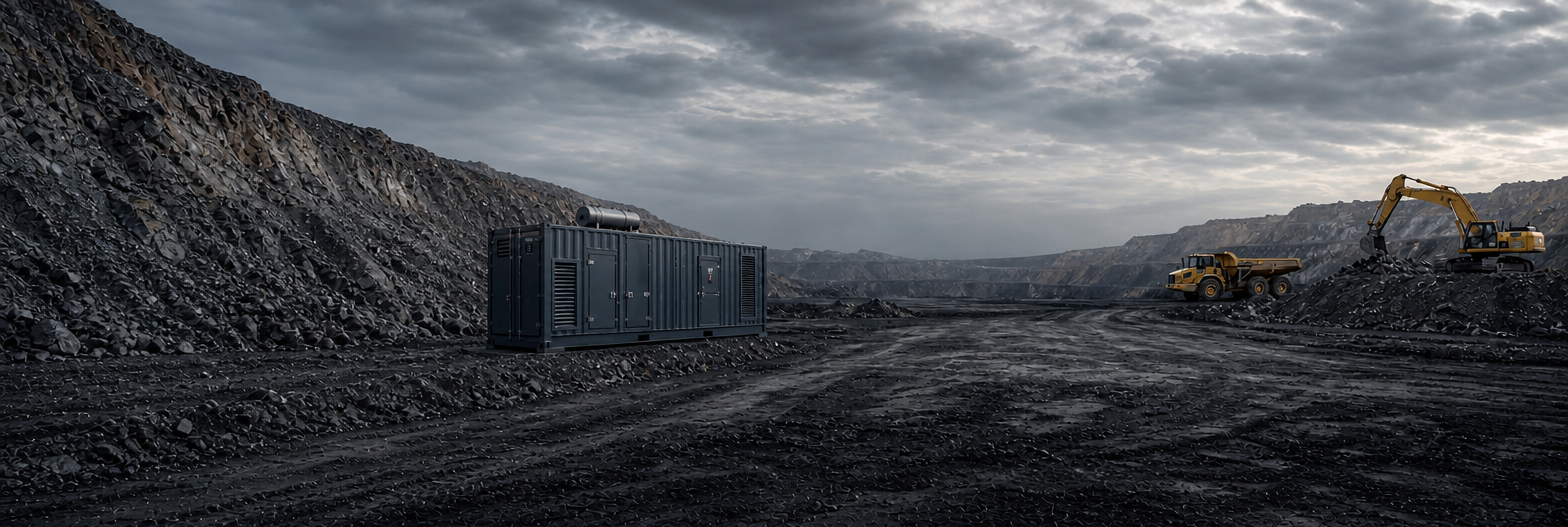
Why mining generator sets lose capacity at altitude and high ambient: engine derating, cooling packages, multi-stage filtration, enclosure airflow and service.
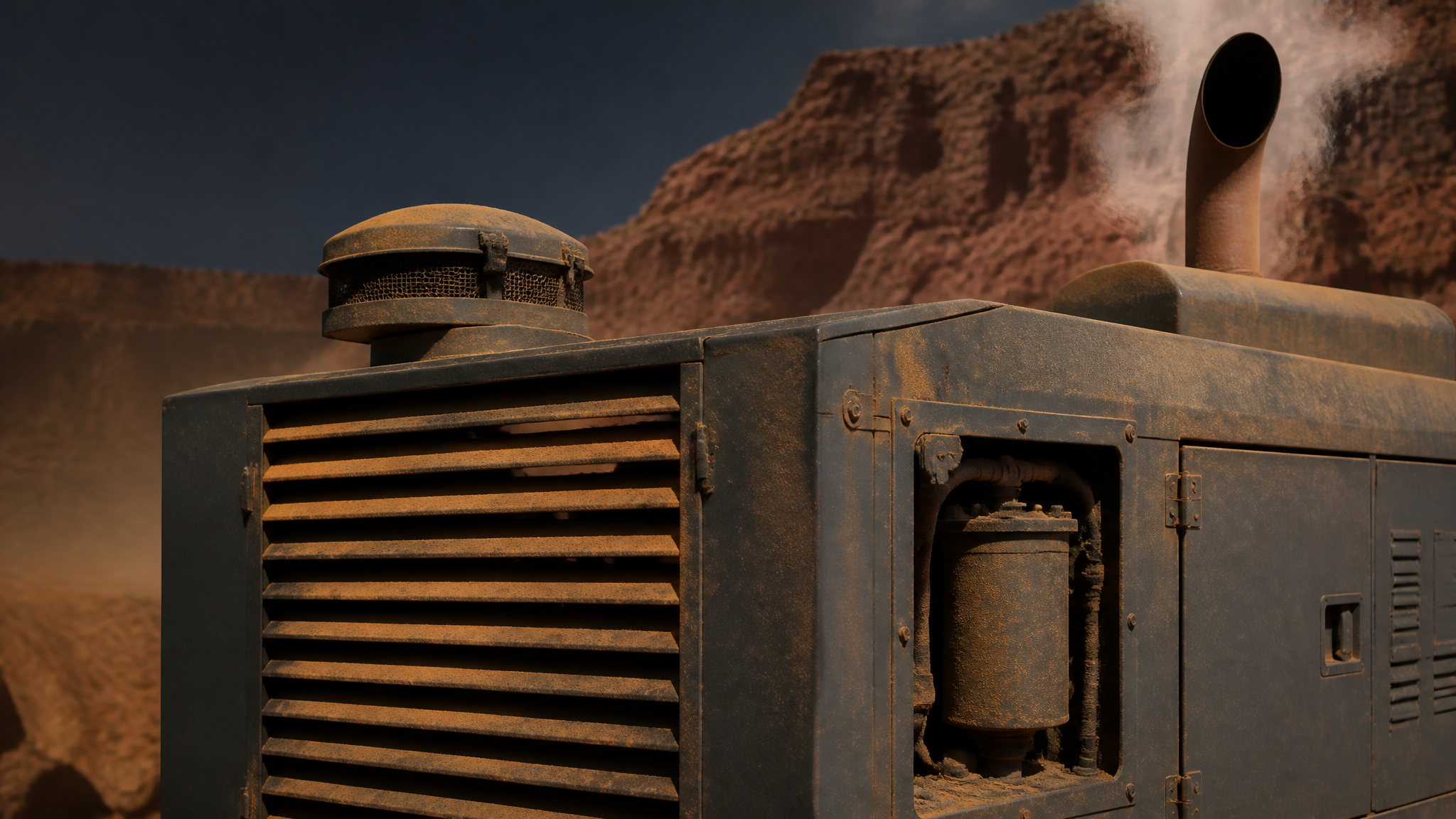
Two generator sets with the same nameplate rating will not deliver the same output in a mine at 2,000 metres in 45 °C dust and in a coastal workshop at sea level. This is not a marketing nuance. It is arithmetic: an engine needs a mass of air to burn fuel, a cooling system needs a mass of air to reject heat, and a filter needs clean air to keep doing its job. Dust, heat and altitude attack all three at once, and the resulting loss of usable capacity is usually larger than the margin a project team assumed it had.
Shanghai Outevo Machinery Co., Ltd. engineers generator-set packages for mining and construction duty within the 10–3,750 kVA range when applicable, and for these environments the configuration discussion starts with site conditions rather than with a rating. This article sets out what a buyer or project engineer should require from a supplier, and what should appear in the specification, before a mining generator set is selected.
Air density falls with altitude. A naturally aspirated engine loses roughly in proportion to the drop in air mass; turbocharged engines recover part of the loss but do not eliminate it. The cooling system suffers the same problem from the other direction: thinner air carries less heat away per cubic metre of fan flow, so the radiator's effective capacity falls even as the engine produces more heat per unit of output.
The engineering consequence is that a generator set must be selected against site conditions, not catalogue conditions. The correct method is to obtain the manufacturer's altitude and temperature derating data for the specific engine and cooling package and apply it to the design ambient at the site altitude. Rules of thumb applied at tender stage are the main reason projects discover a capacity shortfall during commissioning.
Altitude also affects the electrical side in ways that are often overlooked: air is the insulating medium and the cooling medium inside the alternator, and reduced density reduces both dielectric strength and heat transfer. For high-altitude sites the alternator's altitude rating and the enclosure's ventilation design deserve explicit confirmation rather than assumption.
| Altitude consideration | What to confirm in the offer |
|---|---|
| Engine output | Derated output at site altitude and design ambient, by engine model, stated as a table rather than a percentage. |
| Cooling package | Radiator and fan selected for the altitude and ambient, with the resulting heat rejection margin stated. |
| Alternator | Altitude and temperature rating of the alternator, including insulation class implications. |
| Starting | Cold and altitude effects on cranking and on the fuel system, particularly for mechanical governors. |
| Enclosure | Airflow path and filter area adequate for the reduced density, without recirculation. |
Every generator set has a design ambient. Above it, the engine's combustion efficiency and the cooling system's capacity both degrade, and protection systems begin to act. A unit rated at a standard reference ambient may need a materially lower continuous output at a pit floor that reaches 45–50 °C in the sun, especially where the enclosure is close to a hot surface or where hot exhaust is recirculated.
Three practical measures reduce the exposure. First, position the set so that intake air is drawn from the coolest available side and exhaust is discharged away from the intake, with enough separation that recirculation cannot occur. Second, specify an enclosure whose ventilation openings and fan capacity were designed for the site ambient, not for a European workshop. Third, treat the radiator as a serviceable component: dust-loaded fins lose capacity long before the engine shows any other symptom, and a differential-pressure indicator or a defined cleaning interval is far cheaper than a derated set.
Heat also has a fuel and oil dimension. High ambient raises oil and coolant temperature margins, shortens lubricant life and increases the importance of correct coolant mixture and of verifying that the protection setpoints match the site rather than a generic template.
Mining dust is not uniform. It includes fine silica, abrasive grit, and in some operations reactive or conductive material. Its effects compound:
The specification response is a filtration and enclosure package matched to the measured dust environment, plus a maintenance regime based on observed restriction and inspection rather than a fixed calendar. It is also worth agreeing with the supplier what "dusty" means in measurable terms — for example, the site's typical airborne particulate level and the cleaning interval the design assumes — because "suitable for dusty environments" is not a specification.
Altitude, ambient temperature and dust do not act independently. A set at altitude in high ambient with a dust-loaded radiator may have usable capacity substantially below its nameplate figure, and the shortfall appears as an overtemperature shutdown under load rather than as an obvious failure. The correct sequence is:
If a supplier cannot provide steps 2 to 4 in writing for the specific model offered, the offer is not yet an engineering proposal.
The enclosure is often chosen last and matters most. On a mine it has to do five jobs simultaneously: keep dust and water out, let enough air in, attenuate noise where required, allow maintenance access, and survive transport and lifting.
Design details that separate a site-ready enclosure from a catalogue canopy include: separate combustion-air and cooling-air paths; a pre-cleaner or cyclone stage that can be emptied without tools; removable or hinged panels that give access to filters, belts, batteries and drain points; a bunded base for fuel and oil containment; lifting points rated for the fully fuelled weight; and corrosion protection appropriate to the site's humidity and any saline or chemical exposure. Where the site requires a stated ingress protection class, that class must be verified on the delivered configuration — including cable entries and door seals — not merely asserted for the product family.
Most environmental failures on mining generator sets are maintenance failures with an environmental trigger. Three behaviours prevent the majority of them: checking the restriction indicator and cleaning the pre-cleaner at every shift; keeping the area around the intake clear of stockpiles, trucks and hot surfaces; and recording ambient temperature and load so that a pattern of summer afternoon shutdowns can be diagnosed before it becomes a failure.
Where a site has multiple units, a simple log of ambient temperature against load and any high-temperature alarms gives the maintenance team evidence to adjust cleaning intervals and, if necessary, to revisit the derating assumptions with the supplier.
The loss depends on the engine, its aspiration type and the altitude, and it must be taken from the manufacturer's derating data for the specific model. This is why an offer should state derated output at the site's design altitude and ambient rather than a generic percentage.
Yes. Alternator output is limited by winding temperature, so ambient temperature and altitude both affect usable electrical output, and the alternator's ratings should be checked against the same site conditions as the engine.
Multi-stage filtration with a serviceable pre-cleaner and a restriction indicator is the practical baseline on pit duty. The exact configuration should follow the measured dust environment and the maintenance interval the site can sustain.
Yes, if the enclosure's ventilation and cooling were designed for the site ambient. Adding acoustic treatment to a standard canopy without re-engineering airflow is a common cause of overheating.
The interval should follow observed restriction and inspection findings. Cleaning the pre-cleaner each shift and inspecting the radiator core at defined intervals is a reasonable starting point that can be adjusted with operating evidence.
Outevo configurations typically cover 10–3,750 kVA when applicable, with the delivered rating set by the load study and the site derating basis rather than by nameplate alone.
Share your site altitude, design ambient temperature, dust conditions and load list with Shanghai Outevo Machinery Co., Ltd. We will return a configuration proposal that states the site-rated output, the cooling and filtration basis, the enclosure specification and the maintenance assumptions — the four items that decide whether a mining generator set performs in the second year, not just on the day it is commissioned.

Shanghai Outevo Machinery Co., Ltd. provides custom power supply solutions for industrial applications. Our diesel generator sets deliver reliable, stable electricity with 24/7 production and nationwide support. Request a quote today.
Copyright © Shanghai Outevo Machinery Co., Ltd Privacy Policy


