Planning construction site power: tower crane and concrete pump starting loads, dewatering pumps, temporary facilities, distribution and changeover strategy.
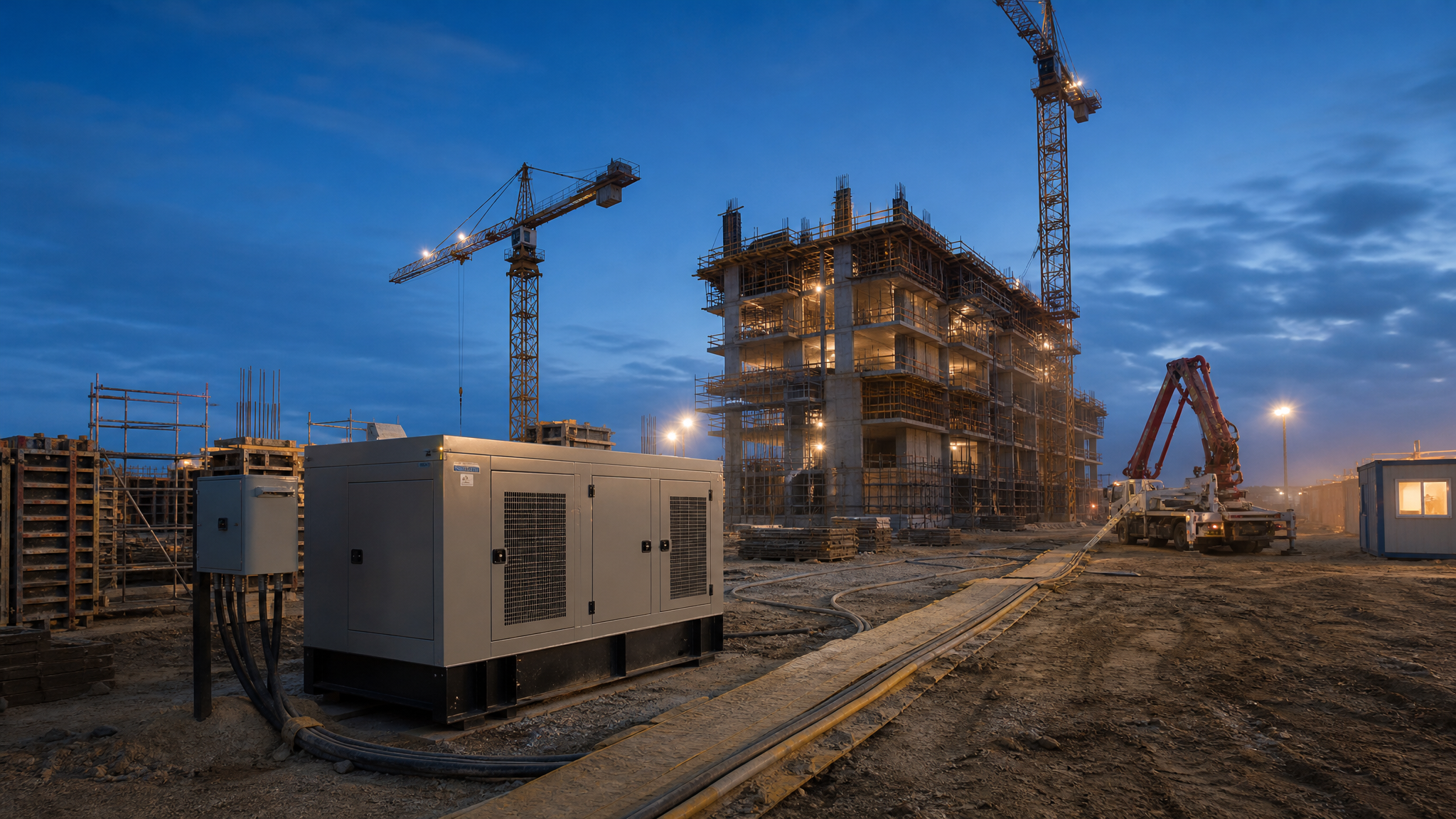
A construction site is the only kind of industrial facility that is designed to disappear. Its power system must arrive before the first crane is erected, run through excavation, structure, envelope and fit-out, and then be removed without leaving a fault behind. That life cycle produces a very specific set of engineering requirements, and it is why generator sets for construction sites are rarely specified well by copying a factory backup specification.
Tower cranes, concrete pumps, dewatering pumps, hoists, welding sets and temporary facilities do not share a single load profile. They share a schedule. On any given day the site may need a few hundred kilowatts at one moment and very little the next, and the peak is usually created by a small number of large motors starting at the same time rather than by steady demand. Shanghai Outevo Machinery Co., Ltd. configures diesel and gas generator sets for construction applications within the 10–3,750 kVA range when applicable, and the useful planning work happens well before a rating is chosen.
The most reliable way to plan site power is to walk the programme. Each phase has a different dominant load, a different location for the generator, and a different consequence if power fails.
| Phase | Dominant loads | Power planning implication |
|---|---|---|
| Enabling works and piling | Piling rigs, pumps, lighting, site offices | Generator is close to the boundary; noise and exhaust are the sensitive issues. |
| Excavation and dewatering | Excavator support, dewatering pumps, ventilation, lighting towers | Highly variable load; pumps restart frequently and often remotely. |
| Structure | Tower crane, concrete pump, hoists, welding, rebar cutting | Highest motor-starting content; crane and pump may start within seconds of each other. |
| Envelope and services | Hoists, compressors, small tools, temporary heating or cooling | Load falls but utilisation becomes erratic; efficiency matters more than capacity. |
| Fit-out and handover | Test loads, temporary power for commissioning, site office and security | Clean, stable power for electronics and commissioning tools; low load factor. |
Once the sequence is written down, capacity decisions become traceable. A generator sized for the structure phase will be lightly loaded during enabling works; the question is whether the site can accept that, or whether a two-unit arrangement with one unit idle is the better operational answer.
A tower crane is not a steady load. Slewing, trolleying and hoisting are separate motions with separate motor characteristics, and the hoist is normally the dominant one. The relevant data for power planning is the hoist motor rating, the starting method, the number of motions that can run simultaneously and the crane's duty class.
Two practical points are routinely missed. First, the crane's electrical demand is highest during acceleration with a rated load, not during steady lifting, so a generator evaluated only against "crane kW" will be optimistic. Second, modern cranes with variable-frequency hoist drives present a much friendlier load to the generator than older contactor-controlled cranes, but they also inject harmonic content that can affect other equipment on the same bus. The specification should therefore state the drive type and the expected harmonic environment, not just the motor rating.
Where more than one crane shares a site, the coincidence assumption must be agreed with the lifting contractor. Two cranes starting hoists within the same few seconds is a normal site event, and it is the event that determines the generator's transient response requirement.
A trailer or truck-mounted concrete pump runs a large hydraulic power pack. During a pour it is essentially continuous load for hours, which makes it the load most likely to thermally load the generator rather than transiently disturb it. The planning implications are different from the crane: the generator needs sustained capacity at the site's ambient temperature, adequate cooling air flow in a congested site compound, and a fuel autonomy that covers a full pour without a refuelling interruption.
Pours also tend to be scheduled early and to involve several subcontractors at once, so the pump, the vibrators, the crane and the site offices are all running. That coincidence — not the pump alone — is the design case.
Dewatering is the load that site teams notice last and depend on most. A sump pump that trips during a storm can cost a week of programme. Because these pumps are often controlled by float switches or telemetry, they start without warning and without an operator present. A generator that is already carrying crane and pump load must absorb that step change without nuisance tripping of variable-frequency drives, soft starters or sensitive electronics.
There are three design responses: limit the size of any single step load relative to generator capacity, stagger pump starts through controls, or specify a generator with better transient performance and verify it during commissioning with a real step-load test. The third option is the most honest, because it is measurable.
Site offices, canteens, drying rooms, security cabins, server and communications equipment, cabin lighting and welfare facilities are small individually and collectively persistent. They are also the loads most sensitive to voltage and frequency variation, and the loads most likely to be forgotten in a load schedule because they are not part of the production process.
Two consequences follow. First, temporary facilities should be on a distribution board that can be transferred to a smaller generator or to the permanent supply early, so the main construction generator is not kept alive solely for office load at the end of the project. Second, earthing and residual-current protection for temporary distribution must be designed for a site that is wet, dusty and full of metal — this is a safety architecture question that sits alongside the generator specification, not behind it.
On a construction site the distribution system is as important as the generation. Long cable runs to a crane base or a sump produce voltage drop that is often mistaken for generator weakness. Poor phase balance on a three-phase generator — caused by single-phase site tools and lighting distributed carelessly — produces negative-sequence current, additional heating and reduced usable capacity.
Urban construction sites face restrictions that have nothing to do with engineering: night-time noise limits, exhaust emission expectations, and the practical reality of residents with mobile phones. A generator set that is technically adequate can still be unusable if it cannot run at the hours the programme requires.
The planning response is to define the site's noise-sensitive boundaries, the permitted operating hours, and the required acoustic treatment for the generator location. Where a project has to run at night, an acoustically treated enclosure with a correctly designed exhaust system is normally the difference between a permitted site and a complaint. Enclosure choice also affects cooling and service access, so it should be decided with the generator configuration rather than added afterwards.
Construction fuel planning is different from plant fuel planning because the refuelling point moves and access changes weekly. Two approaches work: a generator-mounted tank sized for a defined refuelling interval that site logistics can actually meet, or a small day tank fed from a bunded bulk store with a transfer pump and level alarm.
Whatever the arrangement, three requirements should be explicit in the specification: bunding or spill containment, a fuel polishing or filtration arrangement appropriate to the storage duration, and a low-fuel alarm that reaches someone who can act on it. Sites that run generators to empty and then bleed the fuel system lose more hours to that single failure mode than to any other.
Not every construction site needs redundancy, but every site needs a stated position on it. A pragmatic framework:
Whichever model is chosen, the changeover hardware, protection settings and operating procedure should be documented and tested. An untested automatic transfer system is a single point of failure disguised as redundancy.
The construction power system is a temporary asset, which makes documentation easy to skip and expensive to lose. A practical handover pack contains the single-line diagram, protection settings, the commissioning record including load tests, the operating procedure, the maintenance schedule and the fuel and spill procedure. On demobilisation, that same pack supports safe isolation, removal and any transfer of the equipment to the next project.
Because site power often transfers between projects within the same contractor group, the commercial case for a well-documented, robustly built generator set is stronger than it first appears. Equipment that survives one site with clean records is far easier to redeploy than equipment that arrives at the next site with a mystery fault history.
Size is the output of a load schedule that includes starting currents, coincidence assumptions and the construction phase being powered. Two sites with the same crane capacity can need very different generators if one uses variable-frequency hoists and the other uses contactor control.
Often yes, but only if the coincidence and starting behaviour were part of the sizing calculation and verified during commissioning. The limit is usually transient response and motor starting, not steady-state capacity.
Requirements follow local rules and the sensitivity of nearby buildings. What matters practically is that the acoustic specification is defined before the unit is ordered, because enclosure and exhaust design affect cooling and access.
The earthing and protection philosophy must be designed as a system — generator neutral arrangement, distribution board protection, and equipotential bonding of crane structures and metalwork. It should be documented and inspected, not inferred on site.
Configurations typically fall within 10–3,750 kVA when applicable to the project scope, with the final rating set by the load study, site conditions and duty.
Yes, and this is a common purchasing rationale. Redeployment is far simpler when the unit has a documented service history, a standard electrical interface and an enclosure suited to transport.
Send Shanghai Outevo Machinery Co., Ltd. your construction programme, crane and pump data, dewatering arrangement and the site's noise constraints. Our team will return a generator configuration with the load basis, starting-performance assumptions, enclosure and fuel strategy and changeover philosophy stated explicitly, so procurement can compare offers on the same engineering foundation.

Shanghai Outevo Machinery Co., Ltd. provides custom power supply solutions for industrial applications. Our diesel generator sets deliver reliable, stable electricity with 24/7 production and nationwide support. Request a quote today.
Copyright © Shanghai Outevo Machinery Co., Ltd Privacy Policy


