
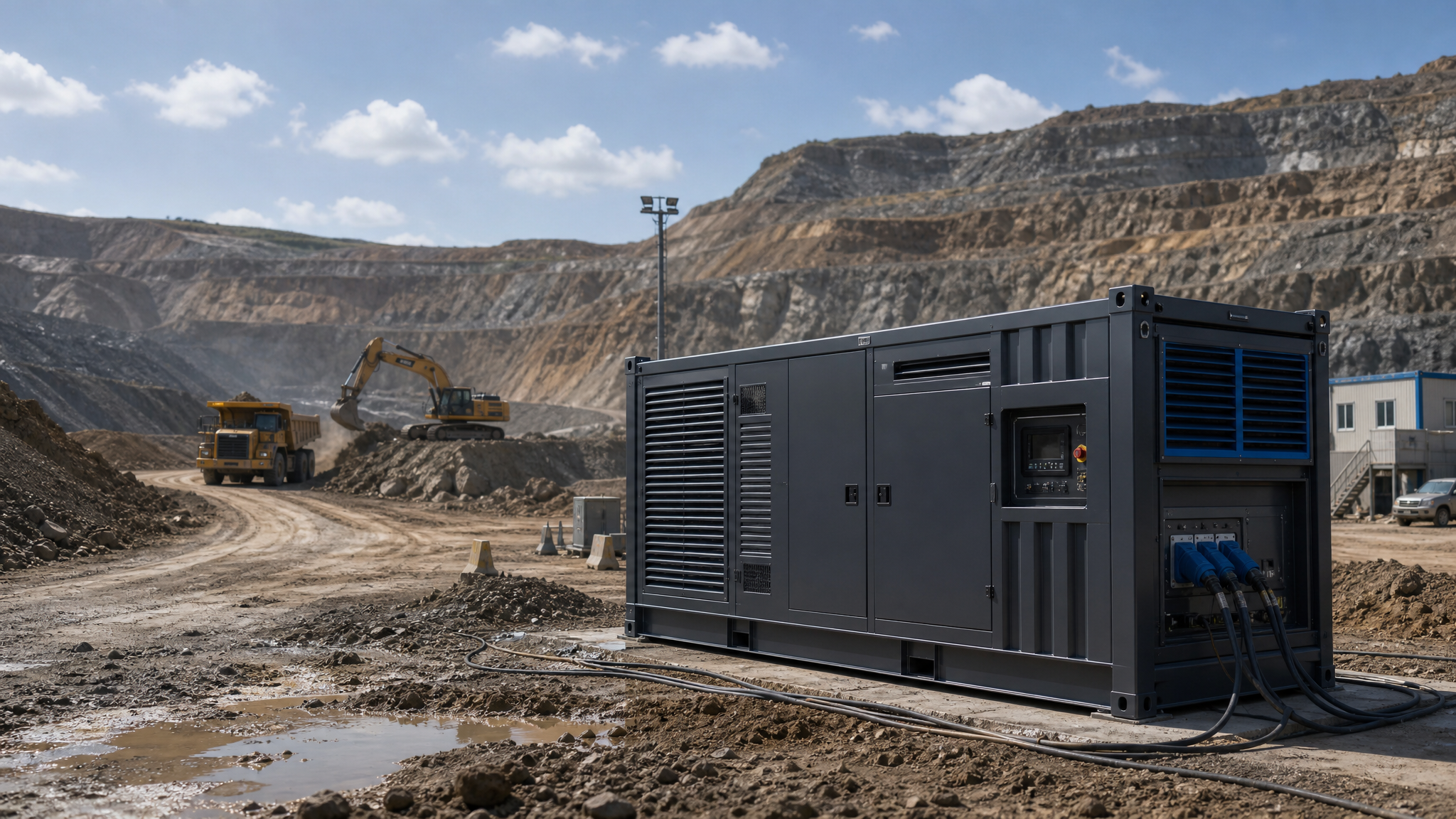
Generator sizing for mining and construction sites is not a matter of choosing the largest set the budget allows. On a remote site the wrong rating shows up months later, either as a set that runs at a quarter of its capacity, glazes its cylinders and needs a rebuild, or as a set that trips the moment a crusher starts and leaves the camp without power. Sizing is a short engineering exercise built from three inputs: a load list, a starting study and a duty decision. It has to be finished before the purchase order, not after commissioning.
This guide follows the method used when a project team sends over a load schedule: how to build the list, how motor starting changes the required kVA, how duty and site conditions modify the nameplate rating, and what to write into the specification so that every supplier quotes the same machine you have designed.
Start With a Load List, Not a Rule of Thumb
Rules of thumb such as "twice the largest motor plus the rest of the load" are useful for a first sanity check and useless for a purchase decision. A working load list records, for every consumer on site, the rated kW, power factor, efficiency, starting method, starting current multiple, daily running hours and whether the load is critical.
- Continuous loads. Camp air conditioning, lighting, pumps, conveyors, ventilation and workshop machines that run for most of the shift. These set the base load the plant will carry for hours at a time.
- Intermittent loads. Welders, compressors, hoists, mixers and crushers that cycle. Their contribution is usually assessed as a diversity-weighted block rather than a simple sum.
- Standby and emergency loads. Fire pumps, life safety systems, control rooms and communications. These define the minimum load the plant must never drop.
- Future loads. The next production line, a second camp block, a dewatering stage. Naming them early is what makes a staged plant possible later.
The list should also state the power factor the site actually operates at. A plant sized only on kW and then asked to carry a low power factor load will run out of alternator kVA before it runs out of engine kW, and the alternator becomes the limiting component.
Why Starting kVA Decides the Rating More Often Than Running kW
An induction motor draws several times its rated current while accelerating. A load list that adds running kW only will understate the transient demand, and the generator will either refuse to accept the load or recover so slowly that contactors drop out and variable speed drives trip on undervoltage.
The starting study should identify the largest starting step and the total step that may occur at the same time, then check the transient voltage dip the site can tolerate. Control systems, drives and IT equipment are far less forgiving than lighting and heaters, so the acceptable dip is usually defined by the most sensitive load, not by the largest one.
How the starting method changes the answer
- Direct-on-line starting draws the full locked rotor current and produces the largest dip. It is simple and cheap, and it drives the generator rating up faster than any other single decision.
- Star-delta and soft starting reduce the initial current but lengthen the acceleration time, which keeps reactive demand on the alternator for longer.
- Variable speed drives limit starting current to close to running current, but they introduce harmonics and a rectifier front end that the alternator must be able to supply. Drive loads deserve a separate conversation with the genset supplier.
- Staggered starting is free. Sequencing the largest motors so they never start together often removes the need for a bigger set altogether.
Prime Power, Standby or Continuous: Duty Changes the Rating
The same generator set carries different ratings depending on how it is used, and the difference is not a marketing detail. A standby rating assumes limited hours per year at variable load with a reliable utility supply for the rest of the time. A prime power rating assumes unlimited hours at variable load, which is the normal duty for a mine camp, a construction site or a remote facility without a grid.
Specifying a standby-rated set for continuous site power is one of the most common and most expensive mistakes in project procurement. The set will run, but it will run hot, at a rating it was never designed to hold, and the engine life will be measured in a few thousand hours instead of tens of thousands.
The third decision is the loading band. Diesel engines prefer to work. A set that spends its life below roughly 30 to 40 percent load suffers wet stacking, carbon build-up and poor fuel consumption per kWh, while a set pushed to its limit for long periods has little margin for a hot day or a blocked radiator. Aiming the base load at around 60 to 80 percent of the prime rating leaves room for starting surges in both directions.
Site Conditions That Reduce Available Output
A rating on a datasheet is normally referenced to standard conditions. The site is rarely standard, and the corrections should be applied before the machine is selected.
- Ambient temperature. High ambient air reduces engine output and, more importantly, reduces the cooling system margin. A set selected for a temperate climate and installed in a desert summer will derate exactly when the load is highest.
- Altitude. Thin air reduces combustion air mass and cooling capability. Sites above roughly 1,000 m need a correction applied to both engine rating and radiator performance.
- Enclosure and room design. A silent canopy or a container power station restricts airflow. The enclosure must be matched to the set, with defined inlet and outlet areas and a hot air path that does not recirculate into the intake.
- Fuel temperature and quality. Hot fuel and contaminated fuel both reduce available power. On remote sites this is a fuel management issue as much as an equipment issue.
- Dust, humidity and salt. These do not change the kVA figure directly, but they set the filtration, corrosion protection and enclosure specification that determine whether the rating is still available two years later.
Planning for Growth Without Oversizing on Day One
Construction and mining projects grow in stages, and the power plant should grow with them. Two approaches work in practice. The first is to select a set with a defined growth margin, typically 20 to 30 percent above the calculated demand, and to verify that the enclosure, cabling and switchgear can accept the larger unit later. The second is to design the plant for modular expansion, starting with one set and adding a second in parallel when the load justifies it.
The modular route costs more upfront in switchgear and controls, but it avoids the situation where a single oversized set runs for years at a load it was never happy with, only to be replaced when the site doubles in size. The decision should be recorded in the sizing document with the load figure that will trigger the expansion.
Sizing Mistakes Seen Most Often on Site
- Sizing from a similar project. A camp in one country is not a camp in another. Altitude, ambient and load profile differ.
- Ignoring the largest starting step. The steady-state calculation looks comfortable and the plant still trips on the first crusher start.
- Forgetting auxiliary loads. Fuel transfer pumps, jacket water heaters, battery chargers, cooling fans and enclosure lighting all draw from the same source.
- Assuming the utility will always be there. Where the grid is weak, the genset becomes prime power whether the specification says so or not.
- Leaving the interface undefined. The boundary between generator breaker, changeover and site distribution is where most late-stage scope disputes begin.
What to Put in the Sizing Document
A one-page sizing document, issued with the enquiry, removes most of the ambiguity from the quotation stage:
- The load list with kW, kVA, power factor and duty for each block.
- The largest starting step, the acceptable voltage dip and the starting method assumed.
- The required duty rating: standby, prime or continuous, with expected annual running hours.
- Site conditions: ambient temperature range, altitude, humidity, dust and enclosure requirement.
- The growth margin and the trigger point for a second unit.
- The electrical interface: voltage, frequency, neutral arrangement, changeover or paralleling requirement.
When this document is clear, quotations become comparable and the technical review turns into a check of the supplier's corrections rather than a debate about assumptions.
FAQ: Generator Sizing for Construction and Mining
Is a bigger generator always safer?
No. A set that is significantly oversized runs at low load, which causes incomplete combustion, wet stacking and higher maintenance. It also costs more to buy and to fuel. The safe choice is a set sized to the load with a defined margin and a duty rating that matches the application.
How much margin should be allowed for future expansion?
A margin in the region of 20 to 30 percent above the calculated demand is a common starting point, provided the switchgear and enclosure can accept the larger unit later. On staged projects, modular paralleling is often a better answer than a single large margin.
Can one generator set start several motors at once?
It can, if the starting study shows the voltage dip stays within the tolerance of the most sensitive load. Where it does not, stagger the starts, change the starting method for the largest motor, or increase the alternator rating rather than the engine rating.
Does an enclosure reduce the generator rating?
It can. A canopy or container restricts airflow, so the cooling and combustion air paths must be designed for the set inside it. The enclosure should be specified together with the set, not added afterwards.
A sizing document built this way gives every supplier the same basis, makes the technical comparison meaningful, and leaves the site with a power plant that matches the work it has to do for the next ten years rather than the first month.
Table of Contents
- Start With a Load List, Not a Rule of Thumb
- Why Starting kVA Decides the Rating More Often Than Running kW
- Prime Power, Standby or Continuous: Duty Changes the Rating
- Site Conditions That Reduce Available Output
- Planning for Growth Without Oversizing on Day One
- Sizing Mistakes Seen Most Often on Site
- What to Put in the Sizing Document
- FAQ: Generator Sizing for Construction and Mining
