How to Choose a Container Generator Set for European Logistics and Warehousing Centres
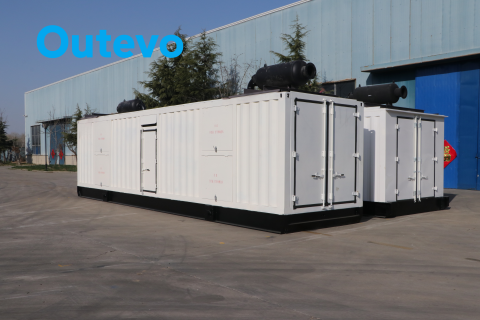
1. Reliable and Transportable Power Solutions
Logistics and warehousing centres in Europe need power that can respond quickly and run reliably. Cold stores, reefer containers, sorting lines, loading bays, gate systems, and security equipment cannot afford long interruptions. A container generator set is often a practical choice because it arrives as a complete, weatherproof, and transportable power station. It can be placed beside a warehouse, in a yard, or near a temporary loading area without major civil work.
2. Accurate Power Selection and Specifications
Power selection should start with the actual load, not only the nameplate rating of the building. For reefer containers, a 15 kW clip-on or undermount genset is usually sufficient. For warehouse standby power, cold stores, sorting equipment, and temporary yard operations, a 20ft or 40ft containerized diesel set is more suitable. A 20ft container generally suits roughly 200–1,000 kVA, while a 40ft container is better for around 1,000–2,500 kVA, depending on engine size, fuel tank, ATS cabinet, and silencer layout. The buyer should confirm prime power, standby power, voltage, frequency, and starting current. European warehouses typically use 400V/230V 50Hz three-phase supply, but the exact requirement should be checked for the destination country.
3. Robust Structure and Sound-Attenuated Enclosure
The structure and enclosure matter as much as the engine. A good container set should be built from a modified ISO container with reinforced floor beams, anti-corrosion coating, sound-absorbing lining, weatherproof doors, and proper ventilation. For logistics sites near residential areas, a sound-attenuated design is important. A well-treated container can keep operating noise around 65–85 dB(A) at 1 m, depending on the power rating and acoustic package. The unit should also allow easy daily inspection, with wide access doors, internal lighting, spill containment, external fuel filling, and clear cable entry points.
4. Premium Components and Smart Control Functions
Engine brand, alternator, and control system should be chosen for long-term service rather than only for initial price. Common engine options include Cummins, Perkins, Volvo, Deutz, Doosan, and Weichai, while alternators such as Stamford, Leroy-Somer, and Mecc Alte are widely recognised in Europe. The control panel should support auto start/stop, ATS interface, remote monitoring, fault alarms, and load management. For sites with changing demand, parallel operation or dual-engine containers can improve fuel efficiency and reduce wear during low-load periods.
5. Essential Compliance and Documentation
Compliance should be confirmed before signing the order. For diesel generator sets entering the EU, CE marking under the relevant directives is normally required, and EU Stage V emissions compliance is often expected for new engines, especially in urban depots and environmentally sensitive locations. The container itself should carry CSC certification if it will be handled as a standard shipping unit. Buyers should ask for factory test reports, technical drawings, operation manuals, spare-parts lists, and warranty terms. These documents make customs clearance, site acceptance, and future maintenance much smoother.
6. Matching the Right Solution to Your Site
For European logistics and warehousing centres, the right container generator set is not only about kilowatts. It should match the real load profile, fit the site environment, meet European compliance expectations, and remain easy to maintain during peak operating seasons. A clear specification early in the process will save time, reduce risk, and make the final installation far more predictable.
