How open-pit mines specify generator sets: zone-by-zone load lists, motor starting, dust and altitude derating, fuel autonomy, redundancy and maintenance.
An open-pit mine does not buy electricity in the way a factory does. It buys availability. Every hour a pit runs without power is an hour of drilling, dewatering, crushing or loading that cannot be recovered, because the material movement plan is built around a fixed fleet, a fixed bench sequence and a fixed haul cycle. When a mine evaluates generator sets for open-pit mining operations, the real question is not "how many kilowatts do we need" but "which loads must never stop, which loads can be shed, and how much of the pit can we keep working while the power system is being maintained".
Shanghai Outevo Machinery Co., Ltd. supplies project-oriented diesel and gas generator-set solutions, with configurations typically in the 10–3,750 kVA range when applicable to the project scope. Mining work sits at the demanding end of that range, not because the kilowatt figure is always large, but because the operating environment, the load behaviour and the logistics are unforgiving. This guide sets out how a mining project team can move from an operational description of the pit to a generator-set specification that will still be defensible after the first year of operation.
Pit electrification is usually discussed as a single load, which is the first planning error. A working open-pit mine is better described as several electrical zones, each with a different duty profile, a different tolerance for interruption and a different distance from the point of generation.
Rotary drills, top-hammer rigs, hydraulic excavator auxiliary power, cable-reel handling and bench lighting. Drilling loads are motor-heavy and start frequently. The important characteristic is repeated motor starting on a generator that is already partially loaded, which produces voltage dip and can disturb controls and instrumentation on the same bus.
In-pit sump pumps, stage pumps and surface transfer pumps. Pumps are often the largest single continuous block of load in a wet pit, and they are frequently the load that decides whether the next bench can be opened. Pump duty is steady but seasonally volatile, and pump sets are usually started remotely, which means the generator must absorb a step load without warning.
Mobile or semi-mobile crushing, screens, conveyors and stackers. Conveyor starting is the classic high-inertia, high-current event in a pit power system. Crusher duty adds shock loading and frequent no-load running.
Workshops, fuel storage and transfer, water treatment, offices, canteen, accommodation, security and communications. Support load is individually small but never switches off, and it is the load most sensitive to poor power quality because it contains electronics, servers and refrigeration.
Once the pit is written down as zones, the specification conversation changes. Instead of one number, the project has a load table with a stated basis for each zone, and it becomes possible to decide which zones share a bus, which zones need an automatic transfer, and which zones can be dropped during a maintenance window.
A defensible load list records, for every significant item: rated input power, starting method, starting current characteristic, power factor, duty cycle, simultaneity with other loads, and whether the load is critical, essential or deferrable. For mining, three columns matter more than they do in commercial buildings.
Where a load list is incomplete, meter the pit. Recording actual demand across a full production cycle — including a wet period and a peak haul period — costs far less than correcting a generation package after installation.
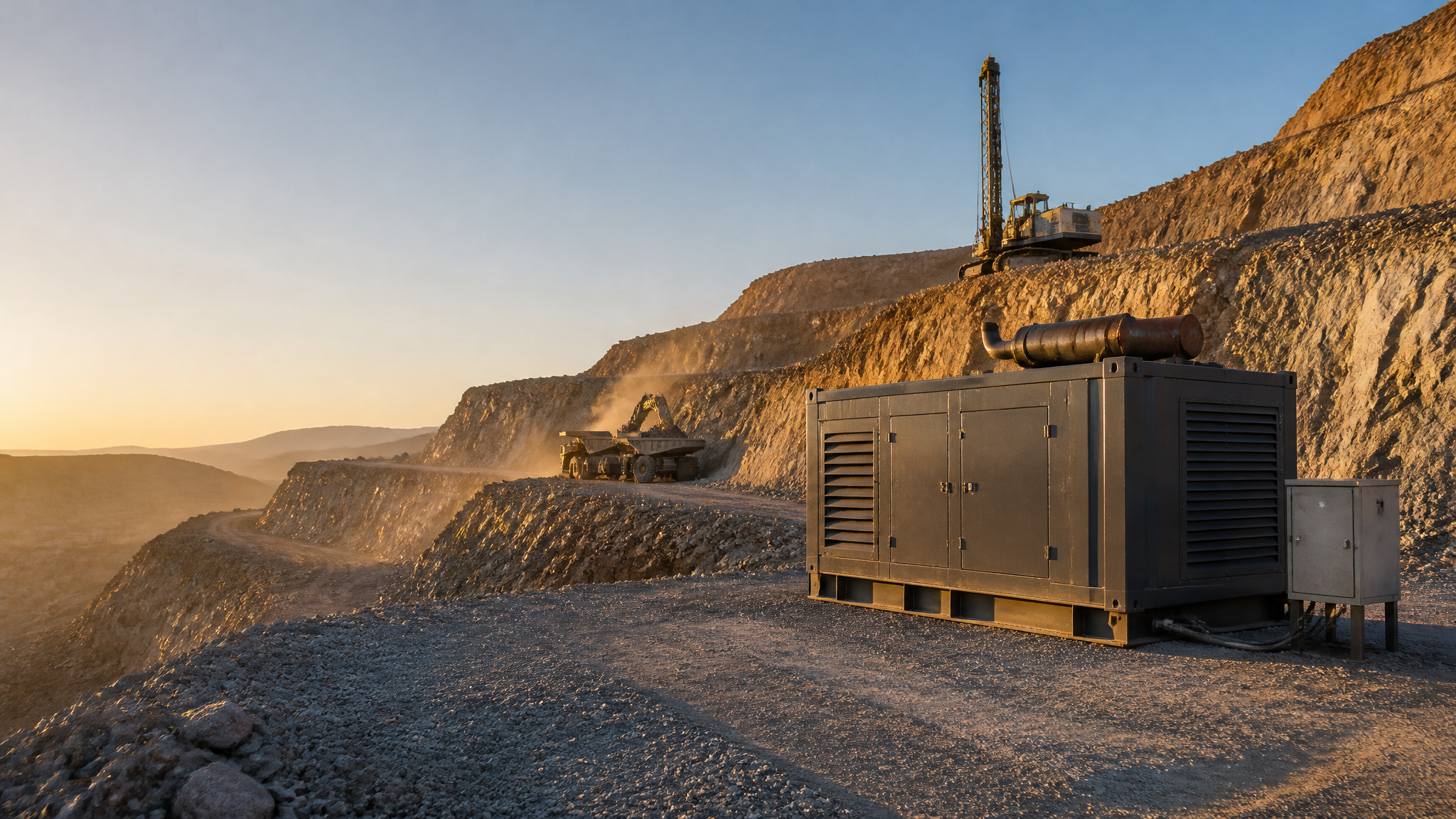
Open-pit dust is abrasive and electrically conductive when it settles on insulation and terminal blocks. A generator set in a pit needs an enclosure strategy, not just a canopy: sealed cable entries, filtered combustion air, a cooling package designed for a dust-loaded radiator and service access that does not require opening the whole enclosure in a wind. Where a project specifies a protection class for the enclosure, that class must be stated as a project requirement and verified against the delivered configuration rather than assumed from a product family name.
Fuel autonomy is an operational decision. A generator set that must be refuelled every shift adds a fuel truck movement on haul roads, a driver, a spill risk and an exposure to weather. A larger on-board tank or a bunded day tank with an automatic transfer from bulk storage changes the operating model. The engineering question is to fix a refuelling interval that the site can actually sustain in the wet season, then size tankage to that interval with margin.
Pit floors are hot, and many mines sit at altitude. Both reduce the air mass available for combustion and cooling, which reduces the usable output of any engine-driven generator. The correction must come from the manufacturer's published derating data for the specific engine and cooling package, applied to the site's design ambient and site altitude — not from a generic percentage applied at the tender stage. (Environmental effects are treated in more depth in the companion article on dust, heat and altitude.)
Two smaller units in parallel are often a better mining answer than one large unit, for reasons that have nothing to do with capital cost. Parallel machines allow load-dependent dispatch, so a lightly loaded pit does not run a large engine at poor efficiency. They allow maintenance without a full shutdown. They also allow a staged build, where the second unit arrives when the pit reaches a new bench rather than being financed at day one. The trade-off is control complexity: parallel systems need proper protection, synchronising, load sharing and a documented operating philosophy that the site team can follow at three in the morning.
Mining projects tend to be procured through documents written by people who will not operate the equipment. A generator-set specification that survives contact with a pit usually includes the following, in this order.
| Section | Content that prevents later disputes |
|---|---|
| Duty definition | Prime, continuous or standby; expected annual running hours; expected average load factor. |
| Site conditions | Design ambient temperature, altitude, dust exposure, humidity, wind, seismic and transport constraints. |
| Electrical interface | Voltage, frequency, phase configuration, neutral arrangement, earthing philosophy, short-circuit contribution and protection coordination. |
| Load schedule | Zone-by-zone load table with starting methods and coincidence assumptions. |
| Control and monitoring | Local control, remote monitoring scope, alarm and shutdown list, data retention, cyber and access policy. |
| Serviceability | Access to filters, belts, batteries and oil drain points; lifting points; fork pockets; maintenance clearance. |
| Documentation | Test reports, wiring diagrams, commissioning records, operating and maintenance manuals in the site's working language. |
The document should also state what is not required: an over-specified package adds systems the site cannot maintain without improving availability.
Generator sets for mining are heavy, and haul roads are designed for ore, not for delicate cargo. Transport planning belongs in the project schedule, not in the supplier's delivery note. Practical points that repeatedly matter:
Commissioning is also where the real load behaviour becomes visible for the first time; measured load will differ from design load, and the documented difference is what makes the operating limits meaningful to the people who run the pit.
Mining maintenance is scheduled around production, and power equipment is often treated as infrastructure that "just runs". That assumption holds until the first unplanned outage. A workable maintenance regime for pit generator sets has four elements: a service interval defined in running hours with a calendar backstop for lightly used units; consumable stock held on site for the items that actually fail (filters, belts, batteries, sensors, coolant); oil and coolant analysis used as a condition signal rather than a formality; and an annual load test at a meaningful load level, because a generator that idles for a year can still fail on the first real demand.
Remote monitoring changes the economics of this: where connectivity exists, telemetry shows fuel level, running hours, load profile and alarm history before a technician is dispatched. Where it does not, the strategy falls back on local logging and a disciplined inspection round.
Beyond the technical specification, mining buyers typically need clear answers on scope boundaries: what is supplied, what is installed by the site contractor, who commissions, who trains operators, what spare-parts list is recommended and how long it is held, what documentation language is provided, and what the escalation path is for a failure during the warranty period. These are the questions that determine whether a generator package becomes an asset or a recurring argument.
Shanghai Outevo Machinery Co., Ltd. works with project teams on exactly this boundary: converting an application description and a load study into a configured generator-set package, with the electrical interface, enclosure, fuel strategy and service plan documented before shipment. Because Outevo is project-oriented rather than catalogue-oriented, the specification is built around the site's duty cycle instead of a standard model number.
There is no universal number. The count follows from the number of independent electrical zones, the acceptable consequence of losing any one unit, and whether maintenance can be scheduled during production. Many pits separate critical dewatering and support loads from production loads so that a single maintenance event does not stop the whole operation.
If the generator set is the primary source for continuous production load, it is prime power duty and must be specified and maintained as such. Standby ratings assume limited running hours and are not a substitute for continuous operation.
Yes, provided the changeover philosophy, protection settings and load priorities are designed in advance and tested. Temporary paralleling or a planned islanded mode is an engineering decision that belongs in the original design, not an improvised workaround.
Dust loads combustion air filters and coats radiator fins, which reduces airflow and raises operating temperature. The practical response is a filtration and cooling package matched to the site, plus a cleaning interval based on observed differential pressure rather than a fixed calendar.
Outevo configurations typically cover 10–3,750 kVA when applicable to the project scope, with the final rating determined by the load study, site conditions and duty definition rather than by a preferred model size.
Ask for the derating basis at the site's ambient and altitude, the protection and control philosophy, the documentation package, the recommended spare-parts list, and evidence that the supplier has engineered for a comparable duty profile. A supplier who can explain the trade-offs in your load list is more useful than one who quotes a number.
If you are planning power for a new pit, a bench extension or a temporary dewatering campaign, send Shanghai Outevo Machinery Co., Ltd. your load list, site conditions and required autonomy. Our engineering team will return a configuration proposal with the duty basis, enclosure and fuel strategy, electrical interface and service plan stated explicitly — so the decision can be reviewed by operations, maintenance and procurement together, and the equipment that arrives on site is the equipment the pit actually needs.

Shanghai Outevo Machinery Co., Ltd. provides custom power supply solutions for industrial applications. Our diesel generator sets deliver reliable, stable electricity with 24/7 production and nationwide support. Request a quote today.
Copyright © Shanghai Outevo Machinery Co., Ltd Privacy Policy