Buying a Containerized Generator Set in the Middle East Three Things That Actually Matter
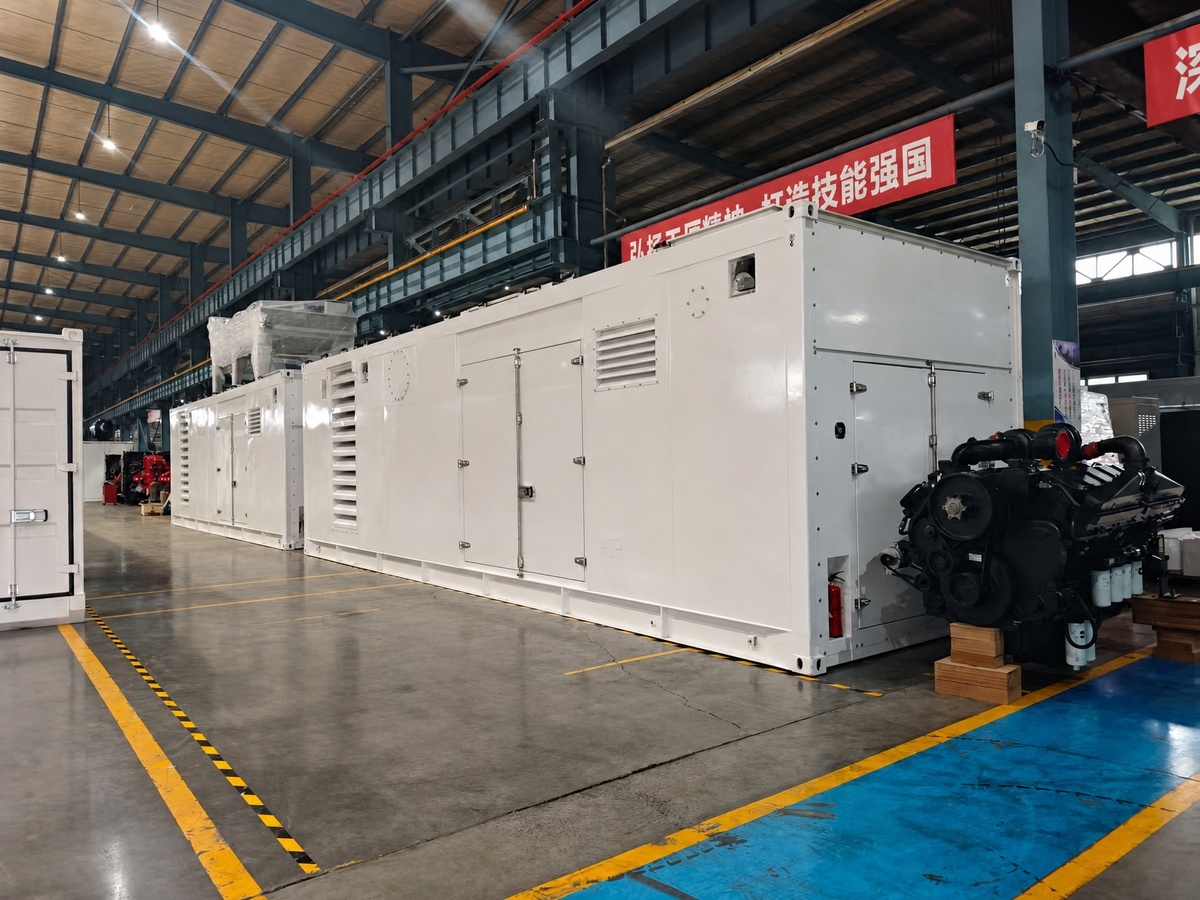
A containerized diesel genset looks like a simple purchase: you pick a kW number, agree on a price, and it arrives on a flatbed ready to run. In the Gulf and Iraq, that simplicity is misleading. Most of the trouble we see on site — derating complaints, overheating shutdowns, premature overhauls — traces back to four decisions made before the order was ever placed. Here they are, in the order they usually bite.
- The nameplate is a laboratory number, not a site number
Every genset carries a rating that was established under reference conditions, typically 40 °C ambient, near sea level, clean intake air, and a defined duty class. Change any of those and the output moves. In the Middle East, all of them move at once.
Ambient temperature is the first one. A turbocharged, aftercooled diesel engine loses roughly 2–3 % of its output for every 10 °C above its rating reference, and the figure is worse on some platforms. A 1000 kW set rated at 40 °C is realistically a 930–950 kW set at 50 °C — and 50 °C is an ordinary July afternoon in Basra or Riyadh, measured in the shade. Add altitude (another 8–10 % per 1000 m on many machines), and add the fact that a partially blocked radiator pushes coolant temperature up and the control system starts trimming load to protect the engine, and you can lose 15 % or more against the catalogue figure.
The second trap is the duty class itself. Under ISO 8528 the three ratings buyers confuse are:
ESP (Emergency Standby) — backup only, limited hours per year, allows a 10 % overload window.
PRP (Prime) — variable load, unlimited running hours, the normal choice for temporary power.
COP (Continuous) — constant load, unlimited hours, no overload.
ESP ratings are typically about 10 % higher than PRP for the same engine. If a supplier quotes you an ESP number and you run it as prime power, you are effectively running permanently overloaded. It will not fail in month one; it will fail in year three, when the overhaul bill arrives.
What to do about it. Before you compare prices, fix the site design ambient temperature in writing — the actual peak, not the annual average — and ask every bidder for the engine manufacturer's derating curve at that temperature and altitude. Then buy the derated number. If you need 3 MW firm at 50 °C, size the installed capacity so that it still delivers 3 MW after derating, which usually means installing 3500–4000 kW of nameplate. That is not over-engineering; that is the only way "firm" means anything.
2. Heat gets the attention, sand does the damage
High ambient temperature dominates the technical discussions, but on Middle East sites the single most common cause of an unscheduled stop is not heat in the abstract. It is dust — dust packed into radiator fins, dust loading up air filters, dust working into electrical enclosures.
A blocked radiator on a 50 °C day has no margin left to give. The set hits high coolant temperature, the controller alarms, and the load drops. It is a maintenance failure that presents as a thermal failure, which is why it gets misdiagnosed.
Air filtration needs to be treated as a system, not a part number:
Two-stage intake — a desert-type pre-cleaner or cyclone separator ahead of the main filter element. A single paper element in a sandstorm lasts days, not months.
Honest service intervals — the 500-hour filter change in the manual assumes moderate dust. In a Shamal season or on an unsealed site, plan for 250 hours or less, and stock filters accordingly.
Enclosure intake design — sand-resistant louvres, and critically, no recirculation. Hot discharge air finding its way back into the intake is the classic container layout error, and it silently eats your derating margin.
Electrical cabinets at IP54 or better, with seals that survive UV and heat, and positive-pressure or filtered ventilation if the site is genuinely dusty.
One more thing buyers overlook: serviceability. Filters, belts, and oil drains need to be reachable without dismantling half the container. Ask to see the maintenance clearances on the drawing, not just the footprint.
What to do about it. Do not accept "air filter included" as a specification. Specify the filtration stages, the expected change interval at your site's dust loading, and the spare filter quantity. It is a small line in the contract and a large line in your operating cost.
3. Fuel is the cost nobody quotes
A 1000 kW genset at full load burns roughly 200–215 g/kWh — call it 250 litres per hour. Run it 8000 hours a year and that is two million litres. Over a five-year temporary power contract, fuel dwarfs the rental or purchase price of the machine by an order of magnitude. Yet fuel is usually the least discussed item in the enquiry.
Two things matter here. The first is quantity: get a realistic consumption curve from the supplier at 25 %, 50 %, 75 % and 100 % load, not just the full-load figure, because your set will rarely sit at full load. The second is quality, and this is where Middle East sites differ from a European specification.
Site diesel in the region is often inconsistent: water from condensation in poorly maintained bulk tanks, suspended solids, higher sulphur, and long storage at 45–50 °C, which accelerates oxidation and gum formation. Genset fuel systems are not forgiving. Common-mode failures — injector wear, pump scoring, filter plugging — usually trace back to fuel, not to the engine.
The practical defences:
Water separators and two-stage fuel filtration, with drainable bowls that someone is actually contracted to drain.
Bulk tank management — settling time, water draining, and shading. A black steel tank sitting in the sun pushes fuel temperature high enough to matter for both storage life and injection behaviour.
Day tank sizing — 8, 12 or 24 hours of autonomy, depending on how reliable the resupply chain is to your location.
Fuel polishing if product is stored for long periods.
What to do about it. Decide early, and in the contract, who supplies fuel and who carries the quality risk. If the operator supplies it, the fuel specification should be stated and the consequences of off-spec fuel excluded from the O&M contractor's performance obligations. If you supply it, budget for filtration and testing. Either way, model the litres-per-hour over your actual load profile before you sign — that number, not the equipment price, is what the project will actually spend.
