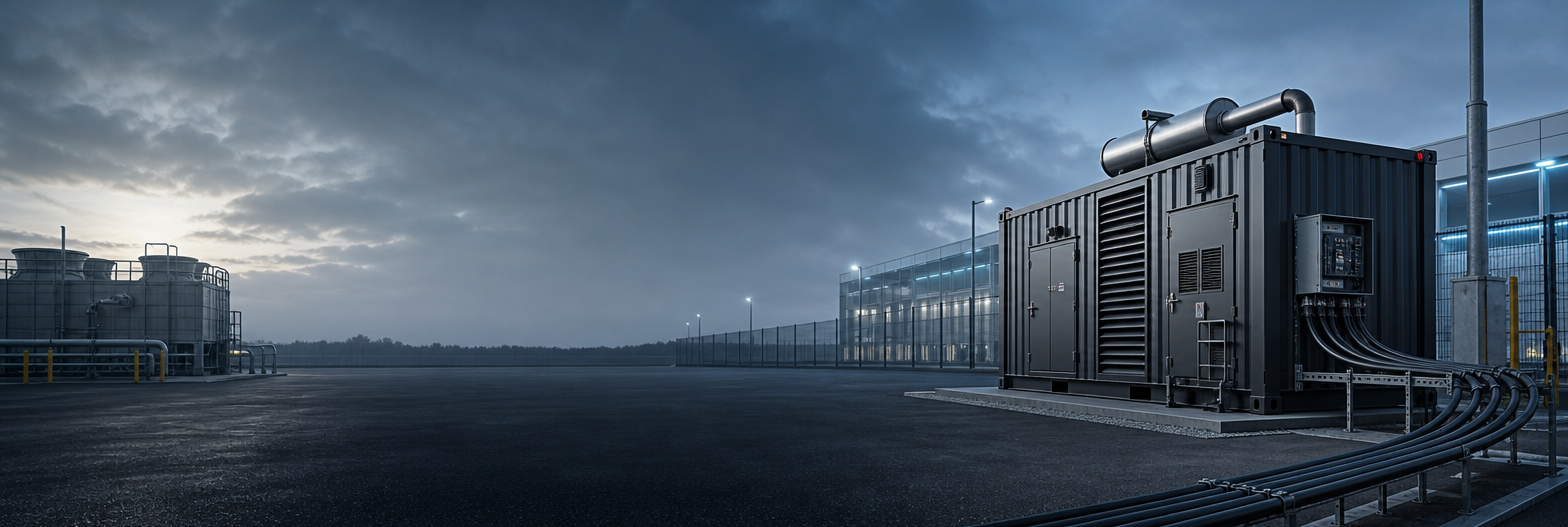

Backup power in a data center is rarely decided by a single number. The generator set that eventually arrives on site is the visible end of a chain of decisions about load, redundancy, fuel, space, noise, electrical topology, and the way the facility will be tested for the next fifteen years. When those decisions are made in the right order, the generator set becomes a predictable asset. When they are made late, the plant room becomes a constraint that the electrical design has to work around.
This guide sets out a planning sequence for owners, consultants, and EPC teams specifying standby generation for data centers, with the configuration logic that Shanghai Outevo Machinery Co., Ltd. applies when a project is translated into a generator set specification.
Start with the critical load, not the building load
The first planning error is usually arithmetic. A designer takes the utility connection capacity, adds a margin, and calls the result the generator rating. That number describes the building, not the backup duty. A data center's critical load is what must remain energised when the utility is absent: IT load, cooling equipment that supports it, associated pumps and controls, security and monitoring, and the losses inside the distribution path itself.
Build the load schedule in layers instead. Separate the IT load into its design maximum and its expected operating point, because a facility that runs at partial occupancy for two years places a very different duty on a generator than its nameplate suggests. Then add the mechanical load that must run concurrently, and be explicit about which mechanical equipment can be shed. Finally, add the electrical losses and a defined design margin agreed with the owner, rather than an arbitrary percentage carried forward from another project.
Two further refinements matter. First, record the load's behaviour, not only its size: an IT load that steps in large blocks when a UPS transfers or a cooling plant restages demands a different machine response than a smooth resistive load of the same total. Second, record the growth assumption and the date at which it is expected. A generator sized for today with no stated growth position is a decision that has not been made; a generator sized for a growth figure nobody has approved is capital spent early. Planning documents should carry both numbers.
Choose the redundancy topology before choosing the machine
Redundancy is an architectural decision that fixes the generator count long before the manufacturer is selected. A single generator set with a maintained utility supply is the simplest arrangement and the most exposed: any planned maintenance on the set removes backup capability unless a temporary unit is brought in. Two sets in a parallel arrangement allow one to be serviced while the other carries the critical load, provided the switchgear and controls are configured to support that state and the load can be carried by one machine.
Distributed arrangements — separate generator rooms serving separate electrical rooms, or a generator per line-up — change the risk profile rather than the arithmetic. They reduce the consequence of a single failure in the plant room, and they increase the number of interfaces that must be commissioned and maintained. What matters is that the topology is chosen deliberately against the availability target the owner has committed to, including the availability frameworks published by industry bodies such as the Uptime Institute, and that the electrical single-line diagram, the generator control philosophy, and the maintenance procedure all describe the same arrangement.
Whatever topology is selected, one question should be answered in writing during planning: with any one generator set out of service, what load can the facility still support, and for how long? If that question cannot be answered from the drawings, the redundancy is nominal. The same document should fix the transfer, earthing, and protection philosophy, because those decisions constrain the generator configuration as much as they constrain the switchgear.
Match starting and step-load duty to the UPS and cooling architecture
Generator sets in data centers are often described as standby machines, which understates their duty. In practice the set must accept a load that arrives in blocks: the IT load transferring from battery, then chiller and pump motors restarting, then additional cooling stages as heat rejection recovers. Each block produces a frequency and voltage excursion at the generator terminals, and the UPS and the cooling controls decide whether that excursion is tolerable.
Planning therefore has to connect three specifications that are usually written by three different parties. The UPS ride-through budget defines how long the load can wait. The generator's transient response defines how quickly it can accept the block. The cooling control sequence defines how large the next block will be and when it arrives. When these are coordinated, a smaller generator set can serve a larger facility than a naive total-load calculation suggests. When they are not, a generously rated set can still trip on a step load because the magnetic saturation, excitation response, and engine governor behaviour were never considered together.
Practical planning outputs from this step are: a required step-load acceptance profile rather than a single kVA figure; a stated starting method for the largest motors, whether direct-on-line, soft start, or variable frequency drive, with the corresponding starting kVA; and an agreed sequence of operation describing what restarts first after a transfer. These three documents are what allow a manufacturer to propose a configuration instead of a catalogue number.
Site the plant for fuel, air, noise, and service access
Generator set planning fails on site more often than it fails on paper. A set that cannot breathe, cannot be refuelled, or cannot have its alternator removed is a liability regardless of its rating. The plant room layout should be developed alongside the electrical room rather than after it.
Airflow is the first constraint. Combustion air and cooling air both require a path in and a path out, and the path must remain available when weather protection, fire dampers, and acoustic attenuators are installed. Radiator discharge should not recirculate into the intake. Where the plant is enclosed, the layout must show that the attenuators have been sized against the actual airflow rather than assumed.
Fuel access is the second. Day tanks, bulk storage, transfer pumps, and the route the fuel tanker will take all belong in the planning set. So does the fire strategy for the fuel storage area and the bunding that contains a leak. Noise is the third: the applicable limit is usually set by the site boundary or by the nearest sensitive receptor, not by the plant room, which means the acoustic treatment may be a function of distance and screening as much as of enclosure design. Service access is the fourth and the most frequently deferred — clearance for filter changes, valve adjustment, breaker operation, and major maintenance must be visible on the layout, not discovered at commissioning.
Plan the fuel strategy as an operating decision
Fuel planning is usually treated as a volume calculation and then forgotten. It is better treated as an operating regime. The volume follows from the required autonomy, the expected load during an outage, and the refuelling arrangements available in the site's actual location. The regime follows from fuel quality: how long the fuel will sit, how it will be tested, how it will be polished or rotated, and what happens to fuel that has aged beyond its usable condition.
Commission with evidence, then hand over a baseline
The final planning step is the one most often left to the contractor: defining what "commissioned" means. For standby generation in a data center, commissioning should produce records rather than assurances. That means documented load tests at defined load steps, recorded frequency and voltage behaviour during those steps, verified transfer and retransfer sequences, protection settings confirmed against the study, and a fuel system proven under flow rather than by inspection.
The handover package should include the as-built configuration, the maintenance schedule with its basis, the spare parts list, and a baseline set of measurements taken at handover. That baseline is what makes later condition monitoring meaningful: a vibration reading or an exhaust temperature is only informative when compared with the same machine's own history. Planning for the baseline at tender stage costs very little; reconstructing it two years later is often impossible.
Configuration logic at a glance
The sequence below is the one this article recommends, expressed as a checklist that can be carried into a specification meeting.
- Critical load schedule, with IT load and concurrent mechanical load separated, and the growth position stated with an approval date.
- Redundancy topology agreed against the owner's availability target, including the single-set-out-of-service case.
- Step-load acceptance profile and the largest motor starting method defined.
- Sequence of operation for the first minutes after transfer, agreed with the cooling and UPS designers.
- Plant room layout showing airflow paths, attenuator sizing, fuel access, and maintenance clearance.
- Fuel autonomy, fuel quality regime, and resupply plan stated as operating commitments.
- Commissioning evidence list and handover baseline defined before the order is placed.
Where Shanghai Outevo Machinery Co., Ltd. fits
Shanghai Outevo Machinery Co., Ltd. supplies project-oriented diesel and gas generator sets, with configurations typically covering 10–3,750 kVA when applicable. For data center work, the relevant capability is not a single product but the translation of a planning package into a buildable specification: enclosure type and acoustic treatment, control and paralleling arrangement, fuel system scope, cooling arrangement for the site's ambient conditions, and the documentation set that the commissioning authority will ask for.
Every data center project has a different load profile, a different climate, and a different maintenance organisation. The generator set should be configured against those facts rather than against a generic template, and the scope boundary between generator supplier, switchgear supplier, and EPC contractor should be written down before manufacturing begins. Project-specific configuration is the normal case, not the exception.
Frequently asked questions
How is the generator rating for a data center actually determined?
From the critical load schedule plus the step-load behaviour of that load, not from the utility capacity. The rating must satisfy the steady load, the largest load step the facility can present, and the site's ambient conditions, with the design margin agreed explicitly with the owner. When applicable, configurations across the 10–3,750 kVA range are matched to that calculation on a project-specific basis.
Should a data center use one large generator or several smaller ones?
Several smaller sets in parallel usually give better maintenance flexibility and a more granular response to partial load, at the cost of more switchgear, more controls, and more commissioning work. One large set is simpler and can be appropriate where the load is stable and a temporary replacement unit is readily available. The decision should follow the redundancy topology, not the other way round.
How long should the generator be able to run without refuelling?
Autonomy is a risk decision, not a standard. It depends on the reliability of the local utility, the distance and reliability of fuel delivery, and the criticality of the load. What matters in planning is that the autonomy figure, the storage volume, and the resupply plan are stated together and accepted by the owner as one commitment.
Does a data center generator need to be paralleled with the utility?
Only if the site intends to use the generator for peak shaving, demand response, or a controlled transfer back to utility without interruption. Each of those modes adds protection, synchronising, and approval requirements. Where the generator is purely standby, a simpler transfer arrangement is usually preferable and easier to maintain.
What documentation should be requested at tender stage?
At minimum: the electrical single-line for the generator scope, the control philosophy, the cooling and airflow basis, the fuel system schematic, the commissioning test plan, the maintenance schedule basis, and the spare parts recommendation. A tender that asks only for a rating and a price leaves the most consequential decisions to be made by default later.
How does the planning sequence change for a retrofit?
For a retrofit, the plant room and the existing electrical topology become fixed constraints, so the sequence starts with a site survey rather than a load schedule. The load schedule is still required, but it is used to test whether the available footprint, airflow path, and fuel arrangement can support the required duty before any equipment is specified.
Discuss your data center backup power requirement
If you are at the planning stage, the most useful starting point is not a rating but a description of the facility: the critical load and its behaviour, the redundancy target, the site conditions, the fuel and refuelling arrangements, and the maintenance organisation that will operate the plant. Shanghai Outevo Machinery Co., Ltd. reviews those inputs and returns a configuration proposal with the scope boundaries made explicit, so that the specification that goes to tender reflects the site rather than a template.
Send your project brief through the contact form on this site, including the application, the required power range, and any site constraints already known. Our engineering team will respond with the questions that need answering before a generator set specification can be fixed.


