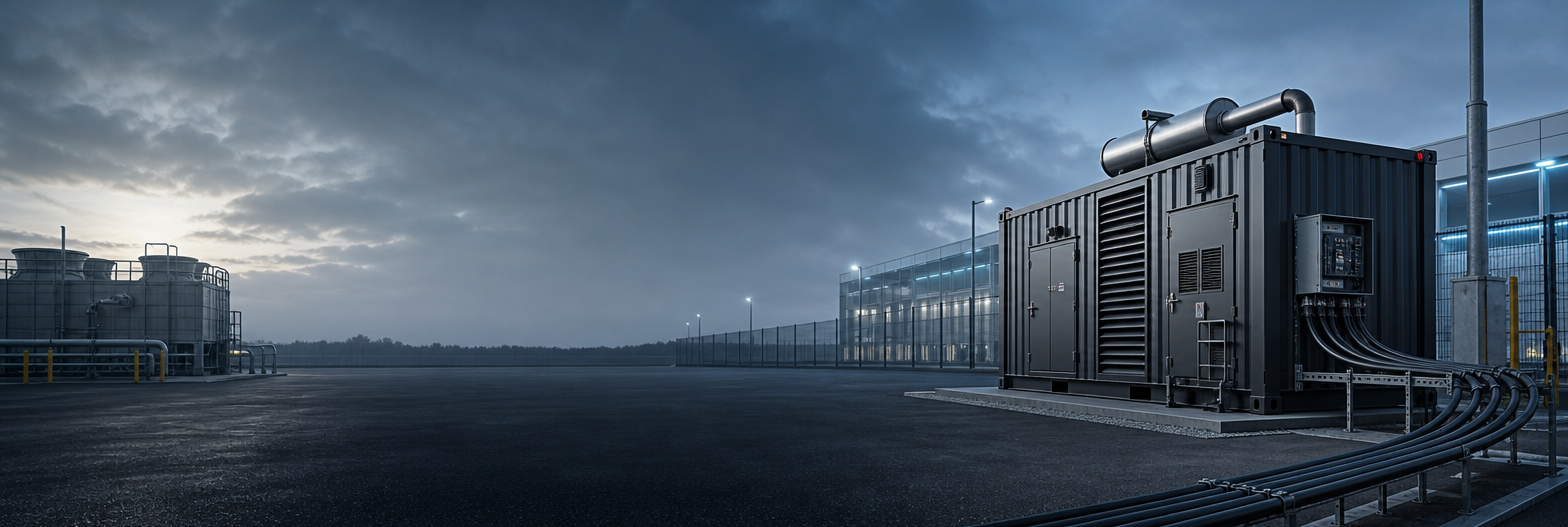
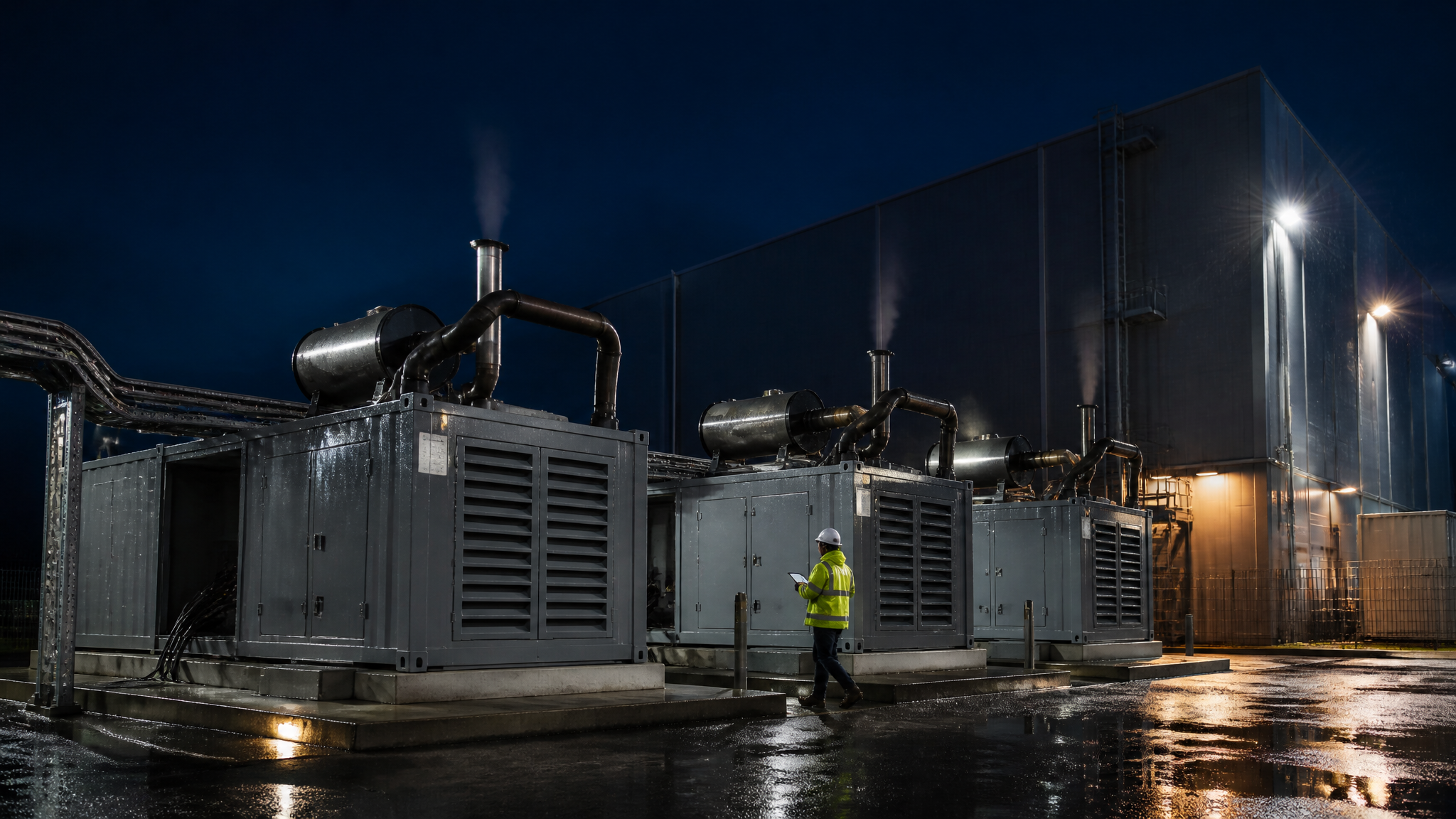
Diesel remains the reference technology for data center standby power for reasons that have little to do with fashion. The fuel can be stored on site, it does not depend on a pipeline or a gas supply contract, and a diesel generator set can be brought from rest to carrying load with a control system that a site electrician can understand and maintain. For facilities that must survive a utility outage of unknown length in an unknown climate, those properties matter more than theoretical efficiency.
This article examines the diesel generator set specifically as an outage-response machine: what the first minutes of an outage place on the equipment, how the configuration should be chosen for that duty, and which details decide whether the set starts reliably in the third year rather than only in the first week. It complements the broader planning sequence covered elsewhere in this section and assumes the facility's load and redundancy decisions have already been made.
What an outage actually asks of the generator
An outage is not a switch. It is a sequence with distinct phases, and each phase stresses a different part of the system. In the first seconds, the utility disappears and the load transfers to battery. The generator receives a start signal, cranks, fires, and reaches rated speed and voltage. During that window the UPS is discharging, and the facility is running on a finite energy store.
In the next phase the generator accepts the transferred load. This is the hardest moment for the machine, because the load arrives as a block and the voltage and frequency response is dominated by transient behaviour rather than steady-state capability. Cooling equipment then restarts in stages, adding further blocks. Finally, the facility settles into a long-run condition in which the generator is no longer a standby device but the site's only source, and fuel consumption, cooling capacity, and lubrication become continuous operating concerns rather than periodic maintenance items.
Most generator failures in data centers are failures of one of these transitions rather than failures of steady-state output. That is why a specification written around a single kVA figure tells you very little about how a set will behave when it is actually needed.
Sizing for the block, not the total
The practical sizing question is how large a load block the set must accept and how quickly the facility can be expected to present it. A diesel generator set has a defined transient capability: it can accept a step load within limits set by its alternator reactance, its excitation system, and its engine governor, and beyond those limits the frequency or voltage excursion will exceed what the downstream equipment tolerates.
Three levers exist, and they are usually cheaper than adding rating. The first is the load's own behaviour: a UPS with a defined ramp or a cooling plant with staged restart presents a gentler profile than equipment that slams on. The second is the machine's excitation and governing: an alternator with a permanent magnet excitation system and a fast electronic governor will accept a larger block than a simpler machine of the same rating. The third is the number of machines: two smaller sets in parallel can share a block that either would struggle to take alone.
When a project does require additional capacity, it should be added for a stated reason — the largest motor start, the cooling restart profile, or the ambient derating — and recorded in the specification. Rating added without a reason is usually rating added without benefit.
Engine, governor, and alternator choices that matter in service
Data center duty is characterised by long idle periods interrupted by demanding events. That pattern rewards robustness over novelty. An engine that is familiar to the local service network, with parts available through established channels, will be maintained more consistently than a more advanced unit that the site's technicians cannot diagnose.
The governor deserves specific attention. Electronic governing gives more precise frequency control and better load-sharing behaviour when sets are paralleled, and it allows the control system to log the response to a load step. Mechanical governing is simpler and, in some markets, easier to support. Either can be correct; what is not correct is leaving the choice unstated, because the rest of the control philosophy depends on it.
Alternator selection influences the transient response more than most buyers expect. Excitation type, winding pitch, and the alternator's ability to sustain a short-circuit current for protection to operate all interact with the site's protection settings. When a facility uses a generator in island mode, the protection study must be run against the generator's actual decrement curve, not against an assumed utility-strength source.
Cooling and enclosure for the site's real ambient conditions
A generator set is rated at a reference ambient condition. Sites in the Middle East, parts of Africa, Central Asia, and Southeast Asia routinely operate above that reference for much of the year, and the difference has to be resolved at specification stage rather than discovered in the first summer. The usual options are a larger radiator, a derated rating, or a cooling arrangement that separates the radiator from the enclosure airflow path.
Enclosure choice follows the same logic. An open set in a purpose-built plant room can be the most serviceable solution where a room exists. A containerised or canopied set is appropriate where the plant must be weather-protected, transported, or located close to a boundary with acoustic limits. In either case the acoustic treatment must be designed against the actual airflow, because attenuators that reduce noise also reduce cooling capacity, and a set that overheats quietly is not an improvement.
Corrosion protection is the detail that separates a ten-year asset from a five-year one in coastal or humid locations. Coating systems, fastener materials, and the treatment of the enclosure base should be stated in the specification for those sites rather than assumed from a standard build.
Fuel system integrity is the most common single point of failure
Diesel fuel degrades. Water ingress, microbial growth, oxidation, and particulate contamination all accumulate in stored fuel, and the consequences appear as blocked filters, injector damage, and inability to carry load. A data center that stores fuel for years without a quality regime is storing a risk, not a reserve.
The fuel system should be specified as a system. That means a bulk tank with proper bunding and access for inspection, a transfer arrangement that does not rely on a single pump, a day tank at the generator with level control independent of the bulk tank, and filtration appropriate to the fuel quality actually delivered on site. It also means a monitoring and testing routine: periodic sampling, water removal, and a polishing or rotation regime that keeps fuel moving.
Two operational details are frequently missed. The first is that a generator should not be run on fuel that has never been proven to reach it under flow; a transfer test at commissioning does more for reliability than any amount of documentation. The second is that the refuelling connection must be accessible to a tanker in the conditions in which refuelling will actually happen, which is rarely a calm dry afternoon.
Emissions and local approval
Emissions requirements for standby generator sets vary by jurisdiction, and they are increasingly applied to emergency equipment as well as to continuous duty. The applicable standard, the required evidence of conformity, and the authority that will inspect it should be established early, because they can determine the engine platform rather than merely a documentation package.
Where local rules impose limits, the practical questions are which standard applies to a standby set on that site, what test evidence is accepted, and who is responsible for demonstrating conformity at handover. Shanghai Outevo Machinery Co., Ltd. will state what a proposed configuration can support for a given project rather than assert a blanket certification, because conformity is a project-specific and market-specific matter.
Scope boundaries: what the generator supplier does not supply
A diesel generator set package typically ends at the terminals. The transfer switch, the low-voltage distribution, the protection settings, the exhaust route beyond the set, the fuel bulk storage, and the building interfaces usually belong to other parties. Ambiguity here is a common source of delay, because the missing item is only discovered when the commissioning sequence reaches it.
Writing the scope boundary into the purchase specification protects everyone. It also clarifies responsibility for the interface tests that matter most: the transfer sequence under load, the return to utility, and the behaviour of the plant when a generator trips while carrying the critical load. Those tests are usually best planned jointly, even when they are executed by different contractors.
A short procurement checklist for diesel standby sets
- Critical load schedule, largest load step, and starting method for the largest motors, stated explicitly.
- Ambient design conditions for the site, with the derating basis and the cooling arrangement that follows from it.
- Governor and excitation type stated, with the reason, and matched to the protection study.
- Enclosure or plant room arrangement with acoustic targets referenced to the site boundary or receptor.
- Fuel system scope, storage volume, quality regime, and resupply arrangements.
- Control interface to the building management system, including alarm priority and remote start policy.
- Commissioning test plan, protective function tests, and the handover documentation list.
- Spare parts and service support route for the location, agreed before order placement.
Frequently asked questions
Is diesel still the right choice for a data center, given alternative fuels?
For sites where fuel must be stored on site and the outage duration is unknown, diesel remains the most predictable option because the energy reserve is physical and independent of any supply network. Alternative and gaseous fuels are credible where the site has a reliable supply and the commercial and regulatory conditions support them. The right choice depends on the site, not on a general preference.
How much reserve capacity above the critical load should be specified?
Enough to cover the largest load step, the site's ambient derating, and an owner-approved growth position — with each element identified separately. A single blanket margin is difficult to defend and often misallocates capacity. When applicable, configurations within the 10–3,750 kVA range are sized to that calculation for each project.
What is the biggest cause of generator start failure on site?
In practice, battery and starting system condition, fuel quality, and blocked or contaminated filtration account for a large share of events, followed by control and sensor faults. All of them are addressed by a defined maintenance and testing regime rather than by equipment selection alone.
Can a diesel generator set run continuously during a long outage?
It can run for extended periods, but continuous duty imposes different requirements than standby duty: sustained load limits, oil consumption, cooling performance at the site ambient, and a maintenance interval expressed in running hours rather than calendar time. If long outages are credible, that duty should be stated at specification stage.
How should a containerised set be specified differently from a plant-room set?
The container adds constraints on airflow, access for maintenance, cable entry, and acoustic treatment, and it must be transportable within the site's lifting and access limits. It also changes the corrosion and condensation picture. The specification should state the container's environmental rating, its airflow design basis, and the maintenance access it provides once installed.
What should be tested at commissioning beyond a load run?
The load run proves output. Commissioning should also prove the transitions: start on command, accept the transferred load, accept the cooling restart steps, return to utility, and recover to standby. Protective functions, alarm annunciation, and fuel transfer should each be demonstrated and recorded, because these are the functions that determine behaviour during a real outage.
Request a diesel standby configuration for your facility
Shanghai Outevo Machinery Co., Ltd. configures diesel generator sets for data center and mission-critical applications on a project basis, with the enclosure, cooling, control, and fuel scope defined against the site rather than a catalogue template. Configurations typically cover 10–3,750 kVA when applicable, with the rating and arrangement confirmed against your load schedule and ambient conditions.
To receive a useful proposal, share the critical load and its behaviour, the site location and design ambient, the redundancy target, the fuel storage arrangements, and the commissioning standard your project will be measured against. Our engineering team will respond with the configuration logic, the scope boundaries, and the open questions that need answers before an order.


