Gas-fuelled generation enters the data center conversation for reasons that are usually commercial or regulatory rather than technical: a pipeline connection already exists, on-site liquid fuel storage is unwelcome, local emissions rules favour gaseous fuel, or the site wants the option of running generation for longer periods than a stored-fuel reserve can support. Each of those reasons is legitimate. None of them removes the need to answer a harder question first — whether the gas will still be there when the grid is not.
This article sets out how gas generator options should be assessed for data center resilience, what changes technically when the fuel is gaseous, and where a gas solution strengthens a facility's position rather than merely relocating its dependency. It is written for owners, consultants, and EPC teams comparing fuel strategies, and it assumes the load and redundancy decisions have already been made.
The resilience question comes before the fuel question
A diesel reserve is a physical quantity on the site. A gas supply is a contractual and infrastructural relationship. During a regional utility event, gas pressure can be affected by the same conditions that caused the electrical outage, and in some networks gas compressors themselves depend on electrical supply. A facility that replaces a fuel tank with a pipeline has not eliminated a dependency; it has exchanged one for another with a different failure mode.
The assessment should therefore start with the gas network's behaviour during the events the facility is designed for. What is the historical pressure stability at the site's offtake? Is there a firm supply agreement, and what does "firm" mean in the contract? Is there storage or line-pack that provides ride-through? What happens to supply during a wider regional incident, and is the site on a priority list? These are questions for the gas supplier and the local authority, and the answers belong in the design basis rather than in a marketing brochure.
Where the answers are strong, gas can be an excellent primary fuel for standby generation. Where they are uncertain, the design should include a mitigation: dual-fuel capability, a retained liquid fuel reserve, or a hybrid arrangement in which gas carries normal operation and liquid fuel covers the credible failure modes.
Which gas, and what it changes
Natural gas is the default option where a pipeline is available. It arrives at a defined pressure and composition, and the generator set is configured for that composition. Biogas is a credible option where the site has, or is adjacent to, an anaerobic digestion or landfill source; its methane content varies, and that variability has to be absorbed by the engine specification and the control strategy rather than assumed away. Liquefied petroleum gas is used where pipeline gas is unavailable but a delivered fuel is acceptable, and it brings its own storage and safety requirements.
Dual-fuel engines offer a route to flexibility, running primarily on gas with a liquid fuel fraction for ignition or as a fallback. The trade-off is complexity: two fuel systems, two sets of safety logic, and a control philosophy that must be explicit about when and how the transition occurs. That complexity can be entirely justified in a facility where gas supply risk is real, but it should be a deliberate decision rather than an optional extra.
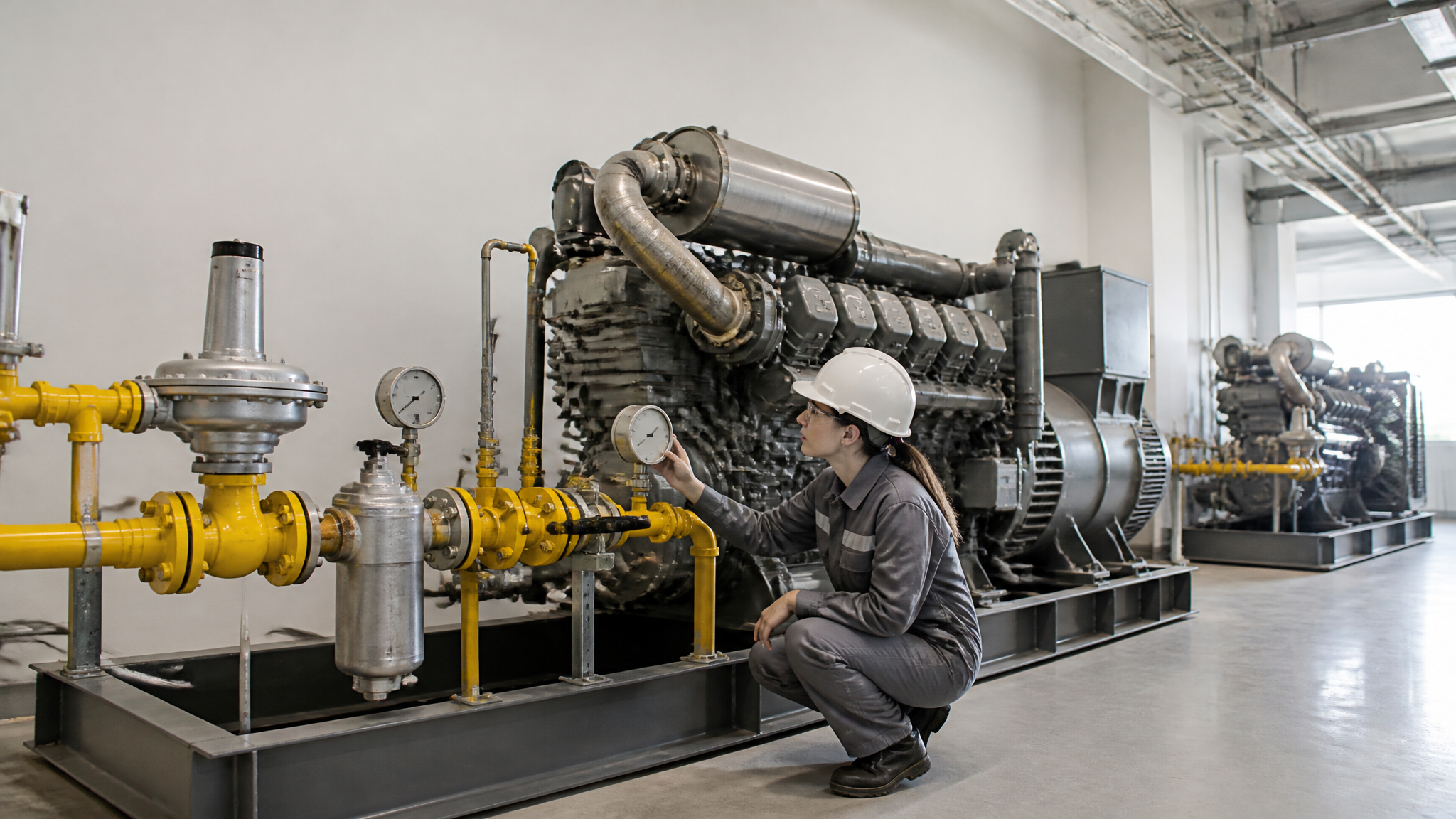
For all gaseous fuels, the practical engineering differences from diesel are consistent. Ignition is by spark rather than compression, so the engine platform is different. The fuel arrives as a gas at low pressure, so a gas train with filtration, regulation, metering, and safety shut-off becomes part of the generator package or the interface to it. Combustion behaviour depends on the fuel's methane number and heating value, which is why a gas specification must state the fuel analysis rather than the fuel name alone.
Rating, derating, and the effect of site conditions
Gas generator ratings are sensitive to conditions that diesel ratings are also sensitive to, plus a few that are specific to gaseous fuel. Ambient temperature and site altitude reduce available output because they reduce the mass of air the engine can ingest. Gas supply pressure affects the achievable load, and a pressure that is adequate at part load may not support full output. Fuel composition affects the achievable efficiency and, in some cases, the maximum continuous rating.
The consequence for procurement is that a gas generator set should not be specified by a nominal rating alone. The specification should state the fuel analysis, the supply pressure range at the battery limit, the site ambient design condition, the altitude, and the duty the set must perform at those conditions. When applicable, the resulting configuration is defined within the 10–3,750 kVA range that Shanghai Outevo Machinery Co., Ltd. typically covers, and the rating is confirmed for the project rather than assumed from a data sheet.
Load-following behaviour and why it matters more on gas
Gas engines are often considered better suited to sustained operation than to abrupt load steps, and there is truth in that generalisation: spark-ignition engines respond to a load block differently from compression-ignition engines, and the fuel delivery system has its own dynamics. In a data center, the load block at transfer is exactly the event that matters most.
The practical response is not to avoid gas but to design the transition. That can mean sequencing the load so the largest blocks arrive after the generator has stabilised, using a UPS with sufficient ride-through, or configuring multiple smaller gas sets so that each accepts a smaller share of the step. Where a facility's cooling restart profile is aggressive, the gas option should be tested against that profile rather than against a steady-state load.
A second consideration is part-load operation. A gas set running at low load for long periods may operate outside its efficient and clean-combustion window, which affects maintenance intervals and emissions behaviour. If the facility expects to run on gas for extended periods at partial load, that duty should be described in the specification so that the engine and control strategy can be matched to it.
Safety, siting, and approval
Gaseous fuel changes the safety case for the plant area. Gas detection, ventilation, ignition-source control, and the definition of hazardous areas become part of the layout rather than an addition to it. The gas train requires its own isolation and vent arrangements, and the route of the supply pipe from the battery limit to the set has to be designed with the same care as the electrical route.
Approval requirements vary widely between jurisdictions, and they frequently determine the layout. Separation distances from buildings and boundaries, the treatment of the meter and regulating station, the fire strategy for the plant area, and the documentation required by the authority having jurisdiction should all be established before the design is frozen. A layout that satisfies the generator supplier but not the local authority is not a design.
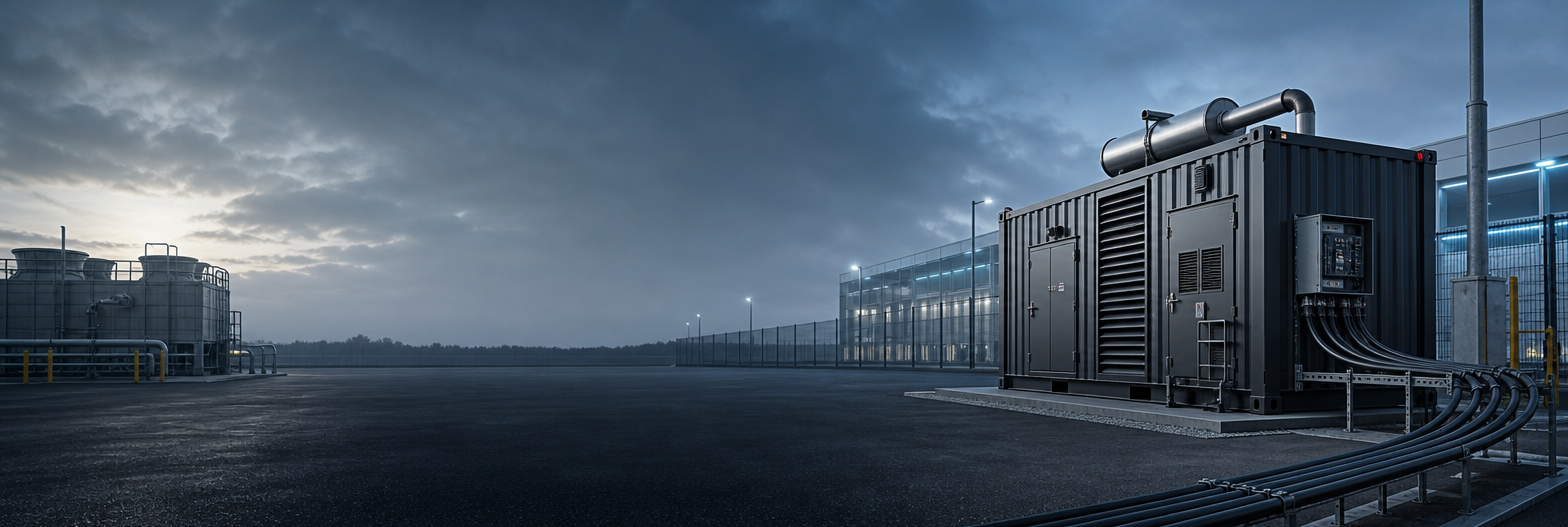
For indoor installations, ventilation design must account for both normal operation and a credible leak scenario. For outdoor or containerised installations, the enclosure must provide the gas-specific safety functions — detection, isolation, and ventilation — without compromising the cooling airflow the engine needs.
Where gas generation earns its place in a data center
Gas generation is most defensible in four situations. The first is a site with a genuinely firm gas supply and a regulatory or community constraint on liquid fuel storage. The second is a facility that expects to run generation for long durations, where a pipeline can supply energy that a tank cannot. The third is a site pursuing a lower-emission operating profile in a jurisdiction that recognises gaseous fuel in its framework. The fourth is a campus with an existing gas infrastructure and an energy strategy that already includes gas for other purposes.
In each case the justification is site-specific. A gas solution specified because it appears modern, without a documented assessment of supply reliability and approval path, is a resilience risk dressed as an improvement. The test is simple: can the facility's design basis describe what happens to gas supply during the events the facility is designed for, and does the answer support the standby requirement?
Comparing fuel strategies without a price sheet
Fuel strategy comparisons are often reduced to a cost per kilowatt-hour, which is the least reliable part of the analysis because it depends on tariff structures, contract terms, and utilisation assumptions that change. A more durable comparison addresses five things: the availability of the fuel during the design event, the site's ability to store or secure reserve, the approval path and the time it will take, the maintenance and competence requirements the fuel imposes on the operating team, and the flexibility the choice preserves for future phases of the facility.
On that basis, many data centers conclude that a liquid fuel reserve should be retained regardless of the primary fuel, because it is the only reserve that is entirely within the site's control. That conclusion does not diminish the case for gas; it defines the role gas should play.
Decision checklist for a gas generator option
- Gas supply reliability during the credible design events, with the evidence source named.
- Contractual position on firm supply, priority, and interruption, reviewed by the owner rather than assumed.
- Fuel analysis, supply pressure range at the battery limit, and the resulting engine configuration.
- Site ambient and altitude design conditions, with the derating basis stated.
- Load step profile and the sequencing required to keep the step within the machine's capability.
- Hazardous area definition, gas detection, ventilation, and the layout consequences.
- Approval path, authority, and the documentation that will be required.
- Fallback fuel strategy and the control logic that governs any transition between fuels.
- Operating team competence and the training the fuel choice implies.
Frequently asked questions
Can a gas generator set replace diesel entirely for a data center?
It can where the gas supply is demonstrably reliable during the events the facility is designed for, and where the approval and safety case support the installation. Where that evidence is incomplete, retaining a liquid fuel reserve or specifying dual-fuel capability is the more defensible position. The decision is a site risk assessment, not a technology preference.
How does a gas generator rating compare with a diesel rating of the same size?
The two are not directly comparable, because output depends on fuel composition, supply pressure, ambient conditions, and altitude. A gas set specified for a hot, high-altitude site may need a larger frame than a diesel set serving the same load. Ratings should be confirmed against the project's actual conditions.
What is the main operational difference between gas and diesel standby sets?
The fuel delivery path. A diesel set depends on stored fuel quality; a gas set depends on supply pressure and composition. That shifts the monitoring emphasis from fuel testing and polishing towards pressure, flow, and gas detection, and it changes the competence the operating team needs.
Is biogas realistic for a data center?
It is realistic where a suitable and consistent source exists nearby, because the variability of biogas composition has to be absorbed by the engine specification. Without a stable source and a defined gas analysis, biogas introduces a fuel-quality risk that a mission-critical facility would find difficult to accept.
Does gas generation suit long-duration outages better than diesel?
It can, because a pipeline is not limited by tank volume. That advantage only holds if the pipeline remains available during the outage, which is precisely the condition that must be verified. Long-duration capability and supply reliability are two different questions and should be answered separately.
What should be included in the gas supply interface specification?
The pressure range and quality at the battery limit, the location and scope of the regulating and metering station, the isolation and vent arrangements, the safety shut-off logic, and the responsibility split between the gas utility, the site, and the generator supplier. Ambiguity at this interface is the most common cause of delay in gas-fuelled projects.
Evaluate a gas option against your facility's design basis
Shanghai Outevo Machinery Co., Ltd. supplies both diesel and gas generator sets, which means a fuel strategy can be assessed on the facility's requirements rather than on what a single product line happens to offer. Configurations typically cover 10–3,750 kVA when applicable, with the fuel system, gas train scope, cooling, and control arrangement defined for the project.
If you are comparing fuel strategies, send the site location, the available gas supply and its contractual basis, the critical load and step profile, the ambient design conditions, and the approval framework the project must satisfy. Our engineering team will respond with the configuration implications of each option and the questions that must be closed before a fuel decision is made.


