Open-Frame Diesel Generators in Europe: A Practical Guide to Base Tank and Brushless Copper Alternator Selection
Introduction
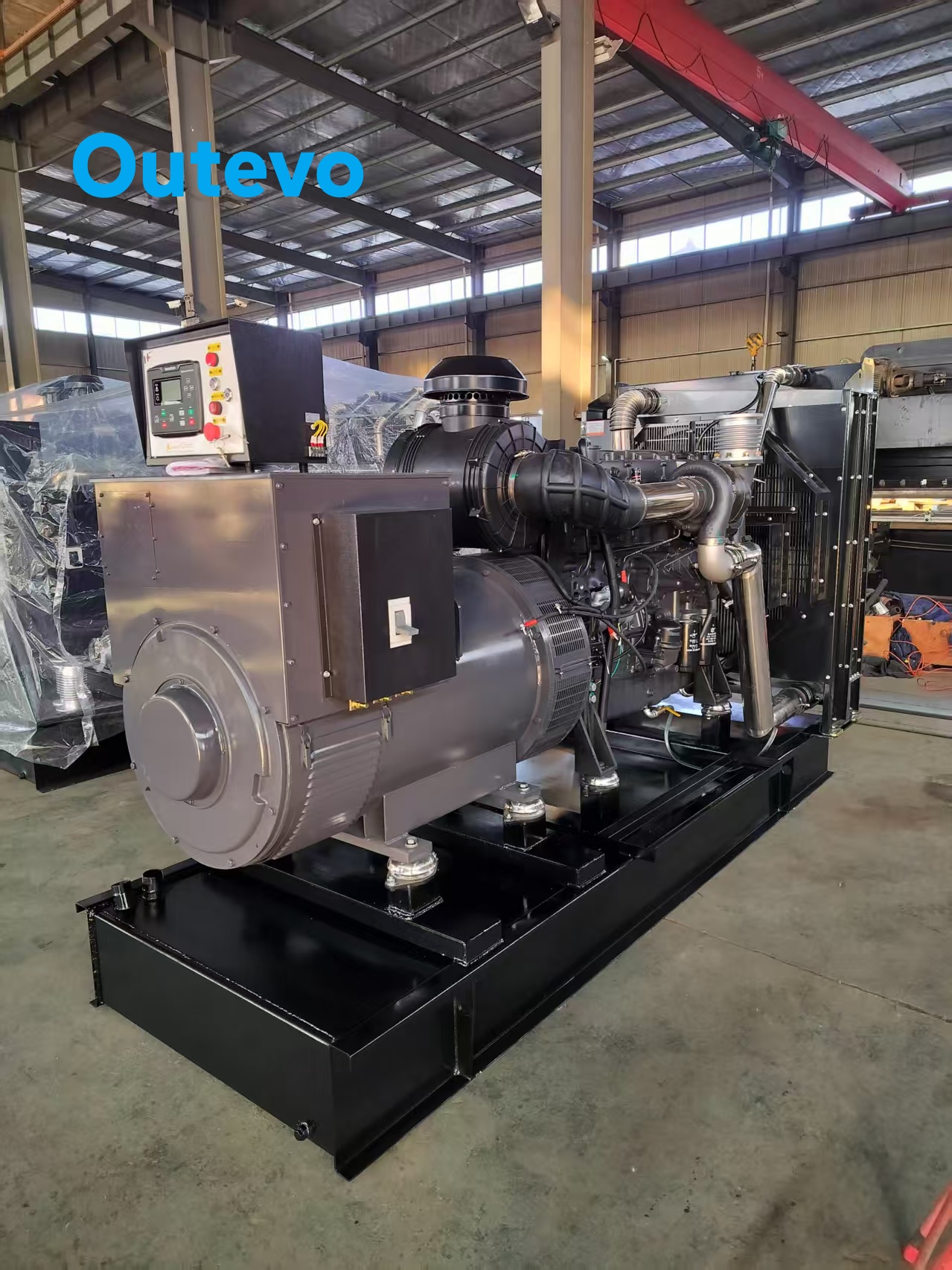
We are focusing on open-frame (also called “open skid”) generator sets — the kind you see on construction sites, at temporary event venues, and in industrial plants across the UK, Germany, Scandinavia, and the rest of Europe. These units are not enclosed in soundproof canopies. They are bare metal, bolted to a steel skid, with the fuel tank welded or bolted into the frame itself. That design choice has real consequences for how you plan installation, manage fuel logistics, and specify the alternator that sits at the heart of the machine.
Part 1: The Integral Base Fuel Tank — More Than Just a Bowl Underneath
What Is a Base Tank, Anyway?
An open-frame diesel generator does not come with a separate external fuel drum sitting next to it. Instead, the fuel tank is built into the generator’s steel chassis — hence the term “base tank” or “skid-mounted tank.” The tank forms the bottom of the frame, so the engine and alternator sit on top of it like a lid. This is not a novelty design. It is the standard configuration for anything from 25 kVA up to several hundred kVA in the European market.
How to Size the Tank — The Numbers That Matter
This is where most buyers make mistakes. They look at the generator’s power rating and assume the tank is big enough. It usually is — but only for a specific runtime. Here is the quick calculation that procurement engineers actually use:
Minimum tank capacity (litres) = Engine power (kW) x specific fuel consumption (g/kWh) x required runtime (hours) / diesel density (g/L)
Let us plug in real numbers. Take a typical 100 kW open-frame set with a Cummins 6BTAA5.9 engine. Its full-load fuel consumption is roughly 207 g/kWh. Diesel (EN 590 standard) has a density of about 840 g/L. If you need 8 hours of autonomy (a common requirement for backup power in European hospitals and data centres), the math works out like this:
100 kW x 207 g/kWh x 8 h / 840 g/L = 197 litres
So a 250-litre base tank (a common factory option for this power range) gives you a comfortable buffer above the minimum. For larger sets — say a 400 kW unit based on a Cummins KTA19 engine — the calculation shifts dramatically:
400 kW x 206 g/kWh x 8 h / 840 g/L = 784 litres
Which is why base tanks on 400 kW+ open-frame sets typically range from 700 to 1,000 litres depending on the manufacturer. Caterpillar, for instance, offers dual-wall base tanks on their C18 platform that hold over 1,000 litres and provide secondary containment meeting EPA and EU Directive 2012/18/EU (Seveso III) requirements.
Part 2: The Brushless Copper Alternator — Why the Material Matters
Brushless vs. Brushed — The Short Answer
Older generator designs used brushed alternators, where carbon brushes press against a rotating slip ring to deliver excitation current to the rotor. Simple, yes. But those brushes wear out. They create sparks. They generate electrical noise. And in a European industrial environment — think paper mills, food processing plants, pharmaceutical cleanrooms — sparks and electrical noise are not acceptable.
A brushless alternator eliminates all of that. The excitation is generated by a small permanent magnet generator (PMG) or by self-excitation through the stator windings, and the rectification happens on the rotating shaft using rotating diodes. No brushes. No slip rings. No sparks. Just a solid-state system that lasts for tens of thousands of hours with virtually zero maintenance.
Why “Copper” Is in the Name — And Why You Should Care
You will see “copper winding” touted in every alternator datasheet from Stamford to Mecc Alte to Leroy-Somer. Here is what it actually means:
The stator windings — the copper coils wrapped around the stator laminations — are the heart of the alternator. They convert the rotating magnetic field into usable electrical energy. Copper is the best practical conductor for this job. Period.
Some manufacturers, particularly in the low-cost segment, substitute aluminium wire for copper. Aluminium is lighter and cheaper, but it has roughly 61% of copper’s conductivity. That means:
- Higher resistance losses — more heat, lower efficiency (typically 2–3 percentage points lower)
- Larger cross-section needed — which means a physically bigger alternator for the same power output
- Poorer transient response — when you switch on a large motor load, an aluminium-wound alternator will dip in voltage more deeply and take longer to recover
- Shorter lifespan — aluminium expands and contracts more than copper with temperature cycling, leading to connection fatigue and eventual failure
For a European buyer, this is not a theoretical concern. EU energy efficiency regulations (ERP Directive 2009/125/EC and the updated Ecodesign Directive) push manufacturers — and by extension, end users — toward higher efficiency equipment. A copper-wound alternator at Class H insulation typically achieves 95–97% efficiency, while an aluminium-wound unit may struggle to reach 92–94%. Over the lifetime of a generator set that runs hundreds of hours per year, that efficiency gap translates into real electricity costs.
