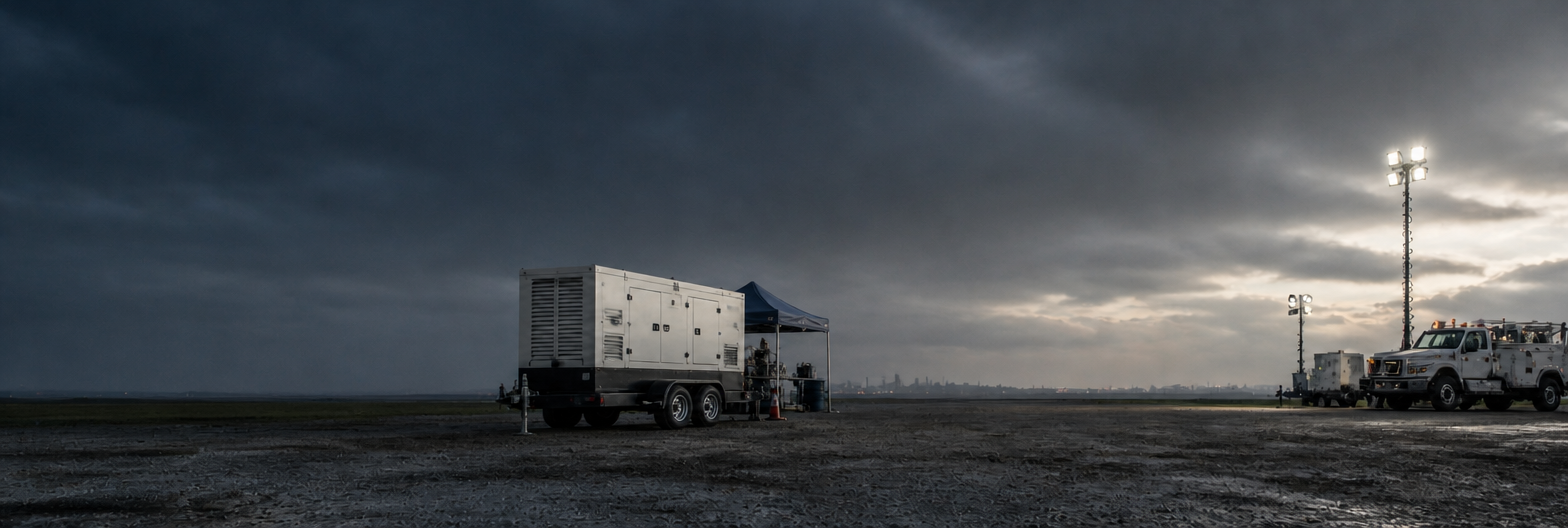
A practical method for temporary power planning on construction and utility works — phase load schedules, supply architecture, distribution and changeover.
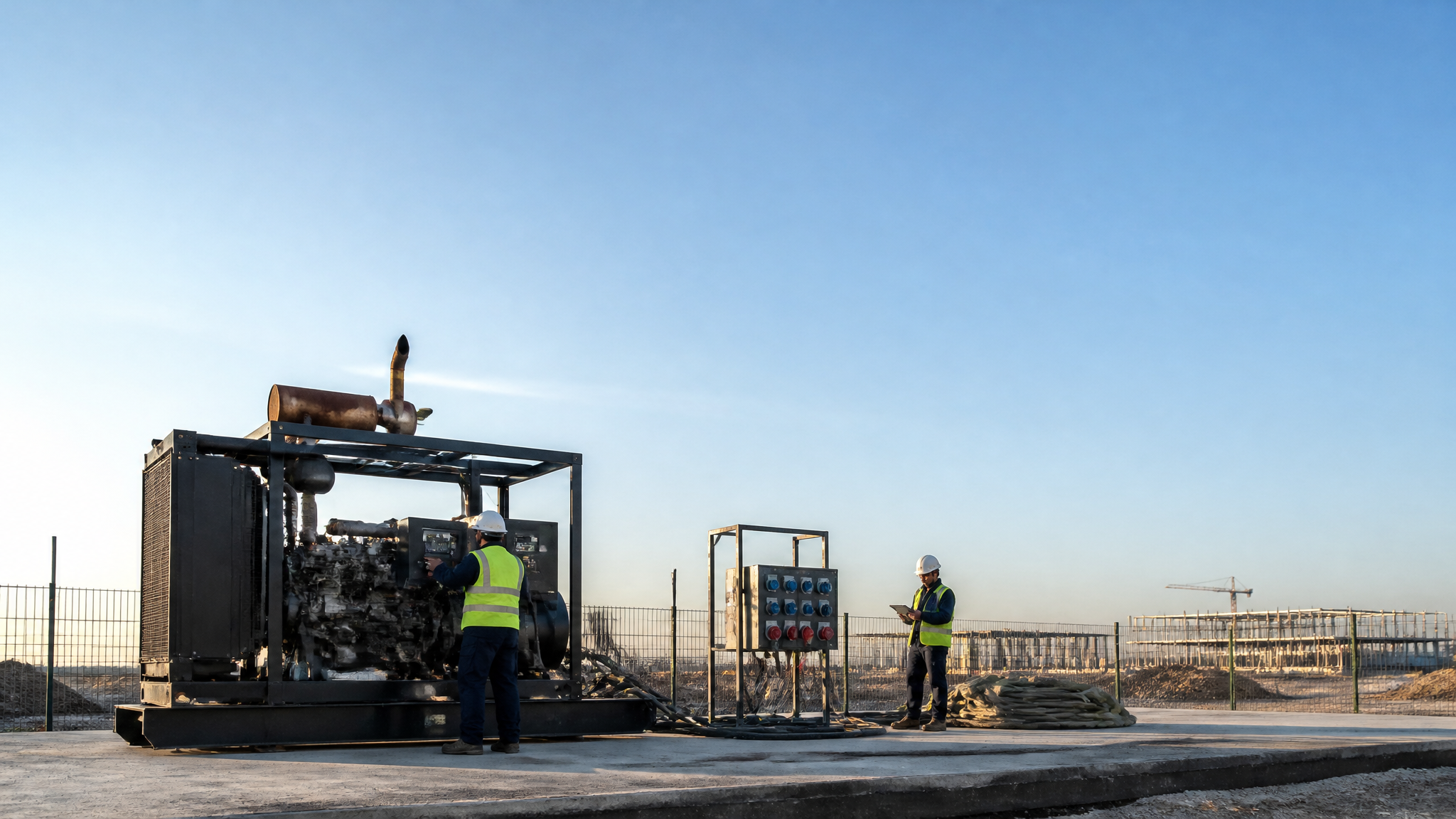
On most construction and utility projects, temporary power is arranged late. A generator is ordered when the site team realises the permanent supply will not be available, and the specification is written around whatever can be delivered quickly. The result is often workable but rarely efficient: cables that are too long, boards in the wrong place, a unit running well below its rated load, and a changeover arrangement that has to be reworked when the permanent supply is energised.
Temporary power planning treats the supply as a design phase with defined inputs and outputs. The inputs are the works programme, the load schedule for each stage, the permanent installation that will eventually take over, and the site constraints. The outputs are a supply architecture, a distribution design, a connection and changeover procedure, a fuel and maintenance plan, and a demobilisation sequence.
Shanghai Outevo Machinery Co., Ltd. has supplied generator-set solutions since 2006, and its current website presents diesel and gas generator sets across 10–3,750 kVA when applicable, in open-frame, silent, containerized and trailer-mounted configurations. Temporary supply arrangements are reviewed as project-specific configurations, because the correct rating and format depend on the works programme and the installation, not on a standard package.
A construction or utility project does not have one load; it has a sequence of loads. Earthworks need dewatering pumps and lighting. Foundations need concrete plant, vibrators and small tools. Structural works add welding sets, hoists and compressors. Fit-out brings temporary heating or cooling, test equipment and commissioning loads. Utility works may add bypass supplies while cables, switchgear or transformers are replaced.
Each stage has a different peak, a different load factor and a different tolerance for interruption. A temporary supply designed for the peak of the whole programme will be oversized for most of it; a supply designed for the average will fail at the peaks. The practical approach is to divide the programme into phases, estimate each phase separately, and then decide whether one supply can serve all phases or whether the architecture should change between them.
A phase load schedule is a simple table with more honesty than most. For each phase, list the equipment expected to operate, its rated input, its starting characteristic, its duty cycle and the period over which it will run. Then apply a realistic simultaneity factor: not every item runs at once, but the ones that do tend to run together.
Three numbers come out of the schedule. The sustained load is what the generator must carry for hours. The peak demand is the highest simultaneous running load. The largest step is the biggest change the generator must accept in one event, usually the starting of the largest motor or drive. The generator must satisfy all three under the ambient conditions of the site.
It is worth adding two further columns: a confidence note on each estimate, and the consequence of losing that load. The first keeps the schedule honest as assumptions are replaced by measurements. The second identifies which loads justify redundancy and which can simply wait.
With the schedule in hand, the architecture question becomes concrete.
A single generator set is the simplest arrangement and the right answer where the total load is modest, the phases do not overlap heavily, and an interruption is tolerable while the unit is serviced. It requires a clear connection point and a distribution design that keeps cable runs short.
Multiple generator sets at separate load centres reduce cable length and distribution losses, and allow each area to be energised independently. On a large site this is often cheaper than one large unit and a long temporary distribution network, and it improves resilience because a single failure does not darken the whole project.
Paralleled generator sets provide capacity beyond a single unit, staged operation at part load, and redundancy. They also require synchronization, load sharing, protection coordination and a control philosophy that the site team can operate. Paralleling should be a deliberate design decision, not a workaround for a rating that was chosen too small.
Mains-connected temporary supply with generator backup is common in utility works, where a temporary transformer or a bypass arrangement provides normal supply and a generator covers planned outages or failures. The changeover and interlocking arrangement is the critical design element in this case.
The architecture should also anticipate the transition to permanent supply. A temporary arrangement that cannot be transferred without a long shutdown has not been planned; it has been improvised.
Temporary distribution is where most site power problems originate. The design should cover:
Utility works introduce a specific requirement: the supply must be transferred deliberately, often to allow work on equipment that would otherwise be live, and often with customers or operations depending on continuity.
The planning sequence for a planned outage usually runs: define the work scope and the circuits that must be isolated; identify the loads that must remain supplied; design the temporary source and the transfer method; agree the switching sequence and the responsibilities for each step; confirm the protection settings for the temporary configuration; brief the operatives; execute the transfer; and record what was done.
Two risks dominate. The first is inadvertent paralleling or back-feed, which endangers the people working on the isolated section. The second is an unplanned loss of supply during the transfer, which may affect the public or a process that cannot tolerate interruption. Both are controlled by interlocked changeover arrangements, written switching sequences and a clear allocation of authority for each operation.
Where the temporary supply serves the public, the physical arrangement also matters: cables across footways, boards accessible to the public, and generator positions near roads all require protection and, in many jurisdictions, notification.
Temporary power on a construction site competes for space with everything else. The generator position should be chosen early, before compounds, spoil heaps and crane bases are fixed. It needs access for fuel delivery, clearance for cooling and exhaust, protection from falling objects and vehicle impact, and enough distance from occupied areas to keep noise acceptable.
Fuel planning follows the same logic as the electrical design: consumption at the expected load, endurance required between deliveries, storage arrangement and refuelling procedure. On sites where a tanker cannot reach the unit, a bunded day tank and a manual transfer procedure are usually necessary, with the associated handling controls.
Temporary electrical installations are subject to inspection and testing regimes in most jurisdictions, and the project should define who is responsible for them. Beyond formal compliance, three practices prevent most incidents: a single line of authority for energisation and isolation, a permit or lock-off system that covers temporary boards as well as permanent ones, and a habit of recording every modification to the temporary distribution.
The generator itself needs an owner. Daily checks of fuel, oil, coolant, belts, battery and enclosure condition, together with running-hour records, turn maintenance from a reactive activity into a planned one and give early warning of a unit that is being overworked.
The end of the temporary supply deserves as much planning as the start. The permanent supply must be commissioned and proven, the transfer sequence agreed, and the temporary equipment removed without leaving circuits that are still energised by an unknown source.
A useful demobilisation plan lists the loads to be transferred, the order of transfer, the tests required before and after each step, the isolation points, and the condition in which the temporary equipment must be returned. On projects with phased handover, the temporary supply may need to shrink rather than disappear, which is easier if the original distribution was designed with that in mind.
A temporary power brief should include the works programme with phases, the phase load schedules, the largest motor or drive, the required voltage and frequency, the permanent supply arrangement and its expected availability, the site layout with proposed generator and board positions, the fuel access, the noise constraints, the duration of each phase and the demobilisation requirements.
Shanghai Outevo Machinery Co., Ltd. reviews these inputs against the current range of 10–3,750 kVA when applicable and proposes a configuration for confirmation. Final rating, enclosure, control and changeover requirements and accessories remain subject to the approved project specification, the site conditions and the electrical design prepared for the works.
As early as the works programme allows. The generator position, fuel access and cable routes are difficult to establish once compounds and excavations are fixed, and the changeover arrangement needs to be coordinated with the permanent electrical design rather than added afterwards.
From a phase load schedule that identifies sustained load, peak simultaneous demand and the largest step change, adjusted for ambient temperature, altitude and the duty required. The largest motor or drive usually sets the step-load requirement, while the sustained load sets the operating point.
Not necessarily. Several units at separate load centres reduce cable length and improve resilience, while one large unit simplifies operation and maintenance. The decision depends on site layout, the number of phases, the tolerance for interruption and whether paralleling can be supported by the site team.
With a written switching sequence, an interlocked changeover that prevents back-feed, confirmed protection settings for the temporary configuration, and a clear allocation of authority for each operation. The loads that must remain supplied should be identified before the sequence is written.
Back-feed at the changeover point, damaged or incorrectly routed cables, inadequate earthing of the generator-supplied system, unprotected boards accessible to others, and unauthorised modification of the distribution. Each is controlled by design, labelling and a permit system.
Outevo's range covers 10–3,750 kVA when applicable in open-frame, silent, containerized and trailer-mounted configurations, which allows a phased approach where the supply changes as the works progress. The architecture and ratings are confirmed as a project-specific configuration against the programme and load schedules.
Send Shanghai Outevo Machinery Co., Ltd. the works programme, the phase load schedules, the site layout, the permanent supply arrangement and the constraints on position, fuel access and noise. The review can then address the architecture, rating, enclosure and connection approach that the project will actually need at each stage.
Request a project review from Outevo
For related equipment, see Outevo's open-frame generator sets, container generator sets, silent generator sets and trailer generator sets.

Shanghai Outevo Machinery Co., Ltd. provides custom power supply solutions for industrial applications. Our diesel generator sets deliver reliable, stable electricity with 24/7 production and nationwide support. Request a quote today.
Copyright © Shanghai Outevo Machinery Co., Ltd Privacy Policy


