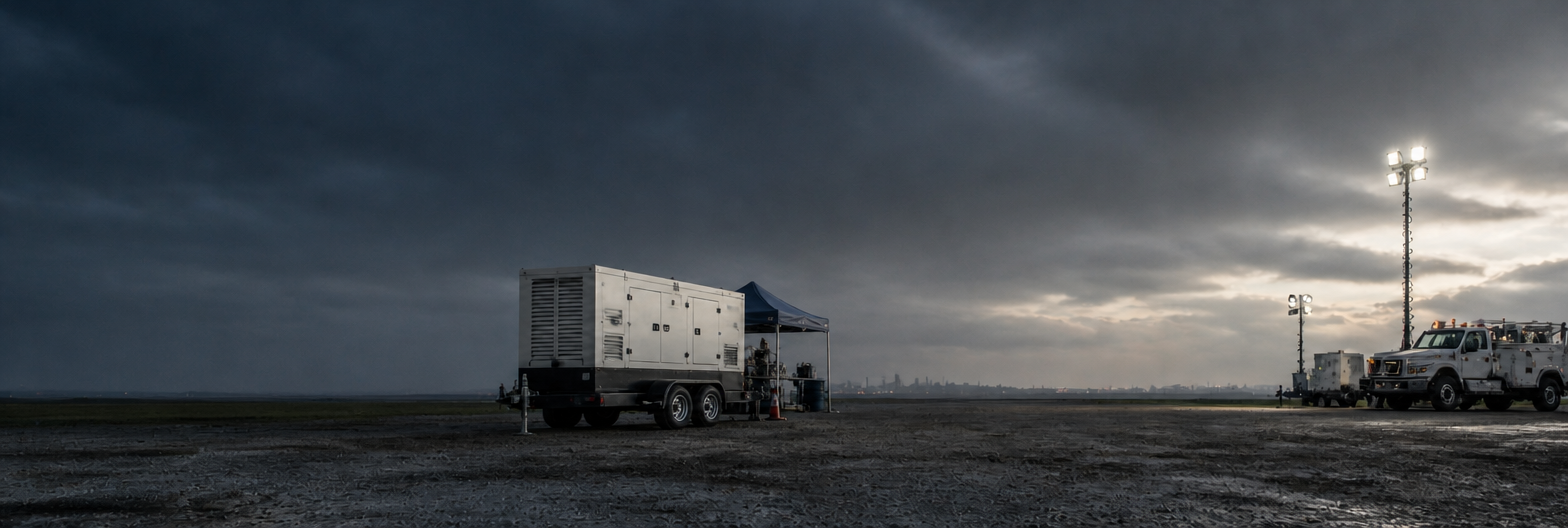
Specifying trailer-mounted generator sets for remote and temporary loads — towing, chassis, site access, cable runs, security and maintenance considerations.
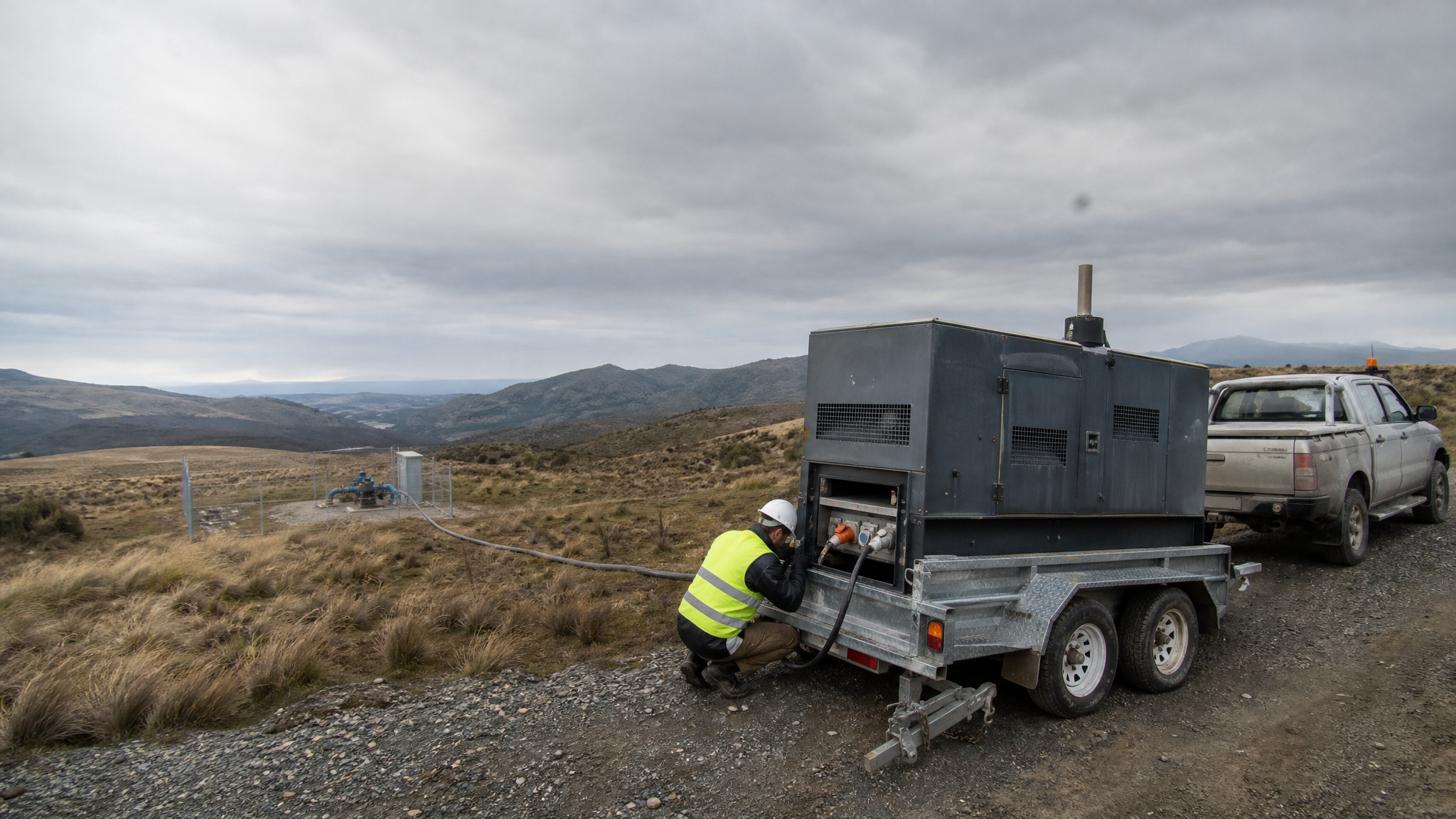
Some power requirements never settle in one place. A pump station is commissioned before its permanent supply exists. A drilling programme moves along a ridge line. A construction camp shifts as the works advance. A wellfield serves scattered boreholes that are each energised for a few weeks. In these cases the generator set is not a fixed asset at all: it is a piece of mobile plant, and it should be specified as such.
Trailer-mounted generator sets are the format built for that role. The generator, alternator, control system and enclosure are carried on a road-going chassis with a towing arrangement, so the unit can be moved by a vehicle the operator already has and positioned close to the load without a crane or a foundation.
Shanghai Outevo Machinery Co., Ltd. has supplied generator-set solutions since 2006, and its current website presents diesel and gas generator sets across 10–3,750 kVA when applicable. Trailer-mounted configurations form part of that range alongside open-frame, silent and containerized formats. Every rating and trailer arrangement is a project-specific configuration, confirmed against the load, the route and the site rather than assumed from a model list.
A stationary generator set is specified around the load and the plant room. A trailer-mounted set is specified around the load, the vehicle that will tow it, the road it will travel and the ground it will stand on. Those additional constraints are not administrative details; they determine whether the unit can be delivered at all.
The first question is towing. The towing vehicle must be rated for the trailer's gross weight, and the coupling, electrical connection, lights and braking arrangement must match that vehicle. The second is the route: bridge weight limits, lane widths, gradients, soft shoulders and site entrances all constrain the size of unit that can reach a location. The third is the destination: a unit that arrives but cannot be positioned within cable reach of the load has not solved the problem.
Specifying mobility properly means treating the trailer as part of the power system. Axle configuration, chassis strength, suspension, mudguards, lights, jockey wheel, parking brake and lifting or jacking points all affect how the unit behaves in service.
The pattern that suits this format is a load that is temporary, geographically dispersed, or both.
Water and wellfield pumping. Boreholes and booster pumps are often energised before the distribution network reaches them, or during mains works. Trailers can be moved from borehole to borehole as commissioning progresses, and the pump's starting characteristic determines the generator's required step-load capability.
Construction and infrastructure works. Site offices, welfare units, compaction and small plant, lighting, dewatering pumps and temporary workshops all need power before and during the build. A trailer-mounted set can follow the works, and can be removed when the permanent supply is commissioned.
Remote camps and facilities. Exploration camps, monitoring stations, border posts, agricultural facilities and small communities may rely on generator power for extended periods. For these, the trailer provides a transportable but semi-permanent solution, with the enclosure and fuel arrangement doing more of the work than the chassis.
Events and temporary public functions. Where power is required for a defined period at a defined site, a trailer-mounted set provides a self-contained supply that can be positioned, secured and removed without building work.
Emergency standby at sites without a plant room. A trailer can provide standby capability at locations where installing a fixed set is impractical, provided it is maintained and its readiness is managed as rigorously as a fixed installation.
Practical deployment questions tend to concentrate on a few points.
Weight and distribution. The trailer's gross weight includes fuel, enclosure and accessories. Weight distribution over the axle and drawbar affects stability at speed and the ability to manoeuvre by hand on site. A unit that is theoretically towable but nose-heavy or difficult to reverse into position slows every relocation.
Braking and lighting. Requirements vary by jurisdiction and by trailer weight. The towing vehicle's electrical system must support the trailer's lights, and the braking arrangement must be compatible with the vehicle and the terrain. These details should be settled at the specification stage, not at the roadside.
Ground clearance and surface. Gravel, mud, sand and sloped ground change what a trailer can do. Tyre type, clearance and the position of the drawbar jockey wheel matter on unprepared sites, and the parking position should be chosen so the unit cannot settle or roll.
Security of position. Once parked, the unit should be chocked, the parking brake applied, and the trailer secured against movement and, where relevant, against unauthorised towing. On unattended remote sites, hitch locks and compound fencing are part of the power plan.
On a trailer, the enclosure does more work than on a fixed installation. It has to protect the equipment during transport, resist rain and dust at the destination, and manage noise where the unit operates near people.
Silent canopied trailers are the usual choice for camps, events and inhabited locations. Open trailers give better access for service and are appropriate where the unit operates in a controlled compound. Whichever is chosen, the enclosure must allow adequate cooling airflow and a clear exhaust path in the parked position, and the access doors must be usable when the trailer is close to a fence, wall or stockpile.
Canopy design also affects maintenance time. Doors that open fully, filters and drain points that can be reached without dismantling panels, and control panels positioned at working height all reduce the duration of routine service in the field, where tools and lighting are limited.
Trailer-mounted sets are often parked further from the load than a fixed installation would be, because the position is chosen for access rather than for electrical convenience. Cable length then becomes a design parameter.
Voltage drop over a long run depends on current, conductor size and length. A cable that is adequate at ten metres may be marginal at sixty, particularly at low voltage and high current. The connection should be designed with the actual route, not an assumed one, and the cable should be protected from vehicles, water and sharp edges along its whole length.
Where the distance is unavoidable, the options are a larger conductor, a higher distribution voltage with a step-down transformer, or a different unit position. All three should be considered before the load is connected, because a marginal cable shows up as overheating, nuisance tripping or equipment malfunction rather than as a clear failure.
Trailer-mounted units are frequently left running unattended overnight. That makes a few controls more important than they would be in a staffed plant room: automatic shutdown on low oil pressure, high coolant temperature and overspeed; a fuel arrangement that will not run dry and draw air into the system; and protection against unauthorised operation.
Load management matters as much as protection. Where the load is a pump or a compressor that cycles, the generator should be reviewed for the starting current and the duty cycle, not only for the running kW. Where the load is a camp with a varying evening peak, the rating should reflect that peak under the local ambient temperature.
For unattended sites, remote monitoring of basic parameters can be valuable, but it should not replace a physical inspection routine. Fuel, oil, coolant, belts, battery condition and the state of the enclosure are still checked on site.
Remote operation changes maintenance from a scheduled task in a workshop into a logistical exercise. The plan should define the service interval by running hours, the consumables to be held on site, and who performs each task. Filters, belts, oil, coolant and batteries should be stocked at the location, because a single missing part can stop a unit for days.
Fuel quality deserves particular attention where deliveries are infrequent and storage is improvised. Water and contamination in stored fuel are among the most common causes of remote generator failure, and simple practices — settling, filtration, keeping tanks full, recording deliveries — prevent most of them.
Records matter too. Running hours, fuel consumed, alarms and repairs build the evidence for when the unit should be serviced, when it should be replaced, and whether the load has outgrown it.
Mobility has costs. A trailer carries less fuel than a comparable static installation, offers less space for controls and accessories, and adds a chassis, suspension and towing arrangement that must be maintained. Where the load is fixed for years, a containerized or open-frame installation in a permanent compound will usually give better access, more fuel autonomy and a lower maintenance burden.
The trailer is at its best when the load is genuinely temporary or genuinely mobile, when the site has no building to house a set, or when the same unit must serve several locations in sequence. Where those conditions do not apply, the specification should say so.
A useful brief describes the load list and the largest step change, the duty and duration, the required voltage and frequency, the towing vehicle and route constraints, the ground and access at each site, the distance from the parking position to the connection point, the enclosure and noise requirement, the fuel endurance required between deliveries, and the ambient conditions. Photographs of the access route and the intended parking position are often more informative than a description.
Shanghai Outevo Machinery Co., Ltd. reviews these inputs against the current range of 10–3,750 kVA when applicable, and proposes a trailer-mounted configuration for confirmation. Final rating, chassis arrangement, enclosure, control specification and accessories remain subject to the approved project specification and to the transport and site conditions.
The practical limit depends on the towing vehicle's rating, the trailer's gross weight, local road rules and the route. Rather than starting from a maximum size, define the load first and then check whether the resulting unit, with fuel and enclosure, can be towed by the available vehicle and pass the route constraints.
It can, provided the unit has appropriate automatic protection, a secure parking position and a fuel arrangement that suits the required endurance. Unattended running still requires a scheduled inspection routine for fuel, oil, coolant and enclosure condition.
Distance is limited by voltage drop, cable rating and the practical protection of the cable route. Long runs at low voltage require larger conductors or a different distribution approach. The cable design should be based on the actual route and current, not on a rule of thumb.
Where the unit will run near camps, events, residences or site offices, acoustic treatment is usually appropriate. Where it operates in a remote compound away from people, an open trailer may be more practical because it gives better service access and cooling.
They can provide standby capability where a fixed installation is impractical, but they require the same readiness regime as a fixed set: regular load testing, fuel management, battery maintenance and a defined connection procedure. A trailer that is not maintained is not standby power.
Outevo's current website presents 10–3,750 kVA when applicable across its generator-set range, with trailer-mounted configurations available as a project-specific option. The suitable rating and trailer arrangement depend on the load, transport and site conditions confirmed during the technical review.
Send Shanghai Outevo Machinery Co., Ltd. the load details, the number and type of sites, the towing vehicle, the route and access conditions, the distance to the connection point and the fuel endurance required. The review can then confirm the trailer arrangement, rating, enclosure and accessories that fit the way the unit will actually be used.
Request a project review from Outevo
For related configurations, see Outevo's trailer generator sets, mobile light towers, silent generator sets and open-frame generator sets.

Shanghai Outevo Machinery Co., Ltd. provides custom power supply solutions for industrial applications. Our diesel generator sets deliver reliable, stable electricity with 24/7 production and nationwide support. Request a quote today.
Copyright © Shanghai Outevo Machinery Co., Ltd Privacy Policy


