How mobile generator sets support disaster response and public infrastructure — deployment formats, load priorities, fuel logistics and safety in damaged sites.
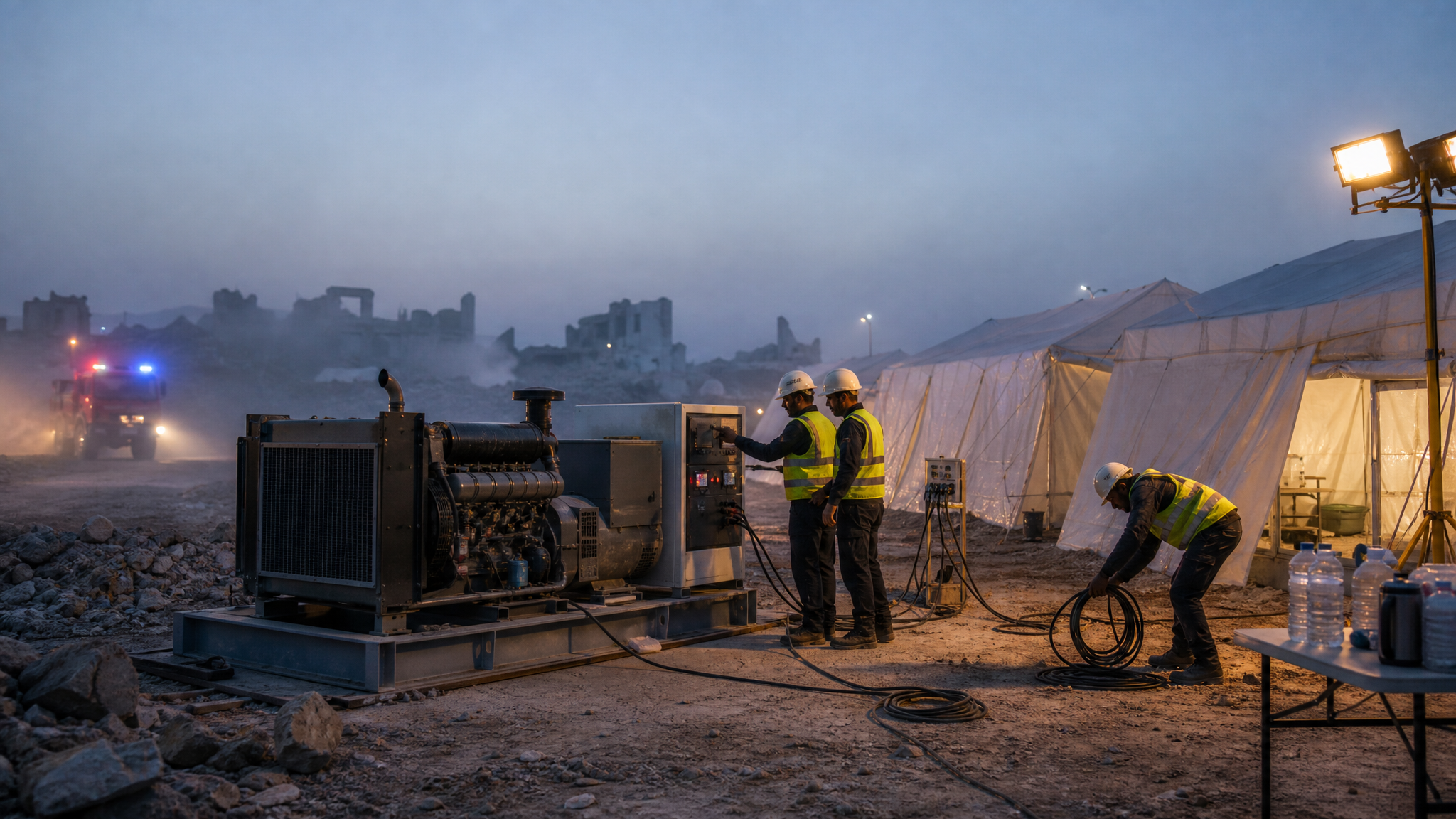
Disaster response and public infrastructure recovery share a defining constraint: the load appears where the damage is, and it appears before the permanent supply can be rebuilt. A shelter opens in a school hall, a water pumping station loses its feeder, a telecommunications cabinet runs on batteries that will not last, a temporary medical point needs lighting and refrigeration. In each case the requirement is not a building services installation but a power source that can be moved, connected and operated by a small team under difficult conditions.
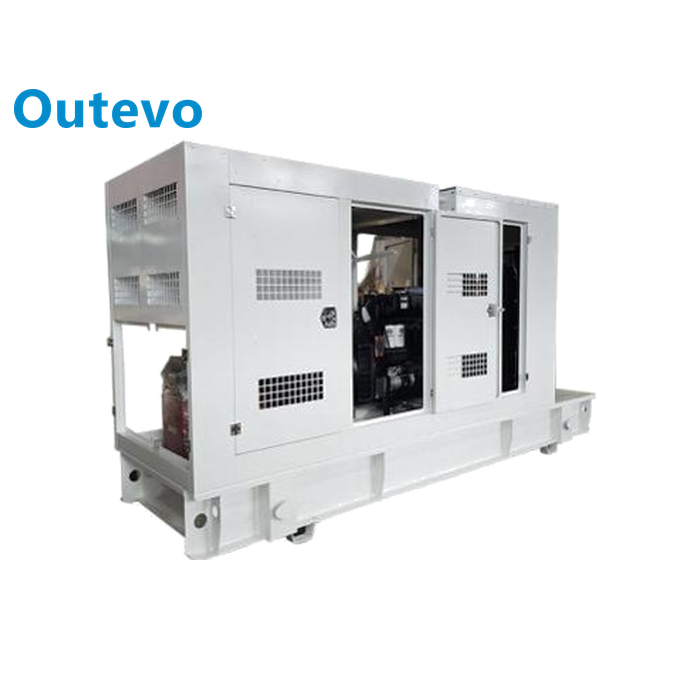
Shanghai Outevo Machinery Co., Ltd. manufactures diesel and gas generator sets for standby, prime and mobile applications, and has supplied generator-set solutions since 2006. The company's current website presents a range of 10–3,750 kVA when applicable, including trailer-mounted, open-frame, silent and containerized configurations. The appropriate format, rating and accessory package for a response role are always project-specific, confirmed against the mission profile, the site and the equipment available to move and connect the unit.
This article looks at mobile generator power from the perspective of the organisations that plan for it: civil protection agencies, municipal utilities, infrastructure operators, contractors retained for recovery works, and the procurement teams that equip them.
A standby generator set is designed around a known building, a known load and a fixed connection. It is tested on a schedule, maintained in a plant room and started by staff who know the installation. Mobile response power has none of these certainties. The load is unknown until arrival, the connection point may be a temporary distribution board, the ground may be soft or flooded, the operator may be working with an unfamiliar team, and the unit may be one of several arriving from different sources.
That changes the priorities. Ruggedness, transportability, simple connection, clear labelling, protection against weather and dust, and a control philosophy that a trained but non-specialist operator can follow become as important as electrical capacity. A unit that requires a specialist commissioning team is of limited use in the first hours of a response.
The planning implication is that mobile power should be specified as a capability, not as a single machine: a set of units, cables, distribution equipment, fuel arrangements, lifting and towing provisions, and a trained crew that can deploy them together.
Response missions impose different load shapes, and the differences should drive the configuration.
Shelters and collective centres need lighting, ventilation or heating, power for charging and communications, and often refrigeration for food and medical supplies. Loads are modest but continuous, and noise near sleeping areas matters, which favours silent configurations. The distribution arrangement is usually a set of small final circuits, so a temporary board with residual current protection is as important as the generator.
Water and wastewater infrastructure is motor-dominated. Pumps and blowers draw heavy starting current, and restoration may require the generator to accept a large step load. The starting method, the pump controls and the sequencing of restarts determine whether the generator can carry the station, and a soft-start or variable-speed installation changes the requirement significantly.
Medical and laboratory points add sensitivity to voltage and frequency, plus the need for continuity during any transfer between sources. Where the load includes diagnostic equipment or cold-chain storage, the transfer arrangement and the ride-through of the connected equipment must be reviewed rather than assumed.
Communications and control rooms combine continuous low-level load with high availability expectations. Fuel duration and the reliability of the refuelling plan often matter more than the rating, because a small continuous load can still exhaust a modest tank over several days.
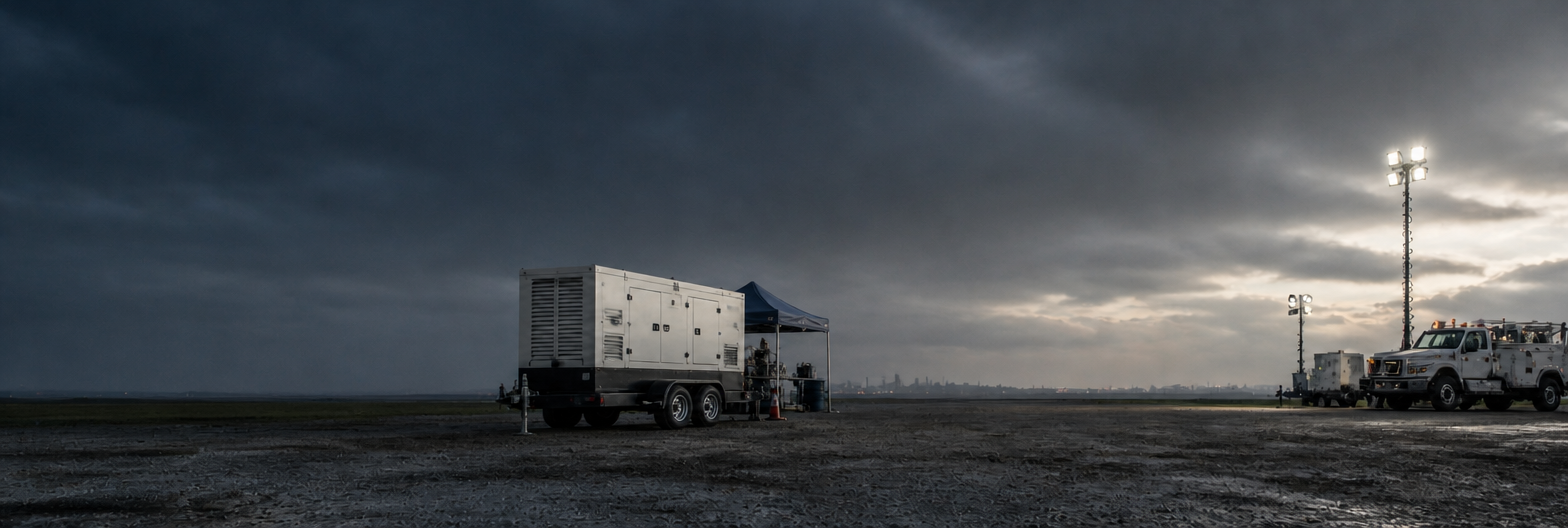
Debris clearance, pumping and works lighting are the opposite case: intermittent, high-impact loads that may run only during working hours. Trailer-mounted units and lighting towers suit this pattern, and mobility between work fronts is more valuable than a permanent installation.
The physical format decides how the unit reaches the load.
Trailer-mounted generator sets are the default for response work. They can be towed by a light commercial vehicle, repositioned as the response moves, and parked close to the connection point. The chassis, axle rating, braking arrangement and tow height must suit the vehicles and roads available, and the unit should be balanced so that it can be moved by a small team once unhitched.
Skid-mounted units suit transport by truck or container and are easier to secure for long journeys. They need lifting equipment or ramps at the destination, which is a real constraint if the receiving site has none.
Containerized units combine generation, controls and often fuel storage in a protected package. They are appropriate for longer recovery programmes, exposed coastal or industrial sites, and locations where security or weather protection is a concern. The trade-off is weight and the need for lifting capacity on arrival.
Open-frame units remain relevant where the generator will be installed inside an existing plant room or a protected compound to replace damaged equipment, and where service access during a long outage is the priority.
Acoustic treatment, exhaust routing, cable connection points and control interfaces should be specified together with the format. In a response, the differences between a unit that is ready to connect and one that needs adaptation on site are measured in hours.
Arrival is the point at which plans meet conditions. Five issues recur.
Access and ground conditions. Soft ground, flood water, debris and narrow lanes limit where a trailer or truck-mounted unit can go. The deployment plan should identify alternative positions and the cable length required to reach the load from each. Unit weight spread over the towing point and tyres matters on saturated ground.
Positioning for exhaust and cooling. Exhaust must discharge away from shelters, tents, windows and air intakes. Cooling airflow requires clear space around the radiator and, for enclosed units, unobstructed louvres. Units placed against walls or under tarpaulins overheat, and that failure is avoidable.
Temporary distribution. Cables must be rated for the load, protected from traffic and water, and supported so that connections are not under strain. Distribution boards should be labelled, accessible and protected from rain. Where multiple units supply one site, the boundaries between their systems must be clear to prevent back-feed.
Earthing in wet or damaged conditions. Damaged installations may have uncertain earthing. The earthing arrangement at the generator, the use of residual current protection on temporary circuits, and the isolation of damaged sections of the permanent installation all need to be decided by a competent person before energisation.
Interface with the damaged installation. Where the generator supplies part of an existing distribution system, the changeover must prevent paralleling with a utility supply that may be restored without warning. Lock-off and tagging arrangements protect both the crew and the utility's personnel.
In a wide-area event, fuel becomes the limiting resource. A response plan should define consumption at the anticipated load, the running duration required before refuelling, the safe storage arrangement and the route by which fuel reaches the unit. Where a tanker cannot approach, intermediate storage and manual transfer have to be planned, with the associated handling risks controlled.
Fuel quality also matters. Long-stored diesel can deteriorate, and water or contamination in a tanker load can stop an engine at the worst possible moment. Simple practices — settling, filtration, keeping tanks full to limit condensation, and recording every delivery — prevent a large share of response failures.
Where the load is small and continuous, a larger fuel tank or a scheduled tanker rotation may be more useful than a larger generator. Matching fuel endurance to the mission is part of the specification, not an afterthought.
Response sites are dusty, wet, hot or cold, often all within the same week. Air filtration, cooling system condition, battery health and electrical connections are the components most affected. Daily checks should cover oil and coolant levels, radiator and louvre condition, belt tension, battery terminals, cable condition and the readings on the control panel.
Operating staff should know the shutdown procedure, the location of the emergency stop, and what to do if the unit alarms. Clear labelling in the languages used by the responding teams reduces the chance of an error during handover between shifts or organisations.
Load management deserves attention too. It is tempting to connect everything available to the first unit that arrives. Recording what is connected, and keeping the load within the rating under the ambient conditions of the site, protects the unit and keeps the supply stable for the loads that matter most.
Public infrastructure recovery involves multiple organisations, and power is a shared dependency. A simple deployment record — unit identification, position, rating, connection point, loads served, fuel deliveries, running hours and faults — supports handover between shifts, informs the demobilisation decision and provides the evidence that public bodies need for after-action review.
Where the generator supplies a public service, the operator should also confirm who is authorised to energise or isolate each circuit, how the public is protected from cables and equipment, and how the arrangement will be removed once the permanent supply returns. Demobilisation is part of the plan: a unit left connected after restoration becomes an unmanaged risk.
Organisations that respond well tend to have made four decisions in advance: they have defined the loads they intend to support, selected formats that suit their transport, trained crews on a repeatable connection procedure, and established a maintenance and fuel regime that keeps the equipment genuinely available. Equipment held without these arrangements tends to underperform when it is finally used.
Shanghai Outevo Machinery Co., Ltd. works with buyers to review those inputs against the current range of 10–3,750 kVA when applicable, and to propose configurations for trailer-mounted, skid, containerized or open-frame deployment. Final rating, enclosure, control interface, fuel arrangement and accessories remain subject to the approved project specification and the conditions at the receiving site.
A standby set is installed at a fixed location with a defined load and connection, and is normally maintained and operated by site staff. A mobile set is transported to the load, connected through a temporary arrangement and operated in unfamiliar conditions, so transportability, weather protection, simple connection and clear labelling matter more.
Trailer-mounted units are the most flexible for changing locations; containerized units suit longer recovery programmes and exposed sites; skid-mounted units suit transport by truck where lifting is available; open-frame units suit replacement of equipment inside a protected plant area. The choice depends on transport, ground conditions and duration.
It can, but pumping loads are motor-dominated and require the generator to accept the starting current of the largest pump plus the running load of the others. The starting method, pump control arrangement and restart sequence must be reviewed, and the rating confirmed against the actual motor data rather than the station's nominal capacity.
Define consumption at the expected load, the endurance required between deliveries, the storage and transfer method, and the minimum level that triggers refuelling. Keep tanks full to limit condensation, settle and filter deliveries, and record each transfer so that endurance can be projected accurately.
Back-feed protection at the changeover point, earthing of the temporary system, protection of cables from water and traffic, and exhaust discharge away from occupied spaces. Access to the unit should be controlled, and the emergency stop and isolation points should be known to everyone on shift.
Outevo supplies diesel and gas generator sets in trailer-mounted, open-frame, silent and containerized configurations across 10–3,750 kVA when applicable, and reviews each requirement as a project-specific configuration. Public infrastructure buyers typically provide load data, site conditions, transport arrangements and the intended duration of operation.
Response power is specified most effectively before an event. Send Shanghai Outevo Machinery Co., Ltd. the loads to be supported, the transport available, the sites likely to be served, the duration of operation and the fuel arrangements under consideration. The review can then match format, rating and accessories to the mission rather than to a catalogue position.
Request a project review from Outevo
For related equipment, see Outevo's trailer generator sets, mobile light towers, silent generator sets and container generator sets.

Shanghai Outevo Machinery Co., Ltd. provides custom power supply solutions for industrial applications. Our diesel generator sets deliver reliable, stable electricity with 24/7 production and nationwide support. Request a quote today.
Copyright © Shanghai Outevo Machinery Co., Ltd Privacy Policy