Power in a Steel Box
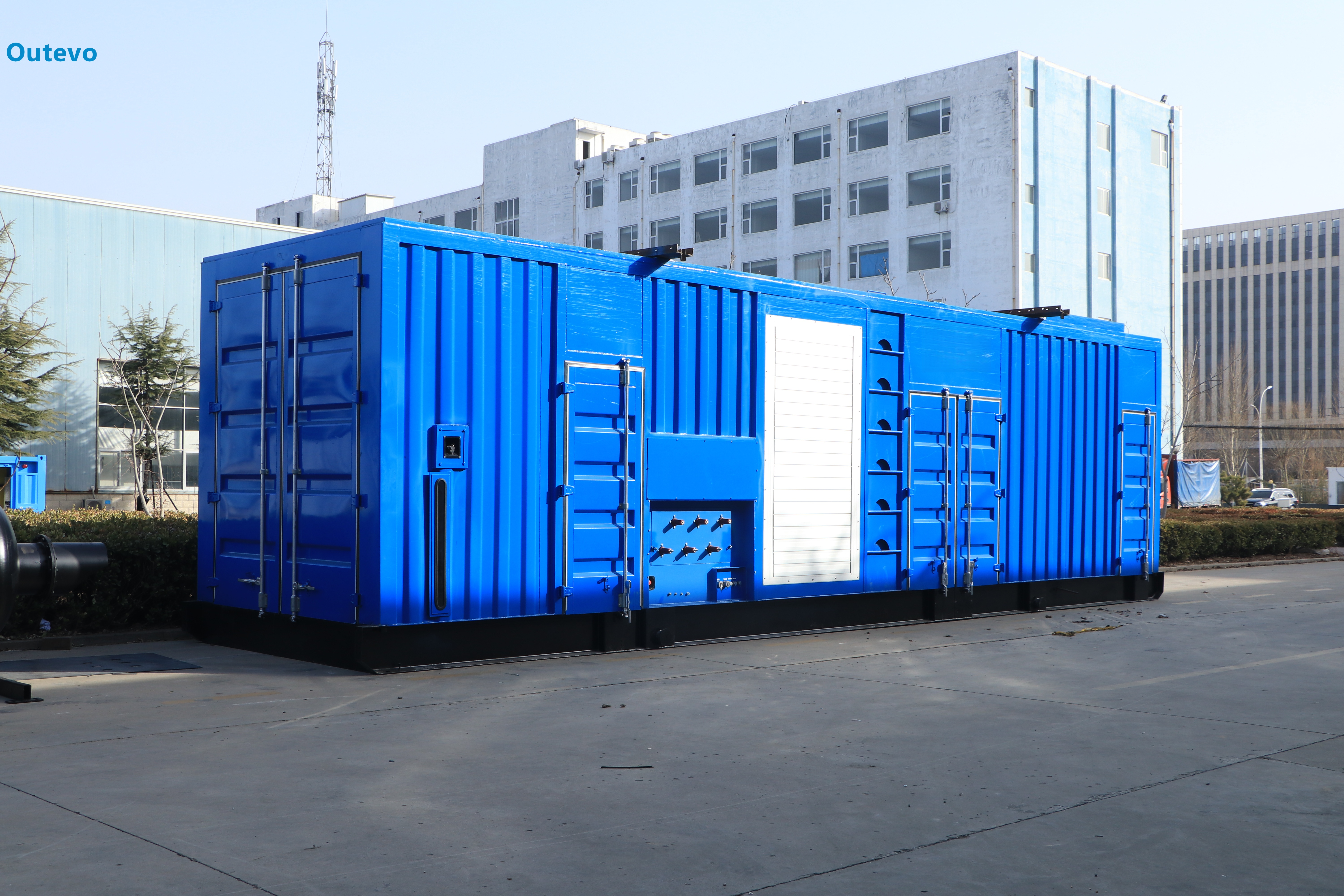
Containerized generator sets across South America: three power classes, the running hours they can honestly deliver, and the upkeep that decides whether one lasts twenty thousand hours or five.
1. Why the box matters more than the engine
A containerized generator set is a diesel engine, an alternator, a radiator, a control panel and a fuel tank bolted inside a steel enclosure built to the same lifting and lashing dimensions as a freight container. That last detail sounds like a packaging decision. In South America it is often the reason the project is possible at all.
The geography is unforgiving. A copper operation in northern Chile sits at 3,000 m, where thin air costs the engine real output. A grain terminal in Mato Grosso runs at 38 °C with chaff in the intake air. A port facility on the Pacific coast gets salt spray most afternoons. A site in Amazonas gets rain for half the year and humidity that never falls below 80%. In each case the container is what lets a fully assembled, factory-tested machine travel by truck, barge or rail car and be set down on a concrete pad with no building around it.
The enclosure also does two jobs that fight each other. It has to hold noise in, and it has to let a great deal of hot air out. Most of the engineering in a containerized set goes into that compromise. In Brazil the noise side of it is not optional: environmental licensing works from CONAMA Resolution 001/90 and the ABNT NBR 10151 criteria, which put an urban residential area at roughly 55 dB(A) during the day and 50 dB(A) at night, measured at the receiver rather than at the machine. Municipal rules in places like São Paulo and Rio add their own conditions on top, and several states require periodic emission testing for larger sets.
2. Three power classes
Ratings get quoted in kVA, but buyers think in kW. At the usual 0.8 power factor, 250 kVA is 200 kW, and that is the number to match against the site load. Manufacturers quote two figures for the same machine: prime, what it can produce for unlimited hours with a varying load, and standby, the higher figure it can hold for short periods when the grid fails. The table below works from prime ratings.
|
Parameter |
Class A — 250 kVA / 200 kW |
Class B — 625 kVA / 500 kW |
Class C — 1250 kVA / 1000 kW |
|
Prime / standby output |
200 kW / 220 kW |
500 kW / 560 kW |
1000 kW / 1120 kW |
|
Prime / standby apparent |
250 / 275 kVA |
625 / 700 kVA |
1250 / 1400 kVA |
|
Typical engine |
Inline 6, 8–13 L, turbocharged and charge-cooled |
Inline 6 or V8, 15–25 L, turbocharged and charge-cooled |
V12 / V16, 30–50 L, turbocharged and charge-cooled |
|
Rated speed |
1500 rpm (50 Hz) or 1800 rpm (60 Hz) |
1500 rpm (50 Hz) or 1800 rpm (60 Hz) |
1500 rpm (50 Hz) or 1800 rpm (60 Hz) |
|
Voltage options |
220/127 V or 380/220 V, 3-phase |
380/220 V or 440/254 V, 3-phase |
380/220 V, 440 V, or 4.16 / 13.8 kV |
|
Fuel burn at 75% load |
≈ 38 L/h |
≈ 95 L/h |
≈ 190 L/h |
|
Fuel burn at full load |
≈ 52 L/h |
≈ 130 L/h |
≈ 255 L/h |
|
Onboard tank and autonomy |
≈ 600 L, about 15 h at 75% load |
≈ 1000–1500 L, about 10–15 h at 75% load |
≈ 2000–3000 L, about 10–15 h; external tank usual |
|
Sound pressure at 7 m |
68–73 dB(A) |
72–78 dB(A) |
78–85 dB(A) |
|
Heat rejected to air |
≈ 300 kW |
≈ 750 kW |
≈ 1500 kW |
|
Enclosure |
20 ft ISO (6.06 × 2.44 × 2.59 m) |
20 ft high cube (6.06 × 2.44 × 2.90 m) |
40 ft high cube (12.19 × 2.44 × 2.90 m) |
|
Dry weight |
5.5–7 t |
10–13 t |
17–21 t |
|
Output breaker |
400 A |
800–1000 A |
1600–2000 A (or HV breaker) |
|
Design point |
40 °C ambient, full output to 1000 m |
40–45 °C ambient, full output to 1000 m |
40 °C ambient; altitude build often required |
|
Typical duty |
Construction camps, clinics, pumping stations, telecom hubs |
Mine camps, food plants, ports, mid-size data halls |
Andean mining, hospitals, industrial plants, grid support |
Class A — 200 kW, the one that moves
This is the largest class that fits a standard 20 ft container with room left over, and builders usually spend the spare volume on a bigger base tank or on fire suppression. At 5.5 to 7 tonnes dry it rides on a conventional truck with no special permit in most countries, which is why it turns up on construction camps, water pumping stations, mid-size clinics and telecom hubs. The engine is typically a turbocharged, charge-cooled inline six of 8 to 13 litres.
Class B — 500 kW, the workhorse
Roughly the biggest output that still fits one 20 ft container with full acoustic treatment, a thousand-litre tank and enough airflow, so it is the most frequently specified size in the region. It burns about 95 litres an hour at three-quarter load — one and a half litres a minute — which means a 1,000 litre base tank is around ten hours of running, and anything longer needs an external tank and a transfer pump. Typical loads are mine camps, food processing plants, port cranes and mid-size data halls.
Class C — 1000 kW, the one that stays put
This class needs a 40 ft high-cube container, a crane or a heavy-haul trailer, and in several countries a road permit. Nobody moves it once it is down. It serves Andean mining operations, large hospital complexes, industrial plants and grid-support duty, and it is often bought as two units in parallel so one can be serviced while the other carries the load. Above roughly 600 kW, medium voltage starts to pay for itself: 4.16 kV or 13.8 kV output removes a step-up transformer and cuts cable size dramatically.
